
Wit vs Witout for Philly Cheesesteak - Mastering Authentic Onion Preferences
Navigating the ordering process of a genuine Philly cheesesteak often feels daunting for the uninitiated. While casual diners rely on standard menu descriptions, mastering the local lexicon is essential. Specifically, requesting "wit" or "witout" grants you the authority of a seasoned regular. Please note: these terms apply strictly to caramelized onions. Renowned establishments like Pat's and Geno's consider this syntax vital for service efficiency. This guide clarifies the cultural nuances and history behind these iconic ordering preferences.
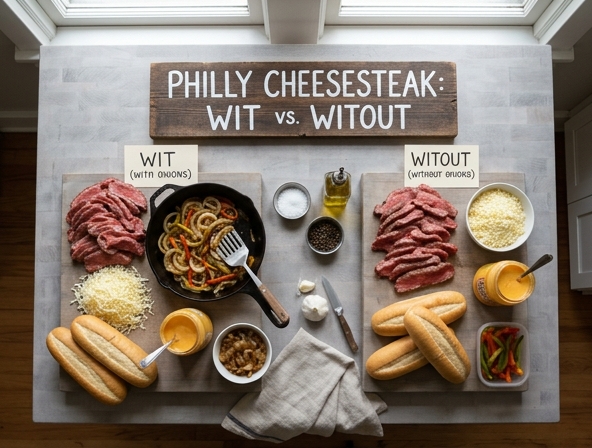
| Term | Meaning | Cultural Significance |
|---|---|---|
| Wit | Includes caramelized onions | Essential local lexicon for ordering at iconic establishments like Pat's and Geno's to ensure service efficiency and demonstrate authentic Philly experience. |
| Witout | Excludes caramelized onions |
Wit vs. Witout: Mastering Authentic Philly Cheesesteak Onion Preferences
In the pantheon of American street food, few items command as much reverence-or inspire as much heated debate-as the Philadelphia cheesesteak. While tourists might focus on the quality of the beef or the specific brand of processed cheese sauce involved, the true litmus test of a diner's Philly bona fides happens in a single, monosyllabic choice: Wit or Witout?
This shorthand, referring to the inclusion or exclusion of grilled onions, is more than just a culinary preference; it is a cultural handshake, a ritualistic entry into the world of Philadelphia's griddle-masters. To understand the "Wit vs. Witout" debate is to understand the soul of the sandwich itself.
The Case for "Wit": The Sweetness of the Steer
For the purist, the "Wit" order is the definitive way to experience a cheesesteak. The onions are not merely a topping; they are an integral component that interacts with the steak on the flat-top grill. When thinly sliced yellow onions hit the scorching surface alongside high-quality shaved ribeye, the magic of the Maillard reaction takes over.
The onions caramelize, releasing sugars that provide a necessary counterpoint to the salt-heavy, savory profile of the beef. As the chef chops the steak and the onions together with heavy-duty spatulas, the onion juices permeate the meat, acting as a natural marinade. By the time the mixture is scooped onto a toasted Amoroso roll, the onions have softened into a jam-like consistency, binding the meat together and providing a textural contrast that prevents the sandwich from feeling one-note.
Advocates of the "Wit" approach argue that without the onions, the cheesesteak lacks the "grease-sweet" balance that gives the sandwich its character. It is a harmonious marriage of flavor profiles-fat, salt, acid, and sugar-all housed within a soft, chewy vessel.
The Case for "Witout": The Purist's Focus
Conversely, the "Witout" movement-a significant contingent of the Philadelphia dining scene-argues for the sanctity of the meat and the cheese. For these patrons, the onion is a distraction, an overwhelming aromatic force that obscures the delicate, charred flavor of the ribeye.
A "Witout" order is an exercise in minimalism. By stripping away the onions, you are forced to engage directly with the quality of the beef and the specific viscosity of the melted American, provolone, or Cheez Whiz. It is the culinary equivalent of drinking a fine spirit neat rather than in a cocktail; you want to taste the core ingredient without additives.
Moreover, some argue that the "Witout" allows the texture of the bread to shine. Without the excess moisture and softening effects of the onions, the roll maintains its structural integrity longer, preventing the "soggy bottom" syndrome that can plague a poorly managed cheesesteak. It is a cleaner, more direct experience that appeals to those who prioritize the ratio of meat to bread above all else.
The Art of the Order: Cultural Etiquette
Beyond the flavor, the choice of "Wit" or "Witout" is governed by the rigid, fast-paced etiquette of the Philly sandwich counter. In the busiest shops, there is no time for hesitation. The "Wit/Witout" question is usually delivered by the line cook as a rapid-fire interrogation.
To master the authentic experience, one must learn the rhythm of the counter:
- Be Prepared: Know your onion status before you reach the front of the line.
- Keep it Simple: "One Wiz Wit" is the gold standard of ordering. It specifies the cheese, the quantity, and the onion preference in three words.
- Accept the Griddle: Regardless of your preference, remember that in most high-volume shops, the griddle is perpetually seasoned. Even a "Witout" sandwich may carry trace elements of onion-scented steam. It is part of the charm-the collective flavor history of the flat-top.
The Science of the Onion
Why do onions matter so much? From a culinary standpoint, the onion provides essential "umami boosters." The sulfur compounds in onions break down during long exposure to high heat, creating a complex, savory flavor that bridges the gap between the proteins in the meat and the dairy in the cheese.
If you prefer a "Witout" sandwich, you are essentially asking for a sharper, more pointed flavor profile. If you choose "Wit," you are opting for a rounded, mellow finish. Neither is "wrong," but they offer fundamentally different dining experiences. Understanding this difference is the difference between eating a quick lunch and participating in a city's gastronomic heritage.
Conclusion: The Ultimate Verdict
The "Wit vs. Witout" debate will likely never be settled, and that is exactly how it should be. The beauty of the Philly cheesesteak lies in its democratic nature-it is a working-class meal that allows for personal expression through simple, binary choices.
If you find yourself standing in line at a classic Philly institution, don't overthink the decision. Experiment. Try the "Wit" to appreciate the way the onions transform the meat, and try the "Witout" to appreciate the raw, unadulterated power of a well-seared steak. Once you have navigated both, you will have moved beyond the role of a tourist. You will have mastered the nuances of the cheesesteak, earning your place at the counter, one onion at a time.
So, what'll it be? Wit, or Witout?
Disclaimer:
The information provided on Eateryn is for general educational and informational purposes only and is not intended as medical, nutritional, or healthcare advice. It should not be used to diagnose, treat, cure, or prevent any disease or medical condition.
Always consult a qualified physician, registered dietitian, or other certified healthcare professional before making changes to your diet, exercise routine, or lifestyle, or regarding any medical questions or concerns you may have. Never disregard or delay seeking professional medical advice because of something you have read on this website.