
Whisking vs Folding for Pancakes - Avoiding Tough Batter
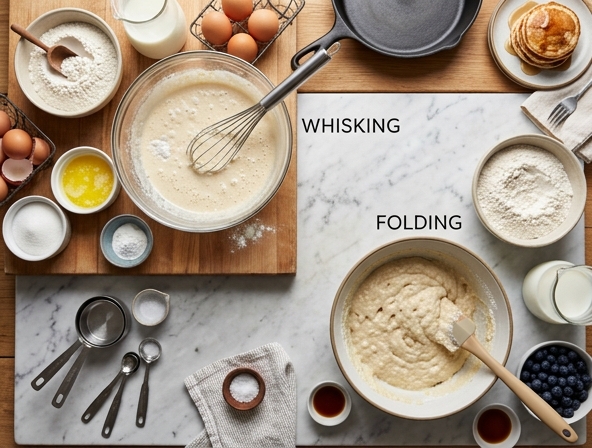
Many home cooks struggle with dense, rubbery pancakes. While standard recipes often advise vigorous whisking, this approach frequently overdevelops gluten, resulting in a chewy texture rather than a light, fluffy crumb. By strategically folding-rather than whisking-you preserve air pockets and ensure tenderness. Note that a lumpy batter is an essential hallmark of success, not a mistake. The following sections explore how specific mixing techniques influence your final stack, providing clear protocols for achieving bakery-quality results every time.
| Aspect | Summary Details |
|---|---|
| Common Problem | Pancakes that turn out dense, rubbery, or chewy instead of fluffy. |
| The Mistake | Vigorous whisking, which overdevelops the gluten in the flour. |
| The Solution | Use a folding technique to combine ingredients to preserve air pockets. |
| Key Indicator | A lumpy batter is a sign of success, not a mistake; it ensures tenderness. |
| Goal | Achieving a light, airy, bakery-quality pancake stack. |
The Pancake Paradox: Why Over-Mixing Is Your Kitchen's Worst Enemy
We have all been there: standing at the stove on a lazy Sunday morning, the smell of butter hitting a hot pan, anticipating that perfect, cloud-like stack of golden pancakes. But sometimes, the reality doesn't match the dream. Instead of a light, airy bite, you are met with a dense, chewy, rubbery disk that feels more like a sponge than a breakfast pastry. If you have ever wondered why your pancakes turn out "tough," the culprit is almost certainly not your recipe, but your technique. Specifically, it comes down to the battle between two mixing methods: whisking and folding.
The Science of the "Gluten Network"
To understand why whisking is often the enemy of the pancake, we must first look at what happens inside the batter when flour meets liquid. Flour contains two proteins: glutenin and gliadin. When these proteins are hydrated and-crucially-agitated, they link together to form gluten. Gluten is the structural backbone of bread, giving it that characteristic chew and elasticity. In a loaf of crusty sourdough, this is a virtue. In a pancake, it is a disaster.
When you aggressively whisk a pancake batter, you are mechanically stretching these gluten proteins, forcing them into long, tough strands. The more you whisk, the stronger this "rubber band" network becomes. As the batter cooks, these strands tighten, resulting in a pancake that feels heavy in your stomach and requires far too much chewing. If you want a pancake that melts in your mouth, you need to minimize this gluten development at all costs.
The Whisking Myth: Why "Smooth" is Not the Goal
Most home cooks have been conditioned to believe that a smooth batter is a better batter. We associate smoothness with quality, perhaps because we are used to blending cake batters or brownie mixes. However, pancake batter is a different beast entirely. When you continue to whisk your batter until it is perfectly smooth, you are essentially telling your batter to become a piece of chewy bread. The whisk acts as a tool of destruction, forcing the flour to hydrate fully and then punishing the proteins until they bond.
The Art of Folding: A Gentler Approach
If whisking is the villain, folding is the hero. Folding is a gentle, purposeful motion designed to combine ingredients without excessive agitation. To execute this correctly, you should ditch the wire whisk as soon as the wet and dry ingredients meet. Instead, reach for a large rubber spatula or a flat silicone scraper.
The technique is simple but requires restraint:
- The "J" Motion: Cut down through the center of the bowl, sweep along the bottom, and lift the batter up and over the top.
- Rotate: Turn the bowl slightly and repeat the motion.
- Stop Early: The most important part of folding is knowing exactly when to stop. You are not looking for homogeneity; you are looking for the mere disappearance of dry pockets of flour.
Embracing the Lumps
This is the counter-intuitive secret that professional chefs use: lumpy batter is good batter. Those small, flour-dusted pockets of dry ingredients are evidence that you haven't over-developed the gluten. When these lumps hit the hot pan, they steam slightly, creating tiny pockets of air that contribute to the fluffiness of the finished pancake. If you see a few stray streaks of flour or a small clump of dry mix, leave it alone. The heat of the griddle will take care of the rest, and you will be rewarded with a tender, delicate texture that a smooth batter can never replicate.
The Role of Resting: The Final Secret
Even if you are careful, gluten development is inevitable to some degree. This is why resting your batter is a non-negotiable step for the serious breakfast cook. After you have gently folded your ingredients, set the bowl aside for 10 to 15 minutes before cooking. During this time, the gluten strands relax, and the leavening agents (like baking powder or baking soda) begin to activate fully.
Resting allows the starches in the flour to swell and hydrate evenly without the need for manual whisking. You will notice that the batter thickens slightly and begins to bubble on the surface-a sign that it is ready for the pan. This resting period acts as a "buffer" for your mixing technique; it ensures that even if you were slightly over-zealous with the spatula, the final pancake will still possess that coveted airy crumb.
Troubleshooting Your Texture
If you find that your pancakes are still coming out tough, consider these three adjustments to your workflow:
- Sift your dry ingredients: By sifting your flour, baking powder, and sugar together first, you remove the need to "whisk out" the clumps later. This makes folding much easier because the ingredients are already aerated and combined.
- Temperature matters: Ensure your liquids (milk, eggs, melted butter) are at room temperature. Cold liquids make it harder to integrate the flour, tempting you to whisk harder and longer.
- Watch the heat: If your pan is too hot, the exterior will burn before the interior has a chance to set and rise. A medium-low heat allows the air bubbles trapped by your gentle folding to expand properly, creating a light texture.
Conclusion: The Patience of the Perfect Breakfast
The journey to the perfect pancake is less about finding a secret ingredient and more about mastering the restraint of your own hands. The next time you find yourself reaching for that wire whisk, take a breath. Remind yourself that you aren't baking a sturdy loaf of bread; you are crafting a delicate breakfast cake. By trading the vigorous whisk for the patient fold, and by embracing the beautiful, rustic lumps in your batter, you are setting the stage for a pancake that is truly light, tender, and worth the extra minute of effort. Your reward will be in the first bite-soft, airy, and anything but tough.
Disclaimer:
The information provided on Eateryn is for general educational and informational purposes only and is not intended as medical, nutritional, or healthcare advice. It should not be used to diagnose, treat, cure, or prevent any disease or medical condition.
Always consult a qualified physician, registered dietitian, or other certified healthcare professional before making changes to your diet, exercise routine, or lifestyle, or regarding any medical questions or concerns you may have. Never disregard or delay seeking professional medical advice because of something you have read on this website.