
Tap Water Vs Soda Water For Buffalo Wings - Using Batter Liquids For Lightness
Achieving a consistently airy, crisp coating on buffalo wings remains a significant challenge for professional kitchens. While standard tap water is the conventional hydration base, it often yields dense, heavy results. Replacing this with carbonated soda water leverages CO2 bubbles to naturally aerate your batter, guaranteeing a signature light finish. Note that consistent low temperatures are essential to inhibit gluten development. Used by leading gastropubs, this technique elevates your fry game. We examine the optimal ratios below.
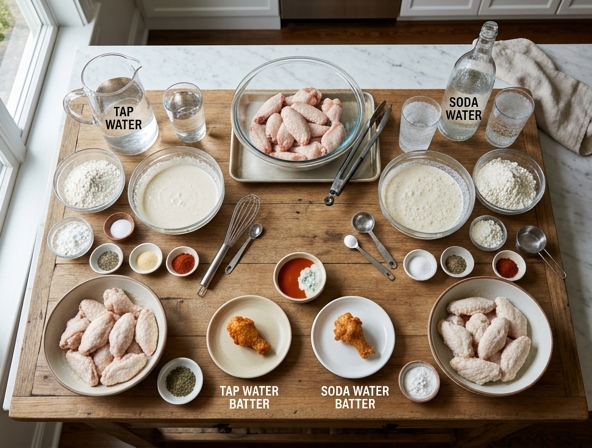
| Feature | Tap Water | Soda Water |
|---|---|---|
| Resulting Texture | Dense and heavy | Light, airy, and crisp |
| Mechanism | Basic hydration | CO2 bubbles provide natural aeration |
| Key Requirement | Standard usage | Must be kept cold to inhibit gluten development |
| Industry Usage | Conventional/Standard | Preferred by professional gastropubs |
The Physics of the Perfect Crunch: Tap Water vs. Soda Water in Buffalo Wing Batters
There is a singular, transcendent experience for any lover of pub food: the moment you bite into a Buffalo wing and the crust delivers a satisfying, audible "shatter" before yielding to succulent, tender meat. Achieving this "shatter-crisp" exterior at home, however, is a pursuit that often ends in tragedy-typically resulting in heavy, doughy, or unpleasantly greasy wings. If you have been searching for the secret to that ethereal, cloud-like batter that holds its own against a tidal wave of spicy vinegar-based sauce, the answer may be sitting in your refrigerator: soda water.
The Science of the Batter: Why Liquid Matters
At its core, a wing batter is a hydration game. When you mix flour or starch with a liquid, you are creating a slurry that will transform in the presence of intense, 375°F (190°C) oil. The goal is to dehydrate the surface of the batter quickly while simultaneously creating tiny air pockets that expand and solidify, resulting in a crispy, porous structure rather than a dense, rubbery casing.
Most home cooks default to tap water because it is convenient and neutral. However, tap water is a static ingredient. It hydrates the starches effectively, but it brings nothing to the table in terms of structural innovation. This is where carbonated water-soda water, seltzer, or club soda-changes the fundamental physics of your frying process.
The Case for Carbonation: Creating "Micro-Bubbles"
When you whisk soda water into your batter, you are introducing thousands of tiny carbon dioxide bubbles. While some of these bubbles inevitably escape during the mixing process, a significant portion becomes trapped within the flour and starch matrix. When that batter hits the hot frying oil, a cascade of rapid physical changes occurs:
- Thermal Expansion: The CO2 gas trapped in the batter expands rapidly as it encounters the heat of the oil. This expansion pushes against the thickening starch, creating microscopic air pockets.
- Steam Generation: As the water in the batter turns to steam, it creates tiny "ventilation shafts" throughout the crust. This allows moisture to escape from the chicken itself, preventing the "soggy skin" phenomenon that often ruins home-fried wings.
- Surface Area: These micro-pockets of air increase the surface area of the crust. A higher surface area means more room for your Buffalo sauce to cling to, ensuring every bite is flavor-dense without adding unnecessary heaviness.
Tap Water vs. Soda Water: A Head-to-Head Comparison
If you perform a side-by-side test, the differences become immediately apparent. The tap water batter is reliable. It produces a crust that is functional, often a bit chewy, and leans toward the "bready" side. It tends to absorb more oil during the frying process because the structure of the crust is denser and less efficient at repelling fat.
The soda water batter, by contrast, is distinctly lighter. Because the CO2 bubbles keep the batter aerated, the final product is thinner and more delicate. It lacks that heavy "flour-bomb" sensation, allowing the flavor of the chicken to remain the centerpiece rather than being overshadowed by a thick, pasty shell. Furthermore, the carbonation helps the batter adhere more cleanly to the wing, leading to fewer "bald spots" in the final presentation.
The Importance of Temperature
While carbonation is the star of the show, the temperature of the liquid is the supporting actor that ensures success. Regardless of whether you choose tap water or soda water, your liquid must be ice-cold.
Cold liquids inhibit the development of gluten. Gluten is the protein structure in flour that creates chewiness (think of a loaf of bread or a bagel). While you want a bit of structure, too much gluten development turns your wing batter into a rubbery, tough skin. By using ice-cold soda water, you keep the gluten strands short and lazy, ensuring the crust is crisp rather than chewy. For the best results, keep your seltzer in the freezer until the exact moment you are ready to whisk the batter together.
Optimizing Your Batter: Starch Ratios and Techniques
While swapping your liquid is a "hack" that will immediately elevate your results, it is most effective when paired with the right powder. A pure flour batter will still be somewhat heavy. To achieve that professional, high-end Buffalo wing texture, consider a 50/50 blend of all-purpose flour and cornstarch (or potato starch).
Cornstarch is the secret weapon for crispness. It does not contain gluten-forming proteins and gels at a different temperature than wheat flour, creating a brittle, glassy crunch that holds up exceptionally well to the heavy, acidic sauces common in Buffalo-style preparations.
Pro-Tips for the Perfect Wing:
- The Dry-Brine: Before you even think about batter, ensure your wings are patted dry with paper towels. A dry surface allows the batter to adhere better and prevents the "steaming" effect that makes skin soggy.
- The "Slump" Test: Your batter should have the consistency of thin pancake batter or heavy cream. If it's too thick, it will turn into a heavy shell. If it's too thin, it will slide right off the chicken.
- Wait to Sauce: Never sauce your wings until the very last second. Even the best batter will eventually yield to moisture; the "crisp" exists in the transition between the fryer and the plate.
Conclusion: The Effervescent Upgrade
Using soda water in your wing batter is one of those rare culinary tricks that requires almost no extra effort for a significant payoff in quality. By harnessing the power of CO2, you are essentially "leavening" your batter, creating a lighter, airier, and more refined crust that makes standard tap-water recipes feel outdated. So, the next time you find yourself craving the heat and tang of a Buffalo wing, reach for the seltzer. Your palate-and your crunch-factor-will thank you.
Disclaimer:
The information provided on Eateryn is for general educational and informational purposes only and is not intended as medical, nutritional, or healthcare advice. It should not be used to diagnose, treat, cure, or prevent any disease or medical condition.
Always consult a qualified physician, registered dietitian, or other certified healthcare professional before making changes to your diet, exercise routine, or lifestyle, or regarding any medical questions or concerns you may have. Never disregard or delay seeking professional medical advice because of something you have read on this website.