
Store-Bought vs Homemade Crust for Apple Pie - Convenience Versus Authentic Quality
Busy home bakers often struggle to choose between the reliability of a store-bought crust and the effort of crafting one from scratch. While commercial options remain a standard convenience, experts frequently weigh them against traditional butter doughs. Selecting the proper foundation ensures a professional finish, though convenience often sacrifices delicate flakiness. For instance, pre-made pastry offers consistency, whereas lard-based crusts provide superior depth. This analysis evaluates these methods to help inform your culinary choice.
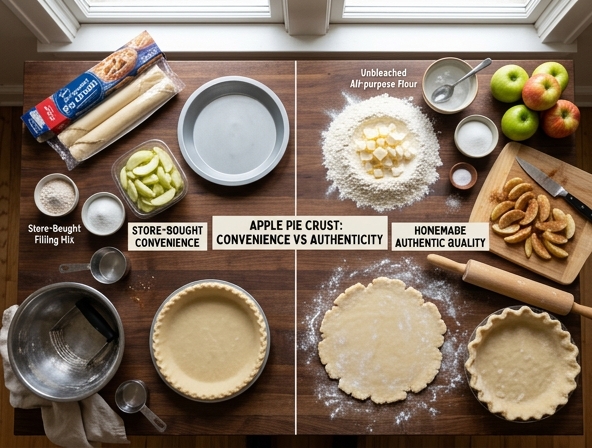
| Feature | Store-Bought Crust | Homemade Crust |
|---|---|---|
| Convenience | High; ready-to-use and time-saving. | Low; requires significant time and preparation. |
| Texture & Quality | Standard; may sacrifice delicate flakiness. | Superior; offers better depth and flakiness. |
| Consistency | Highly reliable and uniform results. | Variable; depends on skill and technique. |
| Best For | Busy bakers needing a quick, reliable base. | Bakers prioritizing authentic, professional flavor. |
Store-Bought vs. Homemade Crust for Apple Pie: Convenience Versus Authentic Quality
The apple pie is more than just a dessert; it is an icon of home, hearth, and nostalgia. At the heart of every great apple pie lies the crust-a delicate, buttery vessel that must be sturdy enough to hold the weight of spiced, macerated fruit, yet tender enough to shatter upon the first bite. But as any home baker knows, the crust is also the primary point of contention in the kitchen. Do you reach for the pre-rolled, refrigerated box at the grocery store, or do you commit to the flour-dusted ritual of rolling out your own dough? The debate between store-bought convenience and homemade authenticity is as old as the rolling pin itself, and the answer, as it turns out, is rarely black and white.
The Case for Convenience: The Store-Bought Savior
In our modern, time-strapped society, the store-bought crust is a miracle of food technology. For the novice baker or the busy parent attempting to whip up a weeknight treat, the convenience of pre-made dough is undeniable. These products-typically found in the refrigerated or frozen section-are designed for consistency and ease.
The advantages of the store-bought route are clear:
- Time Efficiency: You skip the chilling, measuring, and rolling process, shaving at least 45 minutes to an hour off your total prep time.
- Consistency: Manufacturers have mastered the "flake" profile. You are unlikely to end up with a tough, dense brick, which is the most common pitfall for beginner pastry chefs.
- Accessibility: If you lack a food processor or a marble countertop, or if you are intimidated by the temperamental nature of gluten development, store-bought crusts offer a low-stakes entry point into the world of pie baking.
However, this convenience comes at a culinary price. Most mass-market crusts rely on hydrogenated oils, palm oil, or shortenings rather than high-quality butter. While these fats provide stability, they often lack the rich, nutty aroma of pure creamery butter. Furthermore, to ensure the dough remains pliable for months in a box, manufacturers often add preservatives and stabilizers, which can lead to a slight "waxy" mouthfeel that is easily detectable by the discerning palate.
The Magic of Homemade: The "Pâte Brisée" Experience
To roll your own crust is to engage in a sensory experience that no pre-packaged product can replicate. The beauty of homemade *pâte brisée* (short-crust pastry) lies in the chemistry of fat and flour. When you make it yourself, you are in total control of the ingredient quality.
Why the homemade approach remains the gold standard:
- Flavor Profile: When you use high-fat European-style butter, the crust takes on a complexity that complements the tartness of the apples. You can also customize your crust-adding a pinch of cinnamon, a touch of maple sugar, or even ground walnuts to the flour mixture.
- The "Flake" Factor: Achieving flaky layers requires keeping fat in solid, pea-sized chunks. In commercial factories, the machinery often works the dough too much, creating a uniform, uniform texture. At home, you can gently incorporate the fat, ensuring the beautiful, shattery layers that define high-end pastry.
- The Ritual: There is a meditative quality to the process-the tactile feel of cutting cold butter into flour, the visual cues of the dough coming together, and the satisfaction of seeing your own creation emerge from the oven.
The Technical Challenges
The intimidation factor of homemade pie crust is rooted in reality. It is a temperamental beast. Factors such as ambient temperature, the humidity in your kitchen, and even the heat radiating from your hands can ruin a crust. If the butter melts before the pie hits the oven, you lose the steam pockets that create the flake. If you overwork the dough, you develop the gluten, turning your crust into something resembling a chewy cracker rather than a tender pastry.
Yet, these challenges are precisely what make the homemade crust a badge of honor. Learning to manage the temperature of the dough-using ice water, chilling it between steps, and working quickly-is a skill that once mastered, transforms your entire baking repertoire.
The Middle Ground: Elevating the Experience
If you aren't ready to go fully "from scratch," there is a middle ground. Many upscale grocery stores now offer "premium" frozen pie crusts that prioritize butter as the primary fat and avoid artificial preservatives. These occupy the space between the utilitarian budget brands and the labor-intensive homemade method.
Alternatively, if you find yourself short on time but craving homemade quality, consider the "patchwork" technique: use a high-quality store-bought bottom crust to save time on the base, but make a small batch of dough for the lattice top. This allows you to showcase your decorative skills and add that homemade buttery finish without the stress of managing the bottom crust, which is the most prone to getting soggy.
The Verdict: Which Should You Choose?
The choice between store-bought and homemade isn't about which is "better" in a vacuum; it's about the context of the meal. If you are baking a pie for a casual Sunday evening with family and your schedule is packed, the store-bought crust is a perfectly respectable choice that ensures you get to enjoy the pie rather than stressing over the pastry. No one should be shamed for choosing convenience when it allows them to participate in the tradition of baking.
However, if you are looking to create a memorable centerpiece for a holiday, a birthday, or a special occasion, the homemade crust is worth the effort. The difference in taste and the pride of accomplishment are palpable. When you serve a pie that you constructed from start to finish-from the peeling of the apples to the crimping of the hand-rolled edges-you aren't just serving dessert. You are serving a story.
Ultimately, the perfect apple pie is the one that gets eaten. Whether the crust came from a cardboard box or your own marble board, the magic happens when the smell of cinnamon and baked apples fills the house. That scent is the universal signal of care, and that, more than any ingredient, is what makes a pie truly authentic.
Disclaimer:
The information provided on Eateryn is for general educational and informational purposes only and is not intended as medical, nutritional, or healthcare advice. It should not be used to diagnose, treat, cure, or prevent any disease or medical condition.
Always consult a qualified physician, registered dietitian, or other certified healthcare professional before making changes to your diet, exercise routine, or lifestyle, or regarding any medical questions or concerns you may have. Never disregard or delay seeking professional medical advice because of something you have read on this website.