
Sourdough vs Yeast Crust for Pizza - Decoding the Best Texture
Sourdough vs. Yeast Crust for Pizza: Decoding the Best Texture
Achieving a pizzeria-quality crust is a common hurdle for home bakers, often leading to unsatisfying, rubbery textures. While commercial yeast offers speed and convenience, it frequently lacks depth. Sourdough fermentation provides superior value, offering improved digestibility and complex, artisanal profiles. Note that managing wild yeast requires patience and consistent maintenance. When mastered, you will achieve the characteristic blistered, airy crumb and crispy golden exterior of elite pies. This guide evaluates both methods to refine your craft.
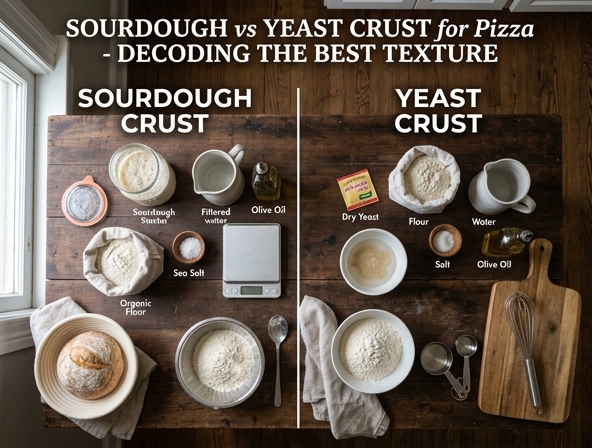
| Feature | Commercial Yeast Crust | Sourdough Crust |
|---|---|---|
| Flavor Profile | Neutral and simple | Complex, artisanal, and deep |
| Preparation | Fast and convenient | Requires patience and consistent starter maintenance |
| Texture | Prone to rubbery results | Airy, blistered, and crispy |
| Digestibility | Standard | Improved digestibility |
Sourdough vs. Yeast Crust for Pizza: Decoding the Best Texture
For the home pizza maker, the crust is the final frontier. It is the canvas upon which the sauce, cheese, and toppings perform their symphony. But the foundation of that canvas-whether born from a packet of commercial instant yeast or a bubbly, long-fermented sourdough starter-changes everything. The debate between sourdough and yeast-leavened pizza dough is not merely about preference; it is a fundamental exploration of chemistry, time, and sensory experience.
The Biological Foundations: Yeast vs. Wild Culture
To understand the texture, we must first understand the biology. Commercial yeast, specifically Saccharomyces cerevisiae, is a high-performance athlete. It is engineered for reliability, speed, and massive carbon dioxide production. When you add a teaspoon of instant yeast to your flour and water, the result is predictable: a vigorous rise, a uniform crumb structure, and a relatively neutral flavor profile.
In contrast, a sourdough starter is a living, breathing ecosystem. It contains a diverse colony of wild yeasts and lactic acid bacteria (LAB). This symbiotic relationship is the secret sauce behind the complexity of sourdough. Because the wild yeast is less concentrated and more variable, the fermentation process is significantly slower. This extended timeline allows for enzymatic activity that breaks down proteins and sugars in ways that rapid-rise yeast simply cannot replicate.
The Yeast Crust: Efficiency and Reliability
The primary virtue of a yeast-leavened pizza dough is its consistency. If you need a pizzeria-style crust on a Tuesday night after work, yeast is your best friend. From a textural standpoint, yeast-leavened crusts tend to be uniform and airy. Because the yeast rises quickly, the air bubbles are often evenly distributed, resulting in a light, fluffy rim (or cornicione) that is soft and pillowy.
The flavor profile of a yeast crust is "clean." It tastes of wheat, salt, and water-a neutral background that allows bold toppings like spicy pepperoni or sharp gorgonzola to take center stage. However, it lacks the depth that only a long fermentation can provide. If not handled with a cold-fermentation process in the refrigerator, yeast dough can sometimes taste one-dimensional or even slightly "yeasty" if too much starter is used.
The Sourdough Crust: The Complex Architecture
Sourdough is where the art of texture truly shines. Because the fermentation happens over 24 to 72 hours, the dough undergoes a structural transformation. The lactic acid produced by the bacteria softens the gluten network. This doesn't make the dough weak; rather, it makes it extensible. When you stretch a well-fermented sourdough, it resists tearing while yielding to your touch, resulting in a crust that is thin in the center and dramatically bubbled at the edges.
The most defining textural characteristic of sourdough is its "chew." While a yeast crust is often soft or crisp, sourdough crusts offer a distinct tension. You have to work through the crumb, which is often riddled with irregular, cavernous air pockets created by the slow, steady gas release of the wild culture. Furthermore, the lactic acid contributes to a characteristic "tang" and a mahogany-colored char that develops faster and deeper in the high heat of an oven.
Comparing the Crumb and Crust
When analyzing the final slice, the textural differences become apparent:
- The Cornicione (The Rim): Sourdough produces a "shattered glass" crispness on the exterior that gives way to a moist, gelatinized interior. Yeast crusts tend to be more uniform-soft throughout with less contrast between the outer crust and the inner crumb.
- The Under-crust: Sourdough's high enzymatic activity leads to better browning (Maillard reaction). This results in a floor that is structurally sound and slightly charred, preventing the dreaded "soggy bottom" that often plagues high-hydration yeast pizzas.
- Digestibility: While not strictly a texture, the breakdown of starches and proteins during long sourdough fermentation makes the crust feel "lighter" in the stomach, even if the chew is substantial.
Practical Considerations: Time vs. Taste
The barrier to entry for sourdough is, undeniably, time. You cannot rush a sourdough culture. If you attempt to speed up the process, you lose the flavor complexity and the textural benefits of the acid development. It requires planning: maintaining a starter, building a levain, and managing long proofing times. For the enthusiast, this is a meditative ritual. For the hurried cook, it is a logistical burden.
Yeast dough, however, rewards the impulsive. You can mix dough in the morning and have pizza for dinner. By incorporating a "cold ferment" (keeping the dough in the fridge for 24 hours), you can bridge the gap between yeast and sourdough, achieving a better texture and flavor than a same-day rise while still utilizing the convenience of commercial yeast.
The Verdict: Which Should You Choose?
If your goal is a standardized, predictable, and pillowy crust that highlights high-end toppings without distraction, master the yeast-based cold-fermented dough. It is a workhorse that never fails and provides a consistently delightful experience.
However, if you are chasing the "perfect" pizza-the one with the blistered, leopard-spotted rim, the complex, slightly sour aroma, and the interplay of a crispy exterior and a chewy, airy interior-sourdough is the superior medium. It elevates pizza from a fast-food staple to a culinary craft. The texture of sourdough isn't just about the bite; it's about the depth, the history of the culture, and the patience required to coax the best out of simple flour and water.
Ultimately, both methods rely on the same fundamental principles: hydration, temperature control, and time. Whether you choose the speed of yeast or the soul of sourdough, the best texture is always found in the dough you understand, practice, and-most importantly-enjoy the process of creating.
Disclaimer:
The information provided on Eateryn is for general educational and informational purposes only and is not intended as medical, nutritional, or healthcare advice. It should not be used to diagnose, treat, cure, or prevent any disease or medical condition.
Always consult a qualified physician, registered dietitian, or other certified healthcare professional before making changes to your diet, exercise routine, or lifestyle, or regarding any medical questions or concerns you may have. Never disregard or delay seeking professional medical advice because of something you have read on this website.