
Sourdough vs White Bread for Grilled Cheese Sandwich - Comparing Structural Integrity
Choosing Your Foundation
Many home cooks struggle with grilled cheese sandwiches that collapse or turn soggy upon heating. While generic white bread remains a standard baseline, its delicate crumb often fails under the weight of robust fillings.
Sourdough offers superior structural integrity, providing a reliable vessel for dense additions like Gruyère. Note that achieving this requires precise heat management to ensure a crisp crust. The following analysis compares the tensile strength and density of both options.
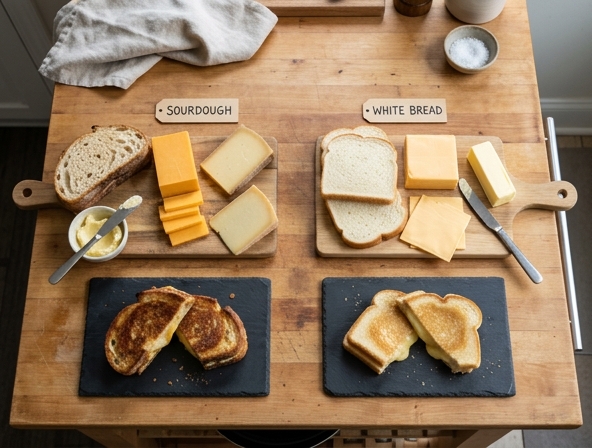
| Feature | White Bread | Sourdough |
|---|---|---|
| Crumb Density | Delicate and light | Sturdy and dense |
| Structural Integrity | Low; prone to collapse | High; retains shape well |
| Filling Compatibility | Best for light, simple ingredients | Best for dense, heavy fillings (e.g., Gruyère) |
| Cooking Requirements | Standard heat management | Requires precise heat for crisp crust |
| Sogginess Resistance | Low | Superior |
The Ultimate Battle of the Lunch Box: Sourdough vs. White Bread for the Perfect Grilled Cheese
To the uninitiated, a grilled cheese sandwich is a simple affair: bread, cheese, butter, heat. But for the culinary architect, it is a masterclass in structural engineering. A perfect grilled cheese isn't just about the flavor profile of the cheese or the golden-brown hue of the crust; it is about the structural integrity-the ability of the bread to act as a vessel for molten dairy without collapsing into a soggy, buttery mess. When we weigh the titans of the sandwich world-the nostalgic, soft white loaf against the robust, tangy sourdough-we aren't just talking about taste. We are evaluating load-bearing capacities, crumb porosity, and crust resilience.
The Anatomy of the Melt
Before diving into the bread, we must understand the environment. Grilled cheese is essentially a thermodynamics problem. As the butter melts into the bread and the cheese transitions from solid to liquid, the bread is subjected to intense heat and moisture. If the bread is too weak, the oils and fats compromise its cellular structure, leading to structural failure. You know the phenomenon: the sandwich becomes "floppy," the center turns gummy, and the crisp edges break away from the core. This is where the choice of bread becomes the most critical decision in your culinary process.
White Bread: The Nostalgic Underdog
Standard white bread, often the staple of childhood memories, is designed for softness. Its fine, uniform crumb and thin, non-existent crust are meant to disappear upon chewing. In a grilled cheese application, this is both a strength and a fatal flaw.
- The Pro: White bread has a high sugar and fat content (often added in commercial processing), which promotes rapid caramelization. It yields a beautiful, deep-golden aesthetic in seconds.
- The Con: Because it is soft and low-density, it lacks "tensile strength." The porous, airy structure of white bread acts like a sponge for butter and oil. Within two minutes of leaving the pan, the steam trapped inside the sandwich permeates the crumb, softening it so significantly that the sandwich loses its structural bite. It is the choice for a quick, "comfort" melt, but it lacks the endurance for gourmet, multi-cheese, or heavy-filling creations.
Sourdough: The Structural Heavyweight
Sourdough is the antithesis of the commercial white loaf. Its structural integrity is a direct result of its fermentation process and the wild yeast culture that governs its growth. Sourdough is, by definition, a "hearty" bread.
The gluten network in a well-baked sourdough is complex and robust. During the long fermentation process, the flour is broken down into a structure that is more resistant to moisture. When you press a sourdough sandwich onto a hot skillet, the crust-often thick and well-developed-creates a protective barrier that seals the moisture inside without becoming saturated.
Furthermore, the "crumb" (the interior) of a sourdough loaf is often more irregular. While this sounds like a liability for leaking cheese, it actually creates a stronger scaffolding. The thick walls of the air bubbles in a sourdough crumb provide rigidity that keeps the sandwich standing tall even when loaded with heavy additions like sharp cheddar, gruyère, or caramelized onions.
Comparing Structural Integrity: The Physics of the Slice
If we treat these breads as building materials, the comparison becomes clear:
1. Crust-to-Crumb Ratio
Sourdough has a significantly higher crust-to-crumb ratio. The crust acts as the load-bearing outer wall, while the crumb is the support column. In a white bread sandwich, both the wall and the columns are essentially made of the same soft material. Sourdough creates a "shell" that protects the structural integrity of the sandwich for much longer, allowing you to enjoy the final bite with the same satisfaction as the first.
2. Resistance to Fat Saturation
Sourdough's density makes it less absorbent than white bread. When you slather butter on the exterior, sourdough holds that fat on the surface, allowing it to fry the crust to a crisp finish. White bread absorbs that fat, which then migrates deep into the crumb, turning the interior into a greasy, dense layer that collapses under the weight of the cheese.
3. The "Dunkability" Factor
If your grilled cheese is destined for a bowl of tomato soup, the structural requirements shift. Sourdough is superior here as well. Because of its structural resilience, a sourdough-based grilled cheese can be dunked into hot soup and held for several seconds without disintegrating. A white bread sandwich, conversely, has a window of about two seconds before it falls apart entirely upon contact with the soup.
Pro-Tips for Maximum Structural Success
Regardless of the bread you choose, you can manipulate your materials to improve the outcome:
- Dry Toasting: If you are nervous about sogginess, lightly toast the interior sides of your bread before assembling the sandwich. This creates a moisture-wicking layer that prevents the cheese from softening the bread from the inside out.
- Cheese Selection: Pair your bread carefully. If you are using white bread, choose a lower-moisture cheese (like a young cheddar or Monterey Jack) to prevent excess liquid from ruining the structural integrity. If you are using sourdough, you can be more adventurous, using higher-moisture cheeses (like Brie or Fontina) that require a sturdier vessel.
- The Weight Factor: Don't press too hard. While the "press" is satisfying, excessive force collapses the gluten structure of the bread prematurely. Let the heat do the work.
The Verdict
If you are looking for a quick, nostalgic, pillowy treat, white bread is your companion. It's comforting, predictable, and disappears quickly. However, if you are looking to build a sandwich that demands respect-a sandwich that maintains its crisp exterior, holds its structural shape under the weight of premium ingredients, and stands up to the rigors of a tomato soup pairing-sourdough is the undisputed champion.
Sourdough doesn't just hold your grilled cheese together; it elevates the entire experience from a simple snack to a sophisticated meal. It is a testament to the fact that when it comes to structural integrity, the foundation is everything.
Disclaimer:
The information provided on Eateryn is for general educational and informational purposes only and is not intended as medical, nutritional, or healthcare advice. It should not be used to diagnose, treat, cure, or prevent any disease or medical condition.
Always consult a qualified physician, registered dietitian, or other certified healthcare professional before making changes to your diet, exercise routine, or lifestyle, or regarding any medical questions or concerns you may have. Never disregard or delay seeking professional medical advice because of something you have read on this website.