
Sourdough Starter vs Yeast for Pancakes - Deepening The Flavor
Sourdough Starter vs Yeast for Pancakes
Many home cooks find standard pancake recipes lack the complex, nuanced flavor found in professional kitchens. While commercial yeast offers reliable lift, it often results in a one-dimensional profile. Sourdough starter introduces wild yeast and lactobacilli, providing a sophisticated tang and superior crumb. Note that this method requires fermentation patience, as biological leavening operates slower than commercial varieties. Recipes like wild-fermented flapjacks prove the depth possible. Below, we explore the technical differences to elevate your breakfast.
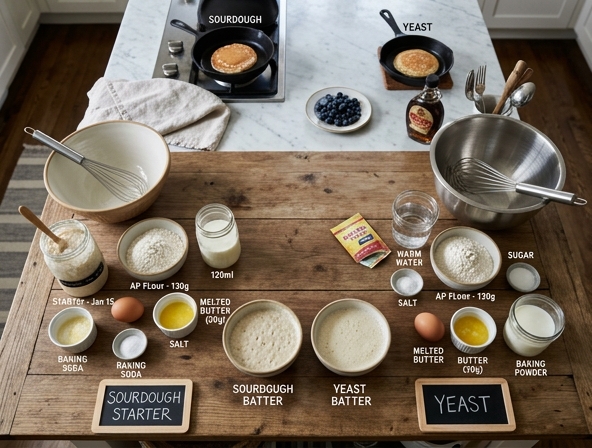
| Comparison Aspect | Sourdough Starter | Commercial Yeast |
|---|---|---|
| Flavor Profile | Complex, sophisticated, and tangy | One-dimensional and neutral |
| Leavening Agent | Wild yeast and lactobacilli | Commercial baker's yeast |
| Texture / Crumb | Superior, airy crumb | Reliable, standard lift |
| Fermentation Speed | Slow (requires patience) | Fast / Efficient |
Sourdough Starter vs. Yeast for Pancakes: Deepening the Flavor
For most home cooks, the Saturday morning pancake ritual is a simple affair: grab the flour, dump in some baking powder, add milk and an egg, and you're flipping golden circles within fifteen minutes. But there exists a culinary divide between the convenience-driven pancake and the artisanal, fermented flapjack. At the heart of this divide lies the choice between two leavening agents: the controlled, rapid-fire power of commercial yeast (or chemical leaveners) and the slow, complex, biological alchemy of a sourdough starter.
The Alchemy of Sourdough: Beyond Just “Sour”
Many people shy away from sourdough pancakes under the misconception that they will result in a breakfast that tastes like vinegar. In reality, a well-managed sourdough starter adds a profound depth-a nuance-that commercial yeast simply cannot replicate. Sourdough is a living ecosystem consisting of wild yeasts and lactic acid bacteria (LAB).
When you incorporate sourdough starter into your pancake batter, you aren't just adding a leavening agent; you are initiating a fermentation process. During this time, the bacteria produce lactic and acetic acids. These acids act as flavor enhancers, breaking down complex starches into simpler sugars, which then undergo the Maillard reaction more readily during cooking. The result is a pancake with a crisp, caramelized exterior and a tender, slightly chewy crumb that carries a subtle, nutty complexity rather than a sharp, artificial tang.
The Efficiency of Commercial Yeast
Commercial yeast (Saccharomyces cerevisiae) is the workhorse of the modern kitchen. It was bred for one primary purpose: speed and reliability. When you use yeast for pancakes-often referred to as “raised pancakes”-you are looking for a massive, airy lift. Yeast works quickly to produce carbon dioxide, creating a light, pillowy structure that is incredibly consistent.
Yeast-leavened pancakes offer a clean, neutral canvas. If you are serving your breakfast with high-quality maple syrup, fresh berries, or flavored compound butters, a yeast-based pancake allows those toppings to take center stage. Because the fermentation time is short, the grain retains more of its original, mild profile. It is a predictable science, perfect for those mornings when the hunger of a family demands immediate satisfaction.
Comparing Texture and Digestion
Beyond flavor, the choice between starter and yeast impacts how your body processes the breakfast. One of the most compelling arguments for sourdough is digestibility. Flour contains phytic acid, an “antinutrient” that can bind to minerals like iron and zinc, making them harder for the body to absorb. The extended fermentation time of a sourdough pancake batter effectively neutralizes much of this phytic acid and begins the process of breaking down gluten proteins.
Conversely, while yeast-leavened pancakes are delightful, they don't provide that same enzymatic breakdown. The starch is still largely intact when it hits the griddle. For those with mild gluten sensitivities, sourdough often feels “lighter” in the stomach, despite the pancake itself being nutritionally dense and filling.
In terms of texture, the two are distinct experiences. A sourdough pancake often feels more “substantial.” There is a slight resistance, a chewiness that feels grounded and wholesome. A yeast-leavened pancake, particularly those allowed to proof for an hour or two, can achieve an almost cloud-like fragility that is difficult to match with any other method.
Practical Implementation: When to Choose Which?
Choosing your leavening agent often comes down to planning. If you are a sourdough enthusiast, you likely already have a jar of starter bubbling on the counter. The key here is to incorporate the starter the night before. By mixing your flour, liquid, and starter in the evening and letting it sit overnight, you allow the bacteria time to work their magic. Come morning, you simply whisk in your eggs, oil, and a touch of baking soda (to neutralize the acidity and give an extra lift), and you have a breakfast that feels professional and intentional.
If you don't have a starter, or if you simply don't have the foresight to prepare the night before, commercial yeast is your best friend. A quick “sponge” method-mixing warm milk, sugar, and yeast and letting it sit for twenty minutes-can produce a pancake that is far superior to those made with standard chemical baking powder. It bridges the gap between the speed of a box mix and the artisanal quality of a fermented breakfast.
The Verdict
So, which should you choose? If your goal is to deepen the flavor profile and create a breakfast that feels like a slow, deliberate act of love, sourdough is the undisputed champion. It transforms flour and water from simple filler into a nuanced, gut-friendly, and profoundly flavorful experience.
However, do not discount the merit of yeast. It is a tool of precision. When you want that perfect, architectural fluffiness or when time is of the essence, yeast provides the reliability that sourdough, in its wild and temperamental nature, sometimes lacks.
Ultimately, the best approach is to be a kitchen chameleon. Keep a starter for those slow Sunday mornings where the aroma of fermentation fills the house, and keep a few packets of instant yeast in the pantry for the busy weekdays when you still crave the satisfaction of a “raised” pancake. Both methods respect the grain, both elevate the humble flapjack, and both offer a path away from the mundane toward something much more memorable.
Disclaimer:
The information provided on Eateryn is for general educational and informational purposes only and is not intended as medical, nutritional, or healthcare advice. It should not be used to diagnose, treat, cure, or prevent any disease or medical condition.
Always consult a qualified physician, registered dietitian, or other certified healthcare professional before making changes to your diet, exercise routine, or lifestyle, or regarding any medical questions or concerns you may have. Never disregard or delay seeking professional medical advice because of something you have read on this website.