
Sour Cream vs Crema for Tacos - Creaminess Level in Gourmet Preparation
Culinary professionals often struggle to achieve the perfect textural balance when elevating taco concepts. While standard sour cream remains the industry default, many kitchens lack the nuance to differentiate its utility from authentic Mexican crema. Understanding the specific fat-to-acid ratio grants you total control over dish viscosity. Stipulation: crema typically lacks the assertive tang of cultured dairy. For example, crema fresca defines delicate seafood tacos, whereas sour cream anchors bold chorizo. We evaluate these profiles below.
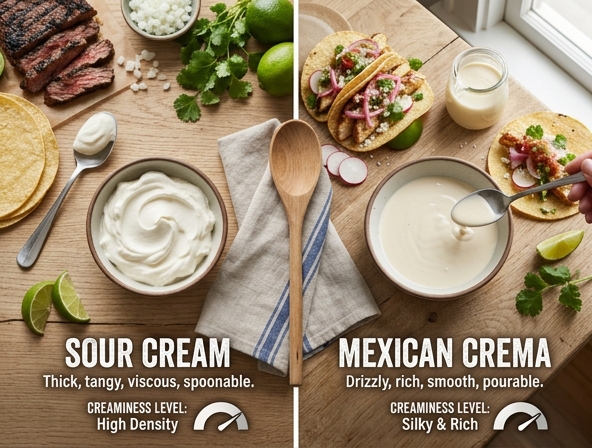
| Feature | Sour Cream | Mexican Crema |
|---|---|---|
| Acidity/Tang | High; assertive cultured flavor. | Low; mild and balanced. |
| Viscosity | Thick and heavy. | Delicate, pourable, and smooth. |
| Primary Role | Provides a sharp, acidic contrast. | Provides rich, creamy mouthfeel. |
| Best Pairing | Bold, spiced meats (e.g., Chorizo). | Delicate proteins (e.g., Seafood). |
| Culinary Goal | To cut through heavy, savory flavors. | To enhance and integrate subtle flavors. |
The Creamy Bridge: Sour Cream vs. Mexican Crema in Gourmet Taco Construction
In the expansive, vibrant world of taco craft, the "creamy element" is often the unsung hero. While the quality of the tortilla, the sear on the protein, and the brightness of the salsa command the initial attention of the palate, it is the dairy component that acts as the essential bridge. It tempers the heat of chiles, adds a luxurious mouthfeel, and binds disparate flavors into a cohesive bite. However, the choice between traditional American sour cream and authentic Mexican crema is more than a matter of preference-it is a fundamental decision that changes the entire architecture of the taco.
The Chemistry of Tang: Understanding Sour Cream
At its core, American sour cream is a product of fermentation. Produced by adding lactic acid-producing bacteria to cream, it is then heated and thickened until it achieves a stable, spoonable consistency. From a culinary perspective, sour cream is defined by its pronounced acidity. This sharpness is a distinct flavor profile, intended to cut through rich, fatty meats like carnitas or chorizo.
However, in gourmet preparation, sour cream's high viscosity can be a drawback. Because it is highly stable, it tends to sit on top of a taco rather than integrating with the other ingredients. Its texture is heavy, often bordering on "cloying" if used in excess. For a chef focusing on balance, the intense lactic acid punch of sour cream can sometimes mask the nuance of high-quality ingredients, such as a delicate salsa verde or a subtle cilantro-lime slaw.
The Elegance of Crema: Depth Without Distraction
Mexican crema, by contrast, operates on a different frequency. While it is also a fermented dairy product, the fermentation process is typically shorter, and the resulting profile is vastly different. Crema is thinner, pourable, and possesses a subtle, nutty sweetness that complements-rather than competes with-the spices of the taco.
In the context of gourmet taco construction, crema serves a different function than sour cream. Because of its lower viscosity, crema acts more like a sauce than a condiment. It distributes itself across the proteins and the tortilla, creating a silky emulsification when it meets the oils from the meat and the juices from a fresh tomato-based salsa. Where sour cream says, "I am here to balance the acid," crema says, "I am here to unify the dish."
The Metrics of Creaminess: Mouthfeel and Viscosity
When we discuss "creaminess level" in a professional kitchen, we aren't just talking about fat percentage. We are discussing the interaction between heat and texture.
- Viscosity: Sour cream is a static component. It holds its shape, which makes it aesthetically pleasing for a photo but potentially overwhelming in a single bite. Crema, being fluid, allows for a more even distribution of flavor across every square inch of the taco.
- Fat and Emulsification: Mexican crema has a higher fat content, which coats the tongue and provides a lingering finish. In a gourmet setting, this is vital; it allows the heat of the chiles to linger, slowly fading into the richness of the milk fats rather than being abruptly cut off by the sharp, acidic tang of sour cream.
- Thermostability: Because crema is less prone to "breaking" or curdling in the presence of heat, it is superior for tacos served fresh off the plancha. It integrates with the steam of the tortilla and the warmth of the meat, creating a cohesive, velvety experience.
Gourmet Applications: Choosing the Right Dairy for the Taco
The decision between these two staples should be dictated by the protein and the regional style of the taco. For instance, in a Baja-style fish taco, the fish is delicate, often breaded or battered, and accompanied by a zesty slaw. Here, a lime-infused crema is essential; it elevates the freshness of the seafood. Using heavy sour cream here would weigh down the taco and drown out the subtle sweetness of the fish.
Conversely, consider the Al Pastor taco. This meat is heavily spiced with achiote, chili, and often paired with pineapple. The pork is incredibly fatty and savory. In this instance, a slightly more acidic sour cream-or a very tangy, high-quality *crema ácida*-can serve as a necessary palate cleanser, slicing through the intensity of the pork fat to prepare the tongue for the next bite.
Elevating the Experience: The DIY Approach
For the gourmet home cook or the chef looking to set their menu apart, the secret often lies in the "middle ground." Many of the best taco establishments create their own house creams by blending store-bought Mexican crema with fresh lime zest, minced chipotles in adobo, or roasted garlic. By starting with the thinner, more neutral base of Mexican crema, you gain a "blank canvas" that allows for the infusion of secondary flavors-something that is far more difficult to achieve with the assertive, pre-thickened profile of commercial sour cream.
The Verdict
Ultimately, while sour cream has its place in the world of "Tex-Mex" comfort food, it is rarely the choice for the gourmet taco. The sophisticated palate seeks the refined, fluid, and nutty characteristics of Mexican crema. It is the subtle, velvety layer that turns a collection of ingredients into a harmonious culinary event. By prioritizing the thin, pourable richness of crema, the chef honors the integrity of the taco's components, ensuring that every bite is as balanced, elegant, and complex as the ingredients from which it is composed.
If you are looking to elevate your next taco night or menu launch, trade the sour cream for a high-quality Mexican crema. Experiment with its viscosity by adding a touch of heavy cream or lime juice, and observe how it transforms the taco from a heavy, static meal into a fluid, refined experience. In the quest for the perfect taco, creaminess is not just about the fat; it is about the nuance.
Disclaimer:
The information provided on Eateryn is for general educational and informational purposes only and is not intended as medical, nutritional, or healthcare advice. It should not be used to diagnose, treat, cure, or prevent any disease or medical condition.
Always consult a qualified physician, registered dietitian, or other certified healthcare professional before making changes to your diet, exercise routine, or lifestyle, or regarding any medical questions or concerns you may have. Never disregard or delay seeking professional medical advice because of something you have read on this website.