
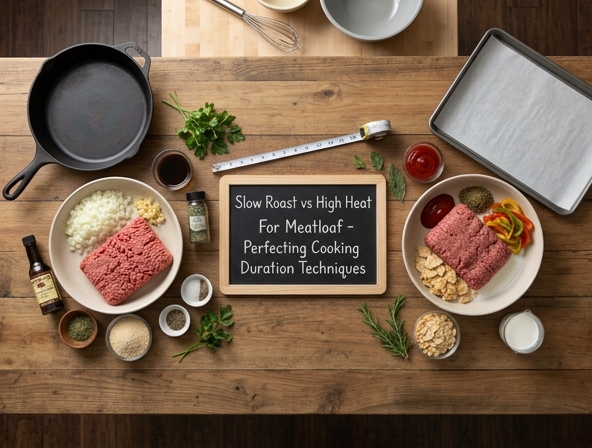
Slow Roast vs High Heat For Meatloaf - Perfecting Cooking Duration Techniques
| Feature | Slow Roast Approach | High Heat Approach |
|---|---|---|
| Primary Goal | Maximum moisture and uniform texture | Standard baseline preparation |
| Heat Dynamics | Controlled, precision thermal application | Rapid, standard oven intensity |
| Outcome | Restaurant-quality consistency | Risk of uneven texture |
| Critical Success Factor | Optimal fat ratios | Optimal fat ratios |
The Great Debate: Slow Roast vs. High Heat for the Perfect Meatloaf
The humble meatloaf is often dismissed as a relic of mid-century convenience, a way to stretch expensive proteins with pantry staples. However, for the home cook seeking culinary perfection, the meatloaf represents a complex thermal challenge. The goal is singular but elusive: an exterior that is deeply caramelized and flavor-packed, cradling an interior that is succulent, tender, and perfectly cooked through. The primary variable in achieving this balance? Temperature management. Whether you opt for a high-heat sear or a gentle, slow-roasted approach, your choice of duration and temperature will dictate the final texture and flavor profile of your dish.
The High Heat Approach: The Quest for Crust
Cooking a meatloaf at high heat-typically between 400°F and 425°F (200°C–220°C)-is primarily driven by the desire for the Maillard reaction. This chemical reaction between amino acids and reducing sugars provides that savory, browned crust that acts as a flavor anchor for the entire loaf. When executed correctly, high heat produces a meatloaf with a crisp, slightly charred exterior that contrasts beautifully with the dense, moist interior.
The Advantages: Speed is the primary benefit. A high-heat meatloaf can be ready in 40 to 50 minutes, making it a viable weeknight option. Furthermore, the intense heat ensures that sugars in your glaze (whether ketchup, brown sugar, or barbecue-based) caramelize into a sticky, concentrated lacquer rather than melting off the sides into a watery puddle.
The Risks: The physics of a dense loaf of ground meat can work against high temperatures. Because meatloaf is a large, solid mass, heat travels slowly to the center. By the time the core reaches a food-safe 160°F (71°C), the exterior can easily become tough, dry, or even burnt. This leads to the "lava-cake" effect: a scorched shell surrounding a center that may still be lukewarm or, in some cases, unevenly cooked.
The Slow Roast Approach: The Pursuit of Tenderness
In contrast, the slow-roasting method-usually conducted between 300°F and 325°F (150°C–165°C)-treats meatloaf more like a delicate roast. By reducing the temperature differential between the oven air and the internal temperature of the loaf, you allow heat to penetrate the center slowly and evenly. This gentle approach results in a uniform texture from edge to center, minimizing the moisture loss that occurs at higher, more aggressive temperatures.
The Advantages: Moisture retention is the crown jewel of slow roasting. Ground meat is inherently susceptible to losing its fat and juices when subjected to rapid protein contraction. Slow, low heat allows the fat to render slowly and the connective tissues to soften without tightening into a rubbery consistency. The result is a fork-tender loaf that feels significantly more luxurious on the palate.
The Risks: The most significant drawback is the lack of surface development. A slow-roasted meatloaf often emerges looking pale and underwhelming, lacking that crave-able, browned exterior. Without the high heat, the glaze often sits on the surface as a runny sauce rather than a caramelized glaze. To compensate, cooks often have to add a final step under the broiler or compromise on the lack of textural variety.
The Hybrid Methodology: The Goldilocks Solution
Professional kitchens rarely choose one extreme; they utilize a hybrid approach to leverage the benefits of both. This methodology involves starting the meatloaf at a high temperature to kickstart the browning process, then dropping the oven temperature to finish the cook gently.
How to execute the hybrid method:
- The Initial Sear: Preheat your oven to 425°F (220°C). Place your meatloaf in the oven for 15 to 20 minutes. This creates the necessary Maillard reaction and helps the exterior set, providing structural integrity to the loaf.
- The Gentle Finish: After the initial crust forms, drop the oven temperature to 325°F (165°C). Continue cooking for another 35 to 45 minutes, or until an instant-read thermometer inserted into the center reads 160°F (71°C).
- The Glaze Application: Apply your glaze during the final 15 minutes of the low-temperature phase. This prevents the sugars in the glaze from burning during the high-heat start while still giving them enough time to become tacky and flavorful.
The Importance of Internal Temperature and Resting
Regardless of the method you choose, the true "technique" in meatloaf preparation lies in the internal temperature and the post-oven resting period. Because ground meat is exposed to more surface bacteria than a solid steak, cooking it to 160°F (71°C) is the industry standard for safety. Using an instant-read thermometer is not a suggestion; it is a necessity for consistency.
Furthermore, never slice a meatloaf the moment it leaves the oven. Resting the meatloaf for at least 10 to 15 minutes allows the internal juices to redistribute throughout the meat. If you cut into it too early, the juices will run out onto the cutting board, leaving you with a dry slice and a puddle of wasted flavor. Resting also allows the structure of the meat, breadcrumbs, and egg binder to firm up, ensuring that your slices remain intact rather than crumbling apart on the plate.
Conclusion: Tailoring the Technique to Your Palate
Ultimately, the "perfect" cooking duration depends on what you value most in a meatloaf. If you prioritize a deep, caramelized crust and have the skill to monitor the internal temperature carefully, the high-heat method offers an aggressive flavor profile. If you prefer a delicate, uniform, and exceptionally moist texture, the slow-roasting method is superior. However, for most home cooks, the hybrid approach provides the best of both worlds-guaranteeing that signature crust while ensuring the center remains succulent and perfectly cooked.
By shifting your focus from "how long" to "how the temperature changes over time," you elevate the meatloaf from a mere filler dish to a centerpiece worthy of any dinner table. Experiment with these durations, invest in an accurate thermometer, and stop fearing the dreaded dry, crumbling slice; precision is the only ingredient you were missing.
Disclaimer:
The information provided on Eateryn is for general educational and informational purposes only and is not intended as medical, nutritional, or healthcare advice. It should not be used to diagnose, treat, cure, or prevent any disease or medical condition.
Always consult a qualified physician, registered dietitian, or other certified healthcare professional before making changes to your diet, exercise routine, or lifestyle, or regarding any medical questions or concerns you may have. Never disregard or delay seeking professional medical advice because of something you have read on this website.