
Slow Cooker vs Pressure Cooker for Barbecue Ribs - Expediting The Cooking Process
Slow Cooker vs. Pressure Cooker for Barbecue Ribs
Craving fall-off-the-bone ribs often requires an all-day commitment that many busy cooks cannot afford. While slow-roasting remains the gold standard for smoky depth, modern pressure cookers offer remarkable efficiency. Devices like the Instant Pot condense hours into minutes, though one must stipulate that you may sacrifice the signature bark found in traditional smokers. This analysis evaluates both methodologies, helping you determine which approach best balances your requirement for speed against your preference for authentic flavor.
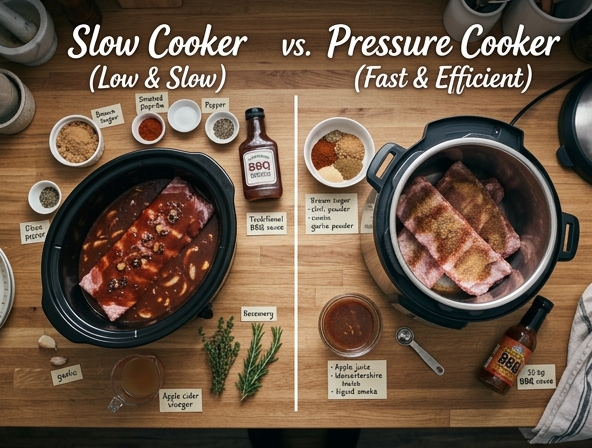
| Comparison Metric | Slow Cooker | Pressure Cooker |
|---|---|---|
| Cooking Time | Long (All-day commitment) | Fast (Minutes) |
| Flavor & Texture | Gold standard for smoky depth and signature bark | Tender results, but lacks authentic bark |
| Ideal User | Flavor purists with time to spare | Busy cooks prioritizing efficiency |
The Great Rib Dilemma: Choosing Between the Slow Cooker and Pressure Cooker
There is perhaps no dish in the American culinary canon that inspires as much patience as a rack of barbecue ribs. Traditionally, the process involves hours of smoke, indirect heat, and constant vigilance over a backyard offset smoker. However, in our modern, fast-paced world, the craving for succulent, fall-off-the-bone ribs often hits long before the six-to-eight-hour cooking window opens. This is where the kitchen countertop showdown begins: the Slow Cooker versus the Pressure Cooker.
Both appliances promise to deliver tender, flavorful results without the need for tending a fire, but they operate on fundamentally different scientific principles. Choosing the right tool depends entirely on your constraints: do you have all day to let the magic happen, or do you need a masterpiece on the table in under an hour? Let's break down the mechanics, the pros, the cons, and the ultimate verdict for preparing barbecue ribs.
The Slow Cooker: The Patient Architect of Tenderness
The slow cooker, or crockpot, is the quintessential "set it and forget it" tool. It works by maintaining a low, consistent temperature-usually between 190°F and 200°F-for an extended period. This method is the culinary equivalent of a marathon, not a sprint.
The Pros:
- Structural Integrity: Because the heat is gentle, the meat fibers break down slowly. This usually results in ribs that are tender but still retain a bit of "bite," which many barbecue purists prefer over meat that falls off the bone at the mere suggestion of a fork.
- Flavor Infusion: Long cooking times allow dry rubs and aromatic liquids to seep deep into the meat. You are essentially braising the ribs in their own juices and sauce, creating a rich, concentrated flavor profile.
- Ease of Use: It is nearly impossible to "overcook" ribs to the point of ruining them in a slow cooker, provided you use enough liquid.
The Cons:
- Time Investment: You are looking at a minimum of 4 to 6 hours on high, or 8 to 10 hours on low.
- Texture Risk: If left on for too long, the meat can eventually become mushy or lose its texture entirely, effectively turning into a pulled-meat consistency rather than a cohesive rib.
The Pressure Cooker: The High-Speed Innovator
The pressure cooker (often an Instant Pot or similar electric multi-cooker) operates on the principle of pressurized steam. By increasing the internal pressure, the device raises the boiling point of water, which forces heat and moisture into the meat at a much faster rate than conventional methods.
The Pros:
- Incredible Speed: You can transform a tough rack of pork or beef ribs into something tender in about 30 to 45 minutes of active cooking time. It is a game-changer for weeknight dinners.
- Moisture Retention: Because the pot is sealed, moisture cannot escape as steam. This ensures that the ribs remain incredibly juicy, even if you are using leaner cuts.
- Efficiency: It uses significantly less electricity than a slow cooker or a standard oven, making it an eco-friendly choice for the kitchen.
The Cons:
- The "Mush" Factor: The high pressure is so effective that it can easily disintegrate the connective tissue too quickly. If you aren't careful with your timing, your ribs may become "fall-off-the-bone" to the point where they fall apart as you try to remove them from the pot.
- Lack of Surface Development: Neither the slow cooker nor the pressure cooker provides the browning or "bark" (crust) that a grill provides. You must always perform an extra step to achieve that classic BBQ aesthetic.
The Final Step: The Non-Negotiable Finish
Regardless of whether you choose the slow cooker or the pressure cooker, there is one step you cannot skip: the finish. Neither of these appliances will provide the caramelized, sticky, charred exterior that defines great barbecue.
Once the ribs are tender from your chosen appliance, remove them carefully-they will be delicate. Place them on a foil-lined baking sheet, brush generously with your favorite barbecue sauce, and slide them under the broiler in your oven for 5 to 7 minutes, or place them on a hot grill. This step caramelizes the sugars in the sauce, creating that signature tacky, charred exterior that provides the perfect contrast to the melt-in-your-mouth meat inside.
The Verdict: Which Should You Choose?
Choosing between these two depends on your relationship with time. If it's a lazy Sunday afternoon and you want your home to be filled with the intoxicating aroma of slow-simmering barbecue for hours, the slow cooker is the clear winner. It offers a more controlled, traditional braise that feels sophisticated and deliberate.
However, if you are a busy parent, a host who forgot to plan ahead, or someone who simply values efficiency above all else, the pressure cooker is a modern miracle. It yields results that are 90% as good as the slow cooker in 20% of the time. When paired with a quick broil at the end, even the most discerning dinner guest will struggle to guess that those ribs were cooked in under an hour.
Ultimately, both methods prove that you don't need a professional-grade smoker to enjoy restaurant-quality ribs. With a good rub, a solid sauce, and the right appliance, the power of barbecue is firmly in your hands-no matter how fast the clock is ticking.
Disclaimer:
The information provided on Eateryn is for general educational and informational purposes only and is not intended as medical, nutritional, or healthcare advice. It should not be used to diagnose, treat, cure, or prevent any disease or medical condition.
Always consult a qualified physician, registered dietitian, or other certified healthcare professional before making changes to your diet, exercise routine, or lifestyle, or regarding any medical questions or concerns you may have. Never disregard or delay seeking professional medical advice because of something you have read on this website.