
Slider Vs. Full-Size For Burger - Best Serving Style
Choosing between sliders and full-size burgers often challenges event planners balancing style and substance. While industry standards typically default to full-size patties for seated meals, modern hospitality increasingly leverages sliders for versatility. Selecting the ideal format ensures guest satisfaction, though yield and prep logistics must be carefully managed. For high-energy networking, sliders facilitate mobility; for formal dining, full-size burgers provide perceived value. The following analysis explores these strategic variables to help you optimize your menu.
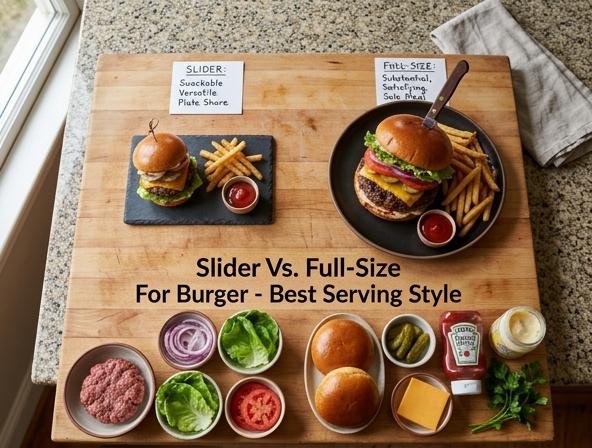
| Comparison Factor | Sliders | Full-Size Burgers |
|---|---|---|
| Best Event Type | High-energy networking & social mixers | Formal seated meals |
| Guest Experience | Facilitates mobility and casual interaction | Provides a sense of substance and high perceived value |
| Versatility | Highly flexible for diverse menu formats | Standardized for traditional dining |
| Logistics | Requires careful yield and portion management | Requires standard prep for main course service |
| Strategic Goal | Prioritizes movement and modern hospitality | Prioritizes traditional guest satisfaction |
The Great Burger Debate: Slider vs. Full-Size Serving Styles
In the expansive and often passionate world of culinary debates, few topics are as contentious as the burger. Yet, the argument isn't always about what goes on the burger-the cheeses, the pickles, or the secret sauces-but rather the very form the burger takes. We are talking, of course, about the eternal showdown between the slider and the full-size burger. Each style offers a distinct sensory experience, a different social function, and a unique place in the landscape of modern dining.
The Case for the Slider: The Art of the "Tasting Menu"
The slider, often misunderstood as merely a "miniature burger," has a rich history that traces back to the early 20th century, most famously championed by the White Castle chain. The beauty of the slider lies in its compact, manageable nature. It is the culinary equivalent of a snack, yet it holds the potential to be a gourmet powerhouse.
The primary advantage of the slider is versatility. Because of their size, sliders allow for the "tasting menu" approach to a meal. Where a single full-size burger locks you into one flavor profile, a slider flight-perhaps featuring a classic American cheddar, a spicy jalapeño-bacon, and an earthy mushroom-Swiss-allows the diner to explore multiple textures and tastes without the commitment of a heavy, singular entree. This makes sliders the ultimate social food; they are perfect for group settings, appetizers, or casual standing events where guests might want to mingle rather than sit down for a fork-and-knife commitment.
Furthermore, sliders offer a unique textural advantage: the crust-to-meat ratio. Because a slider patty is thin, it can be seared at high heat rapidly, allowing for a deep, caramelized crust on both sides while the interior remains succulent. This makes the slider a masterclass in the Maillard reaction, delivering a concentrated punch of savory flavor in every bite.
The Classic Titan: The Full-Size Burger Experience
On the other side of the grill, we have the full-size burger-the undisputed heavyweight champion of the pub, the backyard barbecue, and the elevated bistro. To many, a burger is not truly a burger unless it requires two hands, a handful of napkins, and a momentary suspension of societal decorum to consume.
The full-size burger is an architectural endeavor. With a substantial patty-typically ranging from 6 to 8 ounces-the cook has the ability to manipulate internal temperatures. While a slider is almost always cooked well-done due to its thin profile, the full-size burger allows for the luxury of a medium-rare or medium center. This preserves the texture of the beef, providing a juicy, robust mouthfeel that smaller patties simply cannot replicate.
Beyond the meat, the full-size burger serves as a better canvas for complex ingredient layering. A thick, juicy patty can support the weight of heavy toppings-thick slabs of heirloom tomato, crisp artisan lettuces, sautéed onions, or even a fried egg-without collapsing into a soggy mess. It is a meal that commands attention. It represents satisfaction, comfort, and the classic "American Dream" aesthetic of dining.
Comparing the Dining Dynamics
When choosing between these two styles, one must consider the intended atmosphere. The full-size burger is an introspective meal. It is a hearty, filling, and satisfying objective. It fits perfectly in a sit-down environment where the focus is on the meal itself. It is the "main event."
In contrast, the slider is interactive. It is the food of the food truck, the happy hour, and the high-energy party. It is easier to eat while holding a drink in the other hand. It is less intimidating and more inclusive for those who might not want to overindulge. From a chef's perspective, sliders also offer better control over food waste and portion costs, as they can be served in twos or threes depending on the customer's appetite.
Culinary Psychology: Why Form Matters
There is a psychological element to our preference for burger size. A full-size burger triggers the "comfort food" response-the need to sink one's teeth into something substantial after a long day. It feels like a reward. The slider, however, triggers the "curiosity" response. It invites the diner to experiment, to play with flavors, and to share. It is the burger for the adventurous eater who wants variety over volume.
Moreover, the construction of the bun plays a role in both. The slider is often served on a soft, pillowy potato roll or a Hawaiian bun, emphasizing a sweet-and-savory balance. The full-size burger often utilizes a sturdier, toasted brioche or a sesame-seeded bun, designed to stand up to the structural pressures of the ingredients within. Each is engineered for its specific purpose, proving that size is not just about quantity, but about design intent.
Conclusion: The Best of Both Worlds
Ultimately, the choice between a slider and a full-size burger is not a binary decision; it is a contextual one. If you are hosting a lively summer gathering, sliders are the clear winner, offering variety and ease of movement. If you are looking for that quintessential, soul-satisfying culinary experience after a long week, nothing replaces the structural integrity and juiciness of a well-crafted, full-size burger.
Whether you lean toward the variety of the slider or the classic satisfaction of the full-size patty, the secret remains the same: quality ingredients, proper seasoning, and the passion of the cook. In the end, the best burger is simply the one that brings you the most enjoyment-whether you eat it in three bites or thirty.
Disclaimer:
The information provided on Eateryn is for general educational and informational purposes only and is not intended as medical, nutritional, or healthcare advice. It should not be used to diagnose, treat, cure, or prevent any disease or medical condition.
Always consult a qualified physician, registered dietitian, or other certified healthcare professional before making changes to your diet, exercise routine, or lifestyle, or regarding any medical questions or concerns you may have. Never disregard or delay seeking professional medical advice because of something you have read on this website.