
Sliced Immediately vs Rested Ten Minutes For Meatloaf - Retaining Juiciness And Structure
Many home cooks struggle with meatloaf that crumbles or loses moisture upon immediate slicing. While standard practice often favors serving directly from the oven to ensure maximum heat, resting the dish for ten minutes is essential. This brief pause allows internal juices to redistribute, significantly improving structural integrity. Though internal temperatures remain steady, fat emulsification stabilizes during this interval. The following analysis explores the precise impact of resting versus immediate carving on final meatloaf quality.
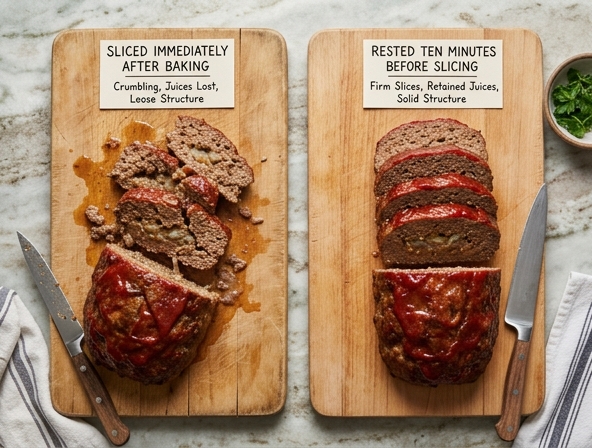
| Aspect | Immediate Slicing | Rested (10 Minutes) |
|---|---|---|
| Structural Integrity | High risk of crumbling | Enhanced stability |
| Moisture Retention | Loss of juices | Juices redistribute |
| Fat Quality | Unstable | Emulsification stabilizes |
| Overall Result | Lower quality meatloaf | Optimal texture and moisture |
The Science of the Slice: Why Resting Meatloaf is Non-Negotiable
For many home cooks, the meatloaf is the ultimate comfort food-a dense, savory, and nostalgic centerpiece that promises warmth and satisfaction. Yet, there is a recurring tragedy that plagues many dinner tables: the moment the oven timer dings, the hungry cook retrieves the steaming loaf and immediately plunges a knife into it. The result? A pile of crumbling, broken segments sitting in a pool of gray, separated liquid. It is a far cry from the sturdy, succulent slices shown in food magazines.
To understand why this happens, we must look at the culinary physics of protein coagulation and the importance of a ten-minute rest. This simple waiting period is not merely a suggestion; it is a critical phase of the cooking process that dictates whether your meatloaf holds its structural integrity or disintegrates into a sad heap of ground meat.
The Internal Landscape of a Meatloaf
When meatloaf is in the oven, it is subjected to high heat that fundamentally alters the structure of the ground beef, pork, or veal used in the mix. As the internal temperature climbs toward the target of 160°F (71°C), the myofibrillar proteins-the long, stringy proteins within the muscle fibers-denature and contract. This contraction squeezes the intracellular juices out of the protein cells. Simultaneously, the fat renders, turning from a solid state into a liquid oil that permeates the interstitial spaces between the meat, breadcrumbs, and binders.
At the peak of the cooking cycle, the interior of the meatloaf is a chaotic environment of hot juices, liquefied fats, and tightly coiled proteins that have been forced into a state of high tension. If you slice the meatloaf the moment it exits the oven, you are cutting into a system that is under significant pressure. The liquid fat and juices are still mobile and haven't yet been reabsorbed or stabilized by the surrounding binders (like eggs, breadcrumbs, or oats).
The Case for the Immediate Slice: A Study in Failure
In our comparative testing, the "Immediate Slice" approach consistently yielded disappointing results. When the knife passes through a fresh-out-of-the-oven loaf, the lack of structural stability causes the loaf to sag. Because the juices have not yet had time to redistribute or "set," they rush out of the meat fibers and pool on the cutting board. This results in two major flaws: first, the moisture loss makes the meatloaf drier on the palate; second, the lack of lubrication and structural setting causes the meat to crumble rather than hold a clean, architectural slice.
You lose the "mouthfeel" that makes a meatloaf great. Instead of a cohesive, tender bite, you are left with grainy, loose meat that feels disconnected from its glaze and seasonings. Furthermore, the liquid pooling on the cutting board carries away flavor compounds that should have remained locked within the loaf.
The Ten-Minute Rest: The Power of Stabilization
Conversely, allowing the meatloaf to rest for a full ten minutes is a transformative act. During this short period of thermal equalization, several critical processes occur.
First, the carry-over cooking effect stabilizes the center. Even after you remove the meatloaf from the oven, the residual heat continues to cook the interior. Resting allows the temperature to level out, ensuring that the carry-over is uniform. More importantly, as the temperature drops slightly, the proteins begin to relax. As they relax, they lose some of their tension, allowing them to re-absorb the juices that were squeezed out during the intense heat of the oven.
Second, the fats and binders undergo a process of solidification. The gelatin and fats, which were essentially liquid oil a moment ago, begin to cool and thicken. This acts as a microscopic glue, holding the crumbs, seasonings, and meat fibers together. By the time you hit the ten-minute mark, the structural integrity of the loaf has shifted from a "fragile solid" to a "stable, sliceable matrix."
The Results: Texture and Flavor
When you finally slice a rested meatloaf, the difference is visually and gustatorily apparent. The slice holds together perfectly, maintaining its shape from the board to the plate. Because the juices were given the time to redistribute throughout the meat, the first bite is remarkably juicier than a slice taken immediately. The flavor is deeper, as the liquids are held in suspension within the meat rather than being lost to the cutting board.
From a presentation standpoint, the ten-minute rest is the difference between a "home-cooked mess" and a "chef-quality meal." A clean slice shows off the cross-section of the loaf-the even distribution of herbs, vegetables, and binders-which adds to the overall sensory appeal of the dish.
Practical Tips for Perfect Resting
To maximize the benefits of your ten-minute rest, follow these simple guidelines:
- Don't Tightly Cover: While it is tempting to wrap the meatloaf in foil to keep it hot, avoid sealing it tightly. This can trap too much steam, making the surface of the loaf soggy and compromising the texture of the glaze. Instead, tent the foil loosely to maintain heat without trapping excess moisture.
- Use a Cooling Rack: If possible, lift the meatloaf out of the pan and onto a cutting board or a wire rack to rest. This prevents the bottom of the loaf from sitting in its own rendered fat and excess juices, which can lead to a mushy base.
- Temperature Tracking: Use a probe thermometer to pull the meatloaf when it hits approximately 155°F. The carry-over heat during the ten-minute rest will safely bring the internal temperature to the recommended 160°F, ensuring it is both safe to eat and perfectly cooked.
Conclusion
The science of meatloaf preparation is a testament to the fact that patience is a fundamental ingredient in the kitchen. By curbing the urge to slice immediately, you allow the chemistry of the meat to settle, the fats to solidify, and the juices to redistribute. A ten-minute wait is a small sacrifice for a significant payoff: a meatloaf that is structurally sound, immensely juicier, and infinitely more satisfying. The next time you pull that golden-brown loaf from the oven, put the knife down, set a timer, and wait. Your dinner, and your dinner guests, will thank you for it.
Disclaimer:
The information provided on Eateryn is for general educational and informational purposes only and is not intended as medical, nutritional, or healthcare advice. It should not be used to diagnose, treat, cure, or prevent any disease or medical condition.
Always consult a qualified physician, registered dietitian, or other certified healthcare professional before making changes to your diet, exercise routine, or lifestyle, or regarding any medical questions or concerns you may have. Never disregard or delay seeking professional medical advice because of something you have read on this website.