
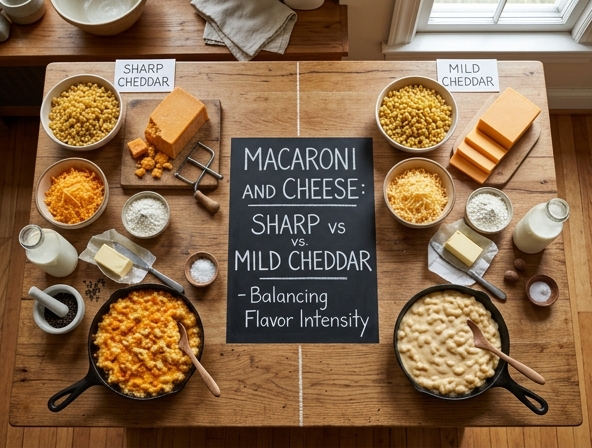
Sharp Cheddar vs Mild Cheddar for Macaroni and Cheese - Balancing Flavor Intensity
Achieving the perfect balance in macaroni and cheese is a common challenge for culinary enthusiasts. While mild, processed cheeses offer consistent meltability, they frequently lack the sophisticated profile desired in premium applications. Selecting the appropriate cheddar intensity is essential to elevating your dish. Note that aged, sharp varieties require careful handling to maintain texture. We recommend pairing sharp cheddar with Gruyère for superior depth. The following sections examine strategies for balancing flavor intensity and structural integrity.
| Cheddar Type | Key Characteristics | Culinary Considerations |
|---|---|---|
| Mild Cheddar | Consistent and reliable meltability. | Often lacks the complex, sophisticated flavor profile desired in premium dishes. |
| Sharp (Aged) Cheddar | Rich, intense, and sophisticated flavor. | Requires careful handling to prevent texture issues during the melting process. |
| Expert Recommendation | Combine Sharp Cheddar with Gruyère to achieve the perfect balance of deep flavor and structural integrity. | |
Sharp Cheddar vs. Mild Cheddar: Mastering the Macaroni and Cheese Balance
Macaroni and cheese is more than just a dish; it is a culinary institution. While the basic components-pasta and a cheese-based béchamel-seem deceptively simple, the secret to the perfect mac and cheese lies in the complexity of the cheese selection. Among the many options available, cheddar reigns supreme. Yet, home cooks and professional chefs alike are constantly faced with a pivotal choice: Should you go with a smooth, approachable mild cheddar, or a bold, punchy sharp cheddar?
The answer is rarely black and white. It is a nuanced dance between flavor intensity, melting capability, and personal preference. To elevate your macaroni and cheese from "good" to "unforgettable," it is essential to understand the science of cheddar aging and how it impacts your final plate.
The Science of the Cheddar Aging Process
To understand why a mild cheddar behaves differently than a sharp one, we must look at how cheddar is made. All cheddar begins the same way: milk is cultured, curdled, and pressed into blocks. The difference in intensity is dictated by time. A "mild" cheddar is typically aged for two to three months, while a "sharp" or "extra sharp" cheddar can spend anywhere from one to five years in climate-controlled aging rooms.
As cheddar ages, two critical transformations occur:
- Flavor Complexity: The bacteria and enzymes in the cheese break down proteins and fats into amino acids and flavor compounds. The longer this happens, the more concentrated and intense the flavor becomes, shifting from milky and sweet to nutty, tangy, and sometimes crystalline.
- Moisture Loss: Aging involves the evaporation of moisture. Sharp cheddars are significantly drier and more brittle than their mild counterparts. This moisture content is the primary factor in how the cheese behaves when it meets a hot roux.
The Case for Mild Cheddar: The Creamy Foundation
If your goal is a mac and cheese that is silky, gooey, and reminiscent of a childhood favorite, mild cheddar is your best friend. Because mild cheddar retains more moisture and fat, it emulsifies more easily into a sauce.
Pros of Mild Cheddar:
- Superior Melting: The high moisture content allows it to liquefy smoothly without separating. You are less likely to encounter the dreaded "oil slick" on top of your sauce.
- Versatility: Its neutral flavor profile makes it a blank canvas. It allows you to experiment with mix-ins like smoky bacon, caramelized onions, or spicy jalapeños without the cheese fighting for center stage.
- Kid-Friendly: Its gentle, sweet notes are widely appealing, making it the safest bet for large family gatherings.
The Case for Sharp Cheddar: The Bold Protagonist
For the cheese aficionado, mild cheddar can feel a bit one-dimensional. This is where sharp cheddar steps in. A well-aged cheddar brings a level of sophistication and "zing" that keeps the palate engaged. It cuts through the heaviness of the pasta and the butter-rich sauce, providing a refreshing contrast.
Pros of Sharp Cheddar:
- Depth of Flavor: A truly sharp cheddar provides a savory complexity that defines the identity of the dish. It transforms a simple meal into a gourmet experience.
- Structural Integrity: If you are baking your mac and cheese for a crusty, golden top, a sharper cheddar holds up better to the heat of the oven without losing all of its character.
However, sharp cheddar comes with challenges. Because of its lower moisture content and higher protein density, it can be stubborn. If heated too quickly or at too high a temperature, the proteins can tighten and squeeze out the fat, resulting in a grainy, oily sauce that separates.
The "Hybrid Strategy": The Sweet Spot
The most successful mac and cheese recipes rarely rely on a single type of cheddar. The gold standard is a blend. By combining sharp and mild cheddars, you gain the "best of both worlds."
A classic 50/50 blend gives you the structural stability and creamy melt of the mild, alongside the intense, savory bite of the sharp. When building your sauce, whisk in the mild cheddar first to establish the emulsion, then fold in the sharp cheddar at the end to deepen the flavor profile.
Pro-Tip: To take this even further, consider a "1/3 rule." Use 1/3 mild cheddar for the sauce base, 1/3 sharp cheddar for flavor, and 1/3 of a high-melting, nutty cheese like Gruyère or Fontina. These additions introduce a level of "stretch" and complexity that cheddar alone simply cannot provide.
Crucial Technical Advice for Success
Regardless of which cheddar you choose, there are two golden rules that every home cook must follow:
1. Grate Your Own Cheese
Never, ever buy pre-shredded bagged cheese. Manufacturers coat shredded cheese in potato starch or cellulose to prevent clumping in the bag. These anti-caking agents prevent the cheese from melting properly, resulting in a gritty, powdery sauce rather than a smooth, velvety one.
2. Mind the Temperature
Never add your cheese to a boiling sauce. Remove your béchamel from the heat entirely before stirring in your cheese. Residual heat is more than enough to melt it. If you continue to boil your sauce once the cheese is added, you will almost certainly break the emulsion, leaving you with an oily, unappealing mess.
Conclusion: Trust Your Palate
Ultimately, the battle between sharp and mild cheddar is a matter of intent. Are you making a comforting weeknight dinner that needs to satisfy a crowd? Lean toward the mild side. Are you preparing an elegant side dish for a dinner party, perhaps paired with a glass of crisp white wine or a malty ale? Go with the sharp. Or, better yet, find your personal signature ratio.
Cooking is a journey of iteration. The next time you find yourself standing in the dairy aisle, remember: the cheese is the soul of the dish. Choose wisely, grate your own blocks, and don't be afraid to mix things up. Your perfect bowl of macaroni and cheese is waiting to be discovered.
Disclaimer:
The information provided on Eateryn is for general educational and informational purposes only and is not intended as medical, nutritional, or healthcare advice. It should not be used to diagnose, treat, cure, or prevent any disease or medical condition.
Always consult a qualified physician, registered dietitian, or other certified healthcare professional before making changes to your diet, exercise routine, or lifestyle, or regarding any medical questions or concerns you may have. Never disregard or delay seeking professional medical advice because of something you have read on this website.