
Shallow Fry vs Deep Fry for Fried Chicken - Finding The Right Fat Ratio
Fried Chicken: The Fat Ratio Dilemma
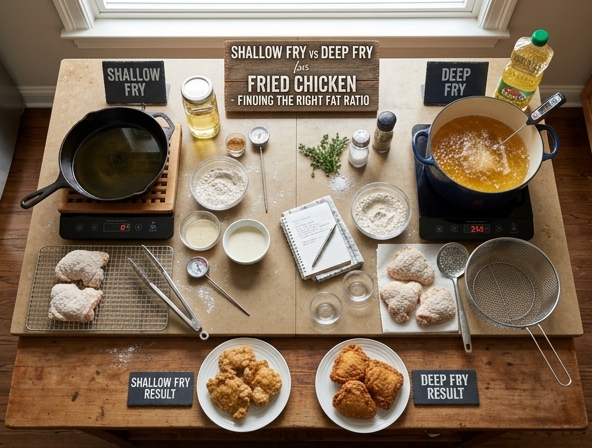
Achieving the perfect crunch-to-moisture ratio is a common culinary hurdle. While home cooks often rely on traditional shallow-frying, commercial kitchens typically default to standardized deep-fry methods. Mastering the precise fat-to-surface-area ratio unlocks superior textures regardless of depth. Please note: oil temperature control remains paramount for consistent quality. Experts like Thomas Keller demonstrate that rigorous technique elevates standard results. Below, we evaluate thermodynamic differences between these methods to determine the optimal approach for your specific kitchen.
| Category | Details |
|---|---|
| Core Goal | Achieving the ideal crunch-to-moisture ratio in fried chicken. |
| Shallow Frying | Commonly used in home kitchens; relies on managing the fat-to-surface-area ratio. |
| Deep Frying | Standardized method preferred by commercial kitchens for consistency. |
| Critical Factor | Oil temperature control is mandatory for quality, regardless of the method chosen. |
| Expert Insight | Rigorous technique and thermodynamic management are the keys to elevating results, as demonstrated by chefs like Thomas Keller. |
Shallow Fry vs. Deep Fry for Fried Chicken: Finding The Right Fat Ratio
Fried chicken is more than just a dish; it is a culinary institution. Achieving that perfect harmony-the shattering, golden-brown crust yielding to succulent, juicy meat-is the holy grail for home cooks and professional chefs alike. Central to this pursuit is the method of frying and, perhaps more importantly, the ratio of fat to chicken. Whether you opt for the total immersion of deep frying or the controlled, contact-driven nature of shallow frying, the chemistry of heat and fat remains the same. Understanding these dynamics is the key to elevating your fried chicken from merely edible to truly transformative.
The Science of Frying: Heat Transfer and Texture
At its core, frying is an exercise in heat transfer. When you submerge chicken in hot oil, you are creating an environment where water content inside the meat turns to steam, pushing outward, while the oil creates a barrier that prevents moisture from escaping entirely. This interaction creates the Maillard reaction-the browning process that imparts deep, complex flavors and the coveted crispy texture.
The difference between deep frying and shallow frying lies in how uniformly that heat is applied. Deep frying relies on convection and total immersion, while shallow frying relies on conduction via the bottom of the pan and ambient heat from the surrounding oil.
Deep Frying: The Immersion Standard
Deep frying is the industry standard for a reason. By completely submerging the chicken in oil, you ensure that heat is applied to every square millimeter of the surface area simultaneously. This leads to a uniform, symmetrical crust that is rarely achievable through other methods.
The Ideal Deep-Fry Fat Ratio
For deep frying, the "Fat-to-Chicken Ratio" is less about precise measurement and more about displacement and temperature stability. If you crowd your fryer, the temperature of the oil will plummet upon adding the cold chicken. This forces the crust to soak up the fat rather than crisping, resulting in a greasy, soggy final product.
- Recommended Ratio: Aim for at least a 4:1 ratio of oil volume to the volume of the chicken pieces being cooked at one time.
- Why: The large volume of oil acts as a thermal battery. It maintains the steady 350°F (175°C) to 375°F (190°C) required to seal the crust before the oil can penetrate the breading.
Shallow Frying: The Art of the Pan
Shallow frying (often referred to as pan-frying) is often misunderstood as a "healthier" or "easier" version of frying, but it is actually a more technical skill. Because the chicken is not fully submerged, you are essentially cooking one side at a time through conduction. This requires a watchful eye and precise heat management.
The Ideal Shallow-Fry Fat Ratio
In shallow frying, you aren't trying to maintain a heat battery; you are trying to create a medium for even contact. The goal is to submerge the chicken about halfway to two-thirds of the way up the sides of the piece.
- Recommended Ratio: A depth of 0.5 to 1 inch of oil in a heavy-bottomed cast iron skillet is ideal.
- The "Flip" Factor: Because you are using less fat, the surface temperature of the pan itself plays a massive role. You must ensure the oil is hot enough to crisp the bottom side before turning, but not so hot that the bottom burns before the internal meat reaches 165°F (74°C).
Choosing Your Fat: Beyond Neutral Oil
The fat you choose is just as important as the ratio. For deep frying, a neutral, high-smoke-point oil is necessary to avoid off-flavors. Refined peanut oil, grapeseed oil, or high-oleic sunflower oil are excellent choices. They provide a clean slate that allows the spices in your breading to shine.
However, when shallow frying, many chefs prefer to incorporate animal fats like rendered lard or bacon fat. Because you are using less oil, the flavor profile of the fat has a significant impact on the crust. A 75/25 blend of vegetable oil and rendered lard provides the perfect marriage of a high smoke point and deep, savory richness that professional kitchens often utilize for "country-style" fried chicken.
Common Pitfalls and How to Fix Them
Regardless of your method, the most common error is the "Cold Pan" effect. If you drop the chicken into oil that hasn't reached the target temperature, the breading becomes a sponge.
1. Monitor Oil Recovery Time
If you are deep frying, never add more than two or three pieces of chicken at once. Wait for the oil to bubble aggressively again before adding the next batch. If the bubbles subside and don't return quickly, you've overloaded the ratio.
2. The Breading/Oil Barrier
Your breading-whether flour-based or batter-based-acts as an insulator. If your ratio of fat is too low in a shallow fry, the bottom side will crisp while the sides remain raw. To compensate, use a high-sided cast iron skillet. The sides of the pan help trap heat, creating a mini-oven effect that helps cook the top of the chicken while it fries in the shallow oil.
The Verdict: Which Method Wins?
If you are looking for the "restaurant experience"-that glass-like crunch and uniform, pale-gold color-deep frying is the superior method. It provides a level of consistency that is difficult to replicate, provided you have enough oil to maintain temperature stability.
However, if you appreciate the rustic, deeply caramelized flavor that comes from direct contact with the pan-and you don't want to deal with a gallon of leftover oil-shallow frying is a masterclass in culinary control. By using a heavy cast-iron skillet and keeping your oil level at exactly half the height of your chicken, you create a crust that is arguably more flavorful and textured than the standard deep-fried variety.
Finding the right fat ratio is ultimately about respecting the thermodynamics of your vessel. Whether deep or shallow, prioritize heat management and adequate volume, and you will find the path to the perfect fried chicken.
Disclaimer:
The information provided on Eateryn is for general educational and informational purposes only and is not intended as medical, nutritional, or healthcare advice. It should not be used to diagnose, treat, cure, or prevent any disease or medical condition.
Always consult a qualified physician, registered dietitian, or other certified healthcare professional before making changes to your diet, exercise routine, or lifestyle, or regarding any medical questions or concerns you may have. Never disregard or delay seeking professional medical advice because of something you have read on this website.