
Sausage vs Frank for Hot Dog - Defining Meat Specifications
Selecting the ideal protein for hot dog production often confuses developers balancing texture and flavor profiles. While standard industry sourcing benchmarks focus primarily on casing diameter, we provide granular meat specifications to sharpen your product differentiation. Note that classification hinges on emulsification processes rather than diameter alone; for example, a finely processed frankfurter behaves differently than a coarse-ground sausage. We will analyze the essential meat-to-fat ratios and technical requirements necessary to elevate your specific menu offerings.
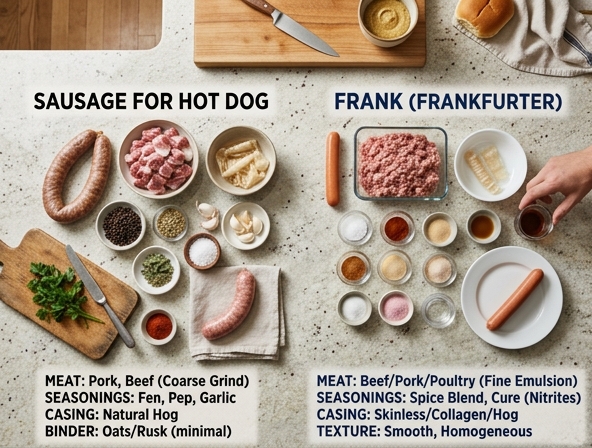
| Category | Details |
|---|---|
| Objective | Improving product differentiation by balancing flavor and texture profiles. |
| Classification Basis | Defined by the emulsification process rather than casing diameter. |
| Processing Styles | Frankfurter: Finely processed; Sausage: Coarse-ground. |
| Technical Focus | Optimization of meat-to-fat ratios and specific product benchmarks. |
Sausage vs. Frank: Defining the Meat Specifications of an Icon
In the world of charcuterie and commercial meat processing, the humble hot dog occupies a space that is as culturally significant as it is technically complex. While the average consumer may use the terms "sausage" and "frankfurter" (or "frank") interchangeably, those in the culinary and meat science industries understand that these terms represent distinct categories governed by specific chemical compositions, processing methods, and meat specifications. Understanding these nuances is essential for both the discerning chef and the food manufacturer.
The Umbrella Term: What is a Sausage?
At its broadest definition, a sausage is a food made from ground, minced, or emulsified meat-typically pork, beef, or poultry-combined with salt, spices, and other flavorings, and often packed into a casing. The sausage category is vast, spanning from the coarse-ground, rustic salamis of Italy to the snappy, emulsified links of the American ballpark. Because "sausage" is a catch-all term, its meat specifications vary wildly. A sausage might be cured, smoked, fermented, or fresh, and it may contain anything from high-quality cuts to organ meats and fat trim.
The Frankfurter: The Art of Emulsification
The frankfurter, a specific type of sausage, is fundamentally different due to its production process: emulsification. Unlike many sausages that rely on the texture of coarse ground meat, a frankfurter is a meat batter. The meat is ground to such a fine consistency that the protein, fat, and water form a stable, homogeneous matrix.
To achieve this, the meat must meet stringent specifications:
- Protein Quality: The raw materials must have high salt-soluble protein content to act as an effective binder for the fat.
- Fat-to-Lean Ratio: A frankfurter typically requires a strict 20% to 30% fat content. Fat is not merely for flavor here; it provides the mouthfeel and "snap" associated with a high-quality frank.
- Temperature Control: During the bowl-chopping phase, the temperature must be kept near freezing to prevent the emulsion from "breaking," which would result in a greasy, crumbly product.
Defining Meat Specifications: The Industrial Standard
When defining the specifications for a frankfurter, manufacturers focus heavily on the "Meat Block." The meat block is the total formulation of protein sources. For a high-end frank, producers prioritize lean beef (often bull meat or cow meat) and high-quality pork trimmings. The goal is to balance the specific protein functionality (to hold water and fat) with the desired sensory profile.
In contrast, a general "sausage" (such as a bratwurst or Italian sausage) does not require this level of fine-emulsion stability. Instead, these products prioritize texture. The meat specifications for these sausages allow for larger particle sizes-often through a plate-grinder rather than a vacuum-sealed bowl chopper-allowing the consumer to identify the specific cuts of meat within the link.
The Chemistry of the Snap
The "snap" is the defining characteristic of a premium frankfurter. This is achieved through a combination of processing techniques and casing selection. Natural sheep casings are the gold standard for frankfurters, as they contract and expand with the meat batter, providing a satisfying resistance when bitten.
From a specification standpoint, achieving this snap requires precise protein extraction. By using a vacuum-chopping process, manufacturers can remove air bubbles from the emulsion, ensuring a dense, uniform structure. When the frank is heated, the casing and the firm, emulsified protein matrix provide that classic "pop." If the meat specifications are skewed-for instance, if too much filler or cereal binder is added-the protein matrix becomes soft, and the snap is lost, regardless of the quality of the casing.
Curing and Preservation
Another major differentiator in meat specifications is the role of curing agents. Frankfurters almost universally rely on nitrites (or celery juice powder in "uncured" varieties) to achieve the iconic pink color and the distinct, tangy flavor profile associated with cured meats. Nitrites also serve a functional role in stabilizing the fat and preventing oxidation during the long smoking process typical of frankfurter production. Many rustic sausages, by contrast, are fresh, containing no nitrates, and are intended for immediate cooking and consumption, requiring an entirely different set of shelf-life management and storage specifications.
Selecting the Right Product
When drafting a specification for production, the distinction is clear: if you are creating a frankfurter, you are essentially engineering a colloid. Every ingredient-from the phosphate levels used to increase water-binding capacity to the specific grind of the fat-is calculated to ensure stability and uniform texture. If you are creating a general sausage, you are curating a profile of textures and spices where the individual pieces of meat are intended to stand out.
For the modern consumer, this distinction often manifests as a price difference. True frankfurters, with their finely tuned protein-to-fat ratio and high-quality emulsion, require more energy, equipment, and precision to produce than a standard coarse-ground sausage.
Conclusion: The Future of the Link
As the meat industry shifts toward cleaner labels and alternative proteins, the technical specifications for sausages and frankfurters are evolving. However, the fundamental physics of the meat matrix remain constant. Whether it is a traditional frankfurter or a coarse-ground specialty sausage, defining the meat specs is the first step in quality assurance. By understanding the functional role of proteins and fats, producers can continue to innovate while maintaining the beloved characteristics that have made these products culinary staples for centuries.
Disclaimer:
The information provided on Eateryn is for general educational and informational purposes only and is not intended as medical, nutritional, or healthcare advice. It should not be used to diagnose, treat, cure, or prevent any disease or medical condition.
Always consult a qualified physician, registered dietitian, or other certified healthcare professional before making changes to your diet, exercise routine, or lifestyle, or regarding any medical questions or concerns you may have. Never disregard or delay seeking professional medical advice because of something you have read on this website.