
Roux vs Evaporated Milk for Macaroni and Cheese - The Best Thickening Technique
Achieving a silky, stable cheese sauce often proves frustrating when emulsions break or flour turns gritty. While a traditional roux remains the standard foundation for thickening, evaporated milk offers a superior, foolproof alternative that creates a velvety, homogenous texture. While a roux requires precise heat management to avoid raw starch flavor, evaporated milk provides immediate stability. Modernist kitchens favor the latter for its consistency. Below, we compare these techniques to optimize your next mac and cheese.
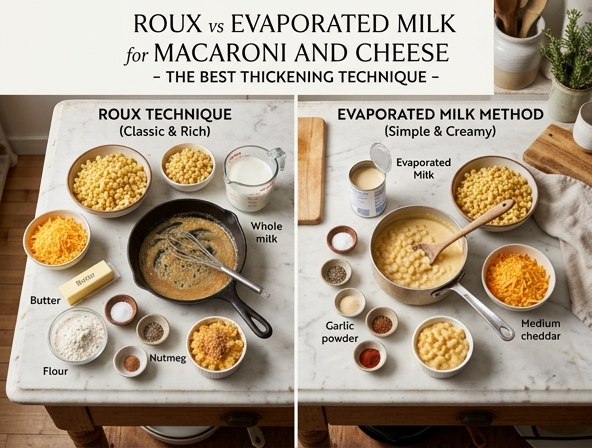
| Technique | Pros | Cons |
|---|---|---|
| Traditional Roux | Standard foundation for classic sauces. | Requires precise heat control; prone to grittiness and raw starch flavor. |
| Evaporated Milk | Foolproof; creates a velvety, homogenous, and stable texture. | Modernist technique; lacks the traditional culinary foundation. |
Roux vs. Evaporated Milk: The Battle for the Perfect Macaroni and Cheese
For the home cook, few culinary quests are as deeply personal as the pursuit of the ultimate macaroni and cheese. It is a dish that sits at the intersection of comfort and science, demanding a balance between flavor, mouthfeel, and structural integrity. At the heart of this challenge is the sauce-specifically, the thickening agent. For generations, the debate has centered on two primary contenders: the classic roux-based béchamel and the modern, streamlined evaporated milk method. Both claim to produce a velvety, clingy cheese sauce, but they arrive there through very different chemical pathways.
The Classic: The Roux-Based Mornay
The traditional approach to macaroni and cheese is rooted in French culinary technique. It begins with a roux-a precise mixture of fat (usually butter) and starch (all-purpose flour). When cooked together, the flour particles swell, and the fat provides a barrier that prevents them from clumping. Once the roux is golden, milk or cream is whisked in to create a béchamel, which is then transformed into a Mornay sauce by the addition of grated cheese.
The Pros of the Roux
The primary advantage of the roux is stability. Flour provides a robust structure, meaning the sauce can hold up to heavy add-ins like breadcrumbs, meats, or vegetables. Furthermore, the act of cooking the roux creates a subtle, nutty undertone that adds depth to the base of the sauce, providing a foundation that highlights the character of the cheese rather than just functioning as a vehicle for it.
The Cons of the Roux
However, the roux method is unforgiving. If the flour is not cooked long enough, the sauce will have a distinct, dusty "raw flour" aftertaste. If the cheese is added while the heat is too high, the proteins can seize, resulting in a grainy, stringy, or broken texture. It requires constant attention, precise temperature control, and a steady hand. For many, the thickness of a roux-based sauce can also lean toward the "pasty" side, especially as the dish begins to cool.
The Modernist: The Evaporated Milk Method
In recent years, influenced by food scientists like J. Kenji López-Alt, a new contender has risen: the evaporated milk technique. Evaporated milk is essentially cow's milk that has had 60% of its water content removed through heat. This process concentrates the milk proteins and creates a naturally thicker, more shelf-stable product.
The Science of the Shortcut
When you combine evaporated milk with cheese, the result is nothing short of magic. Because the proteins in evaporated milk have already been modified by the canning and heating process, they act as an emulsifier. They hold the cheese fat and water together in a stable suspension without the need for flour. This creates a sauce that is inherently thinner and more "satin-like" than a roux-based sauce, wrapping around the macaroni in a thin, perfectly glossy layer.
The Pros of Evaporated Milk
The biggest benefit here is simplicity. There is no risk of a "flour taste," and the sauce is significantly harder to break. It produces a texture that mimics the smooth melt of processed cheese without sacrificing the flavor of high-quality cheddar or gruyère. It is the ideal method for weeknight dinners where speed and consistency are the priorities.
The Cons of Evaporated Milk
The potential downside lies in the flavor profile. Evaporated milk carries a distinct, slightly "cooked" or metallic taste due to the canning process. While most of this fades when mixed with sharp cheese and spices, some palates find it a bit sterile compared to the richness provided by fresh heavy cream or a butter-laden roux.
The Showdown: Flavor, Texture, and Stability
When comparing the two, we have to look at the intended purpose of the dish. If you are building a baked, casserole-style mac and cheese that needs to stand up to the oven heat and potentially sit on a buffet table, the roux is superior. The starch provides the necessary structural support to keep the sauce from weeping or splitting over time.
Conversely, if you are looking for a stovetop macaroni and cheese-a dish designed to be eaten hot, immediately, and with maximum creaminess-the evaporated milk method is the undisputed champion. It delivers a cleaner flavor profile that allows the nuances of your cheese selection (the sharpness of an aged cheddar, the nuttiness of an emmental) to shine through without being masked by the density of a roux.
The Verdict: Which Should You Use?
Ultimately, "best" is a matter of context. For the home cook looking for a foolproof, restaurant-quality stovetop mac, the evaporated milk method is a game-changer. It eliminates the anxiety of tempering cheese and the risk of graininess. However, the roux-based Mornay remains the gold standard for formal, baked dishes where texture and "stick-to-your-ribs" density are required.
Pro-tip: You don't have to choose just one. Many professional chefs now use a hybrid approach. They may use a very small amount of roux to give the sauce a bit of "heft" while relying on evaporated milk to ensure the emulsification remains silky. By combining the stability of the starch with the protein-rich emulsifying power of evaporated milk, you create a sauce that is both indestructible and decadent-the best of both worlds.
Regardless of the method you choose, remember that the most important ingredient will always be the cheese itself. High-quality, freshly grated cheese will always outperform pre-shredded varieties, which are coated in potato starch to prevent clumping. Whether you go the classic route or the modernist path, start with great cheese, monitor your heat, and enjoy the process of perfecting your masterpiece.
Disclaimer:
The information provided on Eateryn is for general educational and informational purposes only and is not intended as medical, nutritional, or healthcare advice. It should not be used to diagnose, treat, cure, or prevent any disease or medical condition.
Always consult a qualified physician, registered dietitian, or other certified healthcare professional before making changes to your diet, exercise routine, or lifestyle, or regarding any medical questions or concerns you may have. Never disregard or delay seeking professional medical advice because of something you have read on this website.