
Rested vs Fresh Off The Grill for Barbecue Ribs - Optimizing Flavor Absorption
Achieving the perfect rib texture often feels elusive, as high-heat grilling frequently leaves meat dry and seasoning superficial. While standard grilling focuses solely on smoke exposure, true excellence lies beyond the fire. Resting your ribs grants critical moisture redistribution and flavor deepening. Note: Resting requires precise thermal control to maintain food safety. Much like the balanced profile of competition-grade brisket, resting ensures consistency. This article explores how strategic resting protocols optimize flavor absorption and succulent tenderness.
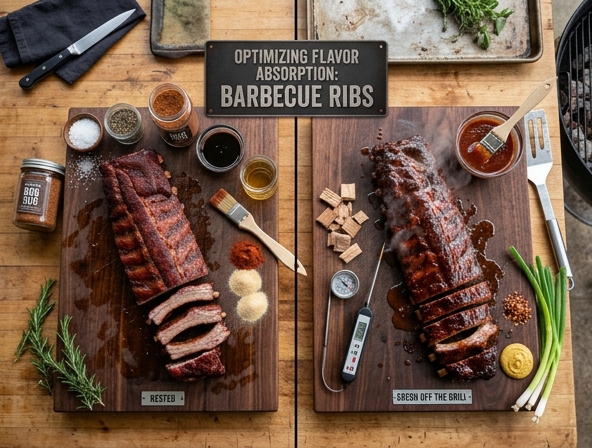
| Category | Details |
|---|---|
| Core Subject | Optimizing barbecue rib quality through resting techniques. |
| The Problem | High-heat grilling often results in dry meat and seasoning that lacks depth. |
| The Solution | Implementing strategic resting protocols post-grilling to allow for flavor absorption. |
| Key Benefits | Improved moisture redistribution, deepened flavor profile, and succulent texture. |
| Important Caveat | Must maintain precise thermal control throughout the resting period to ensure food safety. |
Rested vs. Fresh Off The Grill: Optimizing Flavor Absorption in Barbecue Ribs
For many backyard pitmasters and seasoned professionals alike, the siren call of a rack of ribs fresh off the smoker is almost impossible to ignore. The air is thick with the scent of hickory, maple, or post oak, the bark is glistening with a sticky, caramelized glaze, and the heat radiating from the bones suggests a perfect, tender bite. Yet, there is a fundamental debate in the world of low-and-slow barbecue: is it better to serve them immediately, or should you let them rest?
While the urge to dig in while the meat is piping hot is strong, understanding the science of muscle structure, moisture redistribution, and flavor absorption reveals why the "rest" is not merely an optional step, but a critical component of the perfect barbecue experience.
The Science of Muscle Contraction and Moisture Loss
To understand why resting matters, we must first look at what happens inside the rib meat while it is under high heat. As the temperature of the meat rises, the muscle fibers begin to contract. As these proteins tighten, they act like a wrung-out sponge, pushing liquid toward the center of the muscle or, if the pressure is great enough, out of the meat entirely.
When you pull a rack of ribs from the smoker, the internal temperature is at its peak. The juices are physically agitated, moving turbulently throughout the matrix of muscle, fat, and connective tissue. If you slice into the ribs the moment they leave the smoker, you are effectively creating a release valve. The pressure built up by the heat causes those precious, flavorful juices to run out onto the cutting board rather than staying within the meat. By allowing the ribs to rest-ideally for 30 to 60 minutes-the temperature drops slightly, the muscle fibers relax, and the juices redistribute themselves, reabsorbing into the fibers to create a moist, succulent bite.
The Role of Fat and Collagen
Ribs-whether baby back or St. Louis style-are not just muscle; they are a complex network of fat and collagen. Unlike a lean steak, which relies on muscle juice for tenderness, ribs rely on the breakdown of collagen into gelatin. This process occurs during the long hours of the smoke.
Resting allows this gelatin to "set." Think of it as a cooling period for a gelatinous matrix. When ribs are aggressively hot, that fat and rendered collagen are in a highly liquid state. Allowing them to rest lets that texture stabilize. It results in a "cleaner" bite where the meat pulls away from the bone with that signature tug, rather than disintegrating into a mushy, over-cooked mess. This stabilization is what distinguishes competition-grade ribs from the "fall-off-the-bone" style that often masks a lack of texture.
Optimizing Flavor Absorption: More Than Just Surface Level
The prompt of flavor absorption is particularly interesting because it touches on the interaction between the rub, the smoke, and the meat. Many assume that flavor absorption stops the moment the meat leaves the heat, but the resting period is actually a vital "marination" phase for the surface components.
When you apply a barbecue rub and glaze, you are creating a complex crust. During the rest, the residual heat and moisture continue to work together. The salts and sugars in your rub have a chance to undergo a final, subtle interaction with the surface proteins. As the meat cools slightly, the glaze-often composed of sugars that have caramelized-thickens and adheres more firmly to the bark. This prevents the "slippery" sensation often found in ribs served too hot, where the sauce slides off the meat and onto your fingers.
Furthermore, the resting period allows the smoke profile to settle. Just as a fine whiskey or a complex wine benefits from "breathing," the volatile aromatic compounds absorbed from the wood smoke reach a state of equilibrium during the rest. The sharp edges of the smoke mellow out, allowing the sweeter, deeper notes of the bark to take center stage.
The Technique: The FTC Method
The gold standard for resting ribs is the "FTC" method: Foil, Towel, Cooler. It is a simple yet effective way to manage the environment for your ribs.
- Foil: Wrap the ribs in high-quality aluminum foil or butcher paper. This prevents excessive evaporation while keeping the bark from becoming too soggy.
- Towel: Wrap the foil-wrapped ribs in a clean, dry kitchen towel. This provides an extra layer of insulation.
- Cooler: Place the bundled ribs into an empty, clean cooler. The cooler acts as an insulated vessel that keeps the temperature consistent, allowing for a long, slow drop in temperature rather than a rapid loss of heat.
This method ensures your ribs stay above the food-safe temperature zone for hours, providing ample time for the juices to settle and the flavors to lock in. It also offers the pitmaster a significant advantage: flexibility. If your guests are delayed or you are struggling with your side dishes, the FTC method provides a buffer that ensures your main event remains perfectly primed.
When is "Fresh" Appropriate?
Is there ever a time when "fresh off the grill" is better? Perhaps. In casual settings, such as a quick backyard appetizer where you are serving individual rib tips or smaller, thinner cuts that do not possess the heavy collagen density of a full rack, the immediate heat can provide a sensory experience that is part of the appeal. However, for a full rack of ribs, the structural and flavor benefits of a rest far outweigh the initial thrill of the heat.
Conclusion
The transition from a "hot" rib to a "rested" rib is the transition from a piece of meat to a culinary masterpiece. By choosing to wait, you aren't just delaying gratification; you are actively enhancing the moisture, refining the texture, and allowing the complex marriage of smoke, spice, and fat to harmonize. The next time you find yourself staring at a rack of ribs, smoke curling from the bones, practice the art of patience. Your palate-and your guests-will thank you for the extra hour of wait time.
Disclaimer:
The information provided on Eateryn is for general educational and informational purposes only and is not intended as medical, nutritional, or healthcare advice. It should not be used to diagnose, treat, cure, or prevent any disease or medical condition.
Always consult a qualified physician, registered dietitian, or other certified healthcare professional before making changes to your diet, exercise routine, or lifestyle, or regarding any medical questions or concerns you may have. Never disregard or delay seeking professional medical advice because of something you have read on this website.