
Raw Vs. Caramelized Onion For Burger - Flavor Profile Difference
Optimizing Flavor Profiles: Onion Selection in Burger Craft
Achieving a balanced burger remains a consistent challenge for culinary enthusiasts. While standard toppings often fail to elevate premium proteins, strategic onion preparation serves as a vital differentiator. Note that the specific application of heat fundamentally alters the chemical composition of the vegetable. For instance, crisp red onion provides essential acidic crunch, whereas slow-simmered yellow onions offer a deep, umami-rich sweetness. The following analysis explores how these distinct profiles fundamentally redefine your burger's structural flavor harmony.
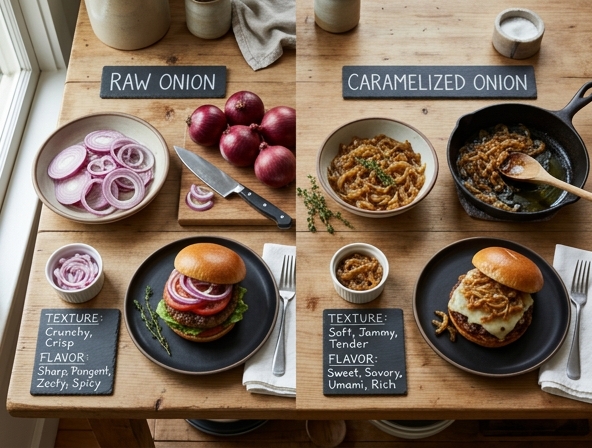
| Onion Type | Preparation Method | Flavor Profile | Culinary Effect |
|---|---|---|---|
| Raw (e.g., Red) | Minimal/None | Crisp, Acidic | Provides essential crunch and acidity for contrast. |
| Caramelized (e.g., Yellow) | Slow-simmered | Deep, Umami-rich, Sweet | Adds depth and structural flavor harmony. |
The Great Burger Debate: Raw vs. Caramelized Onions
The burger is perhaps the most iconic canvas in the culinary world. It is a masterpiece of balance: the richness of fatty beef, the salinity of cheese, the structural integrity of the bun, and the acidity of condiments. But among the toppings, one humble bulb stands above the rest as the ultimate flavor arbiter: the onion. Whether you prefer the sharp, stinging bite of a raw slice or the deep, mellow sweetness of a slow-cooked jam, the onion you choose defines the character of your burger. Understanding the flavor profile difference between raw and caramelized onions is not just a matter of preference-it is a lesson in culinary science.
The Raw Onion: The Sharp Counterpoint
When you bite into a burger topped with raw onion, you are experiencing the vegetable in its most aggressive form. The raw onion provides a distinct "bite" that cuts through the intense fat of a beef patty. This is largely due to the presence of sulfur compounds, specifically syn-propanethial-S-oxide, which is released when the onion cells are ruptured by your knife.
The Flavor Profile: Raw onions are characterized by a pungent, sharp, and slightly sulfuric kick. This intensity is vital for a "diner-style" burger. When paired with a greasy, smashed patty, the raw onion acts as a palate cleanser. Every mouthful of fat is immediately tempered by the crunch and acidity of the onion, preventing palate fatigue and ensuring that the last bite of the burger is as satisfying as the first.
Texture and Utility: The structural role of a raw onion is just as important as its flavor. A thinly sliced red onion provides a crisp, refreshing snap that contrasts beautifully with the soft, pillowy texture of a toasted brioche bun. If you are serving a burger with cold toppings like shredded iceberg lettuce and tomato, raw onion is the natural partner, as it harmonizes with the fresh, clean aesthetic of those ingredients.
The Caramelized Onion: The Umami Depth Charge
Transitioning from raw to caramelized is a journey from aggression to comfort. Caramelization is a patient process that transforms the onion on a molecular level. As you cook onions over low heat for 30 to 60 minutes, the naturally occurring sugars break down and begin to brown-a process known as the Maillard reaction. The result is a total evolution of the onion's soul.
The Flavor Profile: Caramelized onions lose their sulfuric bite entirely. In its place, they develop a profound, jammy sweetness balanced by a complex, savory umami depth. This sweetness doesn't taste like dessert; rather, it mimics the depth of a fine red wine reduction or a rich beef demi-glace. It bridges the gap between the beef and the cheese, creating a seamless, savory cohesion that feels luxurious and decadent.
Texture and Utility: The texture of a perfectly caramelized onion is soft, silk-like, and clinging. Unlike the raw onion, which sits on top of the patty, caramelized onions integrate into the burger, coating the meat in a sweet, savory veneer. They are best suited for "gourmet" burgers-think thick patties, sharp aged cheddars, or even blue cheese. They elevate a burger, turning a standard sandwich into an indulgent dining experience.
The Science of the Transformation
The difference between these two states is essentially a breakdown of enzymes and starches. In a raw onion, the sulfur is at its peak. By applying heat, you are volatilizing these compounds, essentially "cooking off" the harshness. Concurrently, the carbohydrates in the onion are being converted into simpler sugars, which then undergo the Maillard reaction. This is why a caramelized onion feels "heavier" and more satisfying on the tongue; you are essentially eating concentrated sugar and protein-derived compounds.
Which One Should You Choose?
The choice often boils down to the style of burger you are constructing. Here is a quick guide to help you decide:
- The Classic Smash Burger: Go raw. A thin, crispy-edged patty demands the sharp, acidic bite of a white or red onion. It keeps the burger bright and prevents it from feeling too heavy.
- The Steakhouse Burger: Go caramelized. If your burger is thick, juicy, and topped with decadent elements like mushrooms, bacon, or rich cheeses, the sweetness of caramelized onions will match that intensity and provide a sophisticated finish.
- The "In-Between": If you can't decide, consider the "grilled" onion. A quick sear on a hot griddle retains some of the crunch of the raw onion while mellowing the sulfur just enough to take the edge off. It is the perfect middle ground for a pub-style burger.
- The Pickled Shortcut: For those who love the bite of raw onion but want something more dynamic, pickled onions are the secret weapon. They provide that necessary acidity to cut through the fat, but with a vibrant, vinegary pop that raw onion lacks.
Conclusion: The Case for Both
Ultimately, there is no rule stating you must choose one over the other. In fact, many professional burger joints have found success by combining both. A burger topped with a smear of sweet, caramelized onion jam and finished with a scattering of crunchy, raw red onion rings provides a dual-sensory experience that is vastly superior to either on its own. You get the initial hit of sweetness, followed by the refreshing crunch of the raw onion, creating a balance that keeps the diner interested until the very last bite.
Whether you lean toward the clean, sharp punch of the raw slice or the slow-cooked, buttery richness of the caramelized version, respect the onion for what it truly is: the engine of the burger. It is the component that prevents a burger from being merely a pile of meat and cheese, transforming it instead into a balanced, complex, and deeply satisfying masterpiece. So, the next time you fire up the grill, don't just throw on an onion as an afterthought-choose your weapon, and let it define your burger.
Disclaimer:
The information provided on Eateryn is for general educational and informational purposes only and is not intended as medical, nutritional, or healthcare advice. It should not be used to diagnose, treat, cure, or prevent any disease or medical condition.
Always consult a qualified physician, registered dietitian, or other certified healthcare professional before making changes to your diet, exercise routine, or lifestyle, or regarding any medical questions or concerns you may have. Never disregard or delay seeking professional medical advice because of something you have read on this website.