
Potatoes vs Crackers for Clam Chowder - Comparing Essential Serving Pairings
Choosing the ideal pairing for clam chowder often presents a challenge for those seeking the perfect textural balance. While traditional sourdough bread bowls are standard, the choice between potatoes and crackers fundamentally alters the dining experience. Understanding this nuance elevates a simple meal into a refined dish. Note that regional preferences vary widely; local traditions often dictate specific conventions. From Boston's iconic oyster crackers to Maine's potato-rich interpretations, we will now analyze these essential pairings.
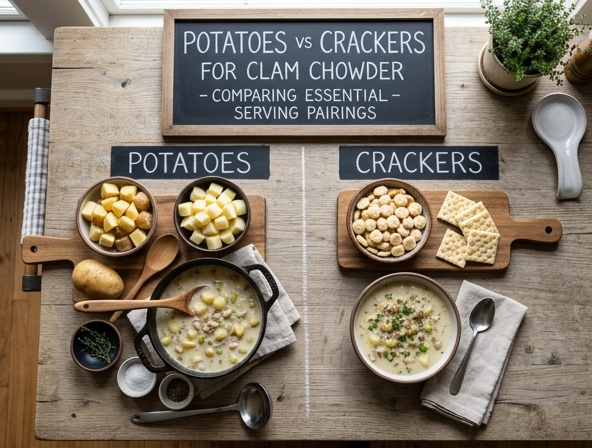
| Category | Summary Details |
|---|---|
| Core Subject | The choice between potatoes and crackers as essential pairings for clam chowder. |
| Objective | Finding the perfect textural balance to elevate the dining experience. |
| Regional Factors | Dining choices are heavily influenced by local traditions, such as Boston's oyster crackers versus Maine's potato-rich styles. |
| Key Takeaway | Selecting a pairing is not just a side dish decision; it fundamentally changes the nature of the meal. |
The Great Chowder Debate: Potatoes vs. Crackers-Comparing Essential Serving Pairings
There are few dishes as emblematic of coastal comfort as clam chowder. Whether you are huddled in a seaside shack in Maine or enjoying a bowl in a bustling city bistro, the experience is almost always defined by the same rich, briny, and creamy notes. Yet, for all the focus on the freshness of the clams, the quality of the cream, and the smokiness of the pork fat, the true soul of the chowder experience often lies in what accompanies the spoon. The eternal, and often heated, debate persists: Is the soul of the chowder found in the humble, starch-heavy potato, or is it perfected by the crisp, salty crunch of the cracker?
The Case for the Potato: The Integrated Foundation
To understand the potato's role in clam chowder, one must first look at the biology of the dish. A traditional New England clam chowder is a study in viscosity. Potatoes are not merely "filler"; they are essential building blocks. When simmered in the chowder base, the potato releases a portion of its natural starch into the cream and clam nectar, acting as a secondary thickener that bridges the gap between the roux and the heavy cream.
Beyond its chemical contribution, the potato provides a structural contrast to the chewy, saline bite of the clam. A well-cooked potato-diced into uniform cubes-should offer a "melt-in-your-mouth" texture. It acts as a neutral vessel, absorbing the essence of the bacon drippings, the onion aromatics, and the briny, oceanic liquor of the clams. For the purist, a chowder without potatoes is not a chowder at all; it is merely a soup. The potato grounds the dish, providing a sense of satiety and earthiness that balances the lightness of the seafood.
The Case for the Cracker: The Structural Accompaniment
If the potato is the foundation, the cracker is the architecture of the experience. The use of crackers in clam chowder is less about chemistry and more about the ritual of texture. Unlike the potato, which exists *within* the bowl, the cracker is an external instrument of interaction.
The oyster cracker-small, pillowy, and dense-is the traditional choice. When dropped into a hot bowl of chowder, the oyster cracker undergoes a fascinating metamorphosis. It begins as a crunchy vehicle for the soup and slowly softens, becoming a saturated, pillowy morsel of salt and dough that disappears into the cream. This "soaking" stage allows the diner to control the density of each bite. If you prefer a soupier bowl, you add a handful. If you prefer a thick, porridge-like consistency, you stir in a dozen until the chowder takes on a heartier, almost stew-like quality.
Saltine crackers, by contrast, offer a different experience. Broken into jagged shards over the top of the bowl, they provide a sharp, brittle crunch that cuts through the velvety richness of the cream. The hit of salinity provided by the crackers also amplifies the sweetness of the clam meat, creating a flavor contrast that potatoes simply cannot achieve.
The Culinary Intersection: Texture and Contrast
Culinary arts are built upon the pillars of texture, temperature, and taste. A successful bowl of chowder relies on the interplay between the "creamy" and the "crisp." The potato satisfies the need for comfort, providing a smooth, soft texture that glides across the palate. However, a bowl comprised entirely of soft elements-clams, potatoes, and cream-can quickly become monotonous. This is where the cracker shines.
The cracker introduces the vital element of "crunch." Research into sensory perception suggests that the sound of a crunch enhances our perception of freshness and flavor intensity. By adding a cracker, you are not just seasoning the dish; you are waking up the palate. The salt content of a high-quality cracker also serves to brighten the heavy cream, acting much like a squeeze of lemon might in a different style of soup. It is the contrast between the hot, heavy, and smooth base and the cool, salty, and sharp crunch of the cracker that makes the spoonful satisfying.
Regional Nuance and the Evolution of the Pairings
The debate is further complicated by regional style variations. In New England, the potato is non-negotiable. The dish is thick, hearty, and designed to sustain a fisherman through a cold day at sea. Here, the potato and the cracker coexist in a symbiotic relationship: the potato provides the bulk, and the cracker provides the intermittent crunch.
However, move south to the Manhattan clam chowder territory, and the potato remains, but the cracker becomes even more critical. Because Manhattan chowder is tomato-based and clear-broth focused, it lacks the velvety coating of cream. The acidity of the tomato demands the balancing act of a salty, starch-heavy cracker to temper the sharpness. Similarly, in the Rhode Island "clear" chowder, where potatoes are often sliced thinner, the cracker becomes the primary thickening agent, allowing the diner to manipulate the consistency of the broth at their own whim.
The Verdict: A False Dichotomy
Ultimately, labeling this a battle between potatoes and crackers is a false dichotomy. To choose one over the other is to ignore the specific roles they play in the culinary experience. The potato is the "internal architecture"-the steady, reliable base that makes the chowder a cohesive meal. The cracker is the "external ritual"-the customizable element that allows the diner to engage with the dish, adjusting texture and salt levels to their own personal preference.
The most sophisticated chowder enthusiasts understand that a perfect bowl requires both. Without the potato, the chowder lacks history and body. Without the cracker, the chowder lacks the sharp, rhythmic crunch necessary to elevate the creamy richness. Whether you prefer your oyster crackers to soak until they are soft or your saltines to stay splintered and sharp, the true magic of clam chowder lies in this duality. It is a dish that invites you to participate in its completion, one spoonful of potatoes and one crunch of a cracker at a time.
So, the next time you find yourself before a steaming bowl of chowder, do not feel compelled to choose sides. Embrace the potato for its earthiness and the cracker for its snap. In the world of coastal comfort food, harmony is not found in exclusion, but in the deliberate balance of these two essential, age-old partners.
Disclaimer:
The information provided on Eateryn is for general educational and informational purposes only and is not intended as medical, nutritional, or healthcare advice. It should not be used to diagnose, treat, cure, or prevent any disease or medical condition.
Always consult a qualified physician, registered dietitian, or other certified healthcare professional before making changes to your diet, exercise routine, or lifestyle, or regarding any medical questions or concerns you may have. Never disregard or delay seeking professional medical advice because of something you have read on this website.