
Pork Ribs vs Beef Ribs for Barbecue Ribs - Comparing Meat Profiles And Cooking Times
Choosing the right rib variety often frustrates pitmasters aiming for perfection. While many follow standard smoking guidelines, failing to account for distinct muscle structures leads to inconsistent results. Mastering these nuances grants you total control over texture and moisture. Stipulation: success requires adjusting technique based on collagen density. Whether navigating the lean demands of St. Louis-style pork or the deep marbling of beef "dino" ribs, this comparison outlines the meat profiles and precise cooking times essential for excellence.
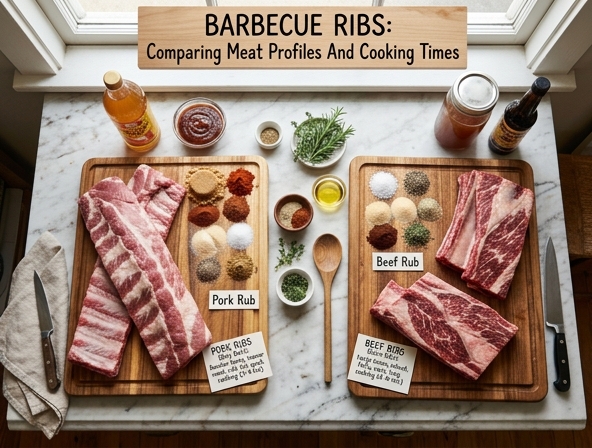
| Rib Type | Meat Profile | Cooking Consideration |
|---|---|---|
| Pork Ribs | Generally leaner; specifically referenced as St. Louis-style. | Requires precise temperature and smoke management to maintain moisture due to lower fat content. |
| Beef Ribs | Deeply marbled with higher collagen density (often called "dino" ribs). | Requires longer cooking times and techniques that break down dense collagen to ensure tenderness. |
| Key Takeaway | Success in barbecue is dependent on adjusting technique to match the specific muscle structure and collagen density of the meat chosen. | |
The Ultimate Smoke-Off: Pork Ribs vs. Beef Ribs
In the world of barbecue, few debates stir as much passion as the choice between pork and beef ribs. Whether you are a backyard hobbyist with a kettle grill or a seasoned pitmaster manning a massive offset smoker, the protein you choose defines the trajectory of your cook. While both offer a delectable, melt-in-your-mouth experience, they are fundamentally different animals-literally and figuratively. Understanding the nuances of fat content, connective tissue, and flavor profiles is the key to mastering both.
The Contender: Pork Ribs
Pork ribs are the traditional backbone of American barbecue. They are approachable, forgiving, and universally loved. When discussing pork ribs, you are generally looking at two main categories:
- Baby Back Ribs: These come from the upper loin section of the hog. They are curved, leaner, and shorter than other ribs. Because of their leanness, they cook relatively quickly and have a very tender texture.
- Spare Ribs (and St. Louis-style): These are cut from the belly of the hog. They are flatter, meatier, and possess significantly more intramuscular fat. St. Louis-style ribs are simply spare ribs with the brisket bone and cartilage trimmed away, creating a uniform, rectangular rack that is perfect for competition-style smoking.
Flavor Profile: Pork has a neutral, slightly sweet base flavor that acts as a blank canvas. It pairs beautifully with a vast range of rubs-from sugar-heavy, spice-rubbed Memphis styles to vinegary, tangy Carolina sauces.
The Challenger: Beef Ribs
Beef ribs are often described as "steak on a bone." They are decadent, rich, and intensely savory. If pork ribs are the everyday hero, beef ribs are the special occasion showstopper.
- Beef Plate Ribs (Dino Ribs): These are the gold standard for beef barbecue. They come from the short plate section of the steer. They are massive, heavily marbled, and boast thick, luscious layers of fat that render down into pure flavor.
- Beef Back Ribs: These are harvested from the prime rib section. While they can be delicious, they are often lacking in meat compared to plate ribs, as the butcher leaves most of the meat on the prime rib roast itself. They are best for those who enjoy the "gnawing" experience.
Flavor Profile: Beef is inherently bold. It has a high level of umami and a mineral richness that doesn't need much help from sauce. Usually, a simple salt-and-pepper rub (Dalmatian rub) is all that is required to let the beef shine.
Comparing Cooking Times and Techniques
The "Low and Slow" mantra applies to both, but the execution differs based on the density of the meat.
Pork Ribs: The 3-2-1 Method
For many, pork ribs follow the reliable "3-2-1" method: three hours of smoke, two hours wrapped in foil or butcher paper with a little moisture (like apple juice or butter), and one hour unwrapped to set the glaze. Total time is roughly 5–6 hours at 225°F–250°F. Because pork is leaner, the wrapping phase is crucial to keep the meat from drying out.
Beef Ribs: The Long Haul
Beef ribs, particularly the massive plate ribs, require more patience. They are denser and have tougher connective tissue that needs significantly more time to break down into gelatin. While they can be done in 6 hours, many pitmasters prefer to take them to 8+ hours. Unlike pork, beef ribs can handle higher heat (up to 275°F) without sacrificing quality, which helps render the thick fat cap. Wrapping is optional; many prefer to go "naked" (no wrap) throughout the cook to develop a deep, dark, crunchy bark.
Quick Reference Comparison Table
| Feature | Pork Ribs | Beef Ribs (Plate) |
|---|---|---|
| Fat Content | Moderate to High | Very High |
| Primary Flavor | Sweet, Mild, Versatile | Rich, Beefy, Intense |
| Cooking Time | 5–6 Hours | 6–9 Hours |
| Best Rub | Sweet & Savory (Paprika base) | Simple (Salt & Pepper) |
| Forgiveness | High | Moderate |
Choosing Your Ribs: Which is Right for You?
If you are hosting a large party, pork ribs are often the smarter financial and logistical choice. They are easier to portion, cook faster, and their versatile flavor profile appeals to almost every palate. They feel like "traditional" backyard barbecue.
Choose beef ribs when you want to impress a smaller group of meat lovers. The visual impact of a rack of "Dino ribs" is unparalleled. They are a luxurious, heavy meal that feels more like an upscale steakhouse dinner than a casual cookout. Be warned, however: beef ribs are usually significantly more expensive per pound than pork.
Final Verdict
There is no "better" rib-there is only the right rib for the right moment. If you crave the complex, sticky-sweet tang of a rack of ribs that pulls cleanly off the bone, go with St. Louis-style pork. If you want a deep, primal, steak-like experience that showcases the quality of the meat, hunt down a rack of beef plate ribs.
Regardless of your choice, the secret remains the same: monitor your temperatures, manage your smoke, and don't rush the process. Whether pork or beef, a well-executed rack of ribs is the ultimate reward for any pitmaster's patience.
Disclaimer:
The information provided on Eateryn is for general educational and informational purposes only and is not intended as medical, nutritional, or healthcare advice. It should not be used to diagnose, treat, cure, or prevent any disease or medical condition.
Always consult a qualified physician, registered dietitian, or other certified healthcare professional before making changes to your diet, exercise routine, or lifestyle, or regarding any medical questions or concerns you may have. Never disregard or delay seeking professional medical advice because of something you have read on this website.