
Pineapple vs Anchovies for Pizza - The Most Controversial Flavor Pairings
The Great Pizza Debate
Navigating divisive toppings often disrupts group dining harmony. While many diners default to standard cheese and pepperoni to ensure consensus, bold flavor profiles offer transformative potential. Understanding the science of pineapple's acidity versus anchovies' deep umami grants you the authority to curate superior menus. Stipulation: these pairings require precise balance, not excess. Examples like a charred Hawaiian or traditional salt-cured anchovy pie demonstrate successful culinary risks. This guide evaluates how to effectively master these polarizing ingredients.
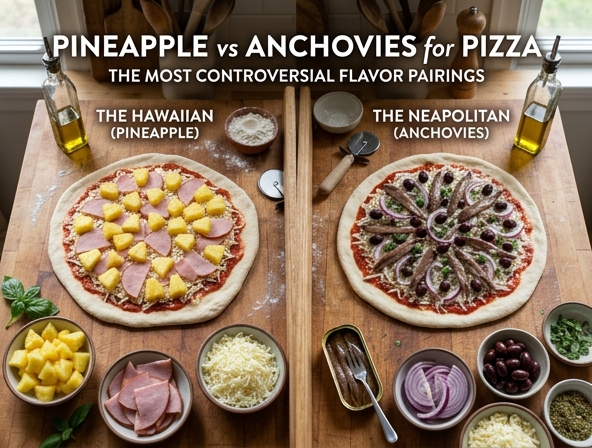
| Ingredient | Primary Flavor Profile | Culinary Strategy |
|---|---|---|
| Pineapple | Acidity | Use for transformative potential; best when charred to balance sweetness and acidity. |
| Anchovies | Deep Umami | Use salt-cured varieties to add savory depth; avoid excess to prevent overwhelming the palate. |
| General Approach | Polarizing Profiles | Success relies on precision and balance rather than quantity to elevate the dining experience. |
The Great Pizza Divide: Why Pineapple and Anchovies Reign as the Most Controversial Toppings
If you were to walk into any pizzeria across the globe and ask the chef what the most divisive subject in the kitchen is, the answer would almost certainly be the topping menu. While discussions about thin-crust versus deep-dish can get heated, nothing triggers a visceral, polarized reaction quite like the mention of two specific ingredients: pineapple and anchovies. These two toppings sit at opposite ends of the sensory spectrum-one representing a clash of sweet and savory, the other an intense, brine-heavy assault on the palate. But why do these two ingredients provoke such strong reactions, and is the vitriol surrounding them actually justified?
The Pineapple Phenomenon: A Sweet and Salty Revolution
To understand the pineapple debate, one must look back to 1962. It was in Chatham, Ontario, that a Greek immigrant named Sam Panopoulos reportedly tossed canned pineapple chunks onto a pizza alongside ham, effectively birthing the "Hawaiian" pizza. At the time, it was an experimental gamble-a fusion of the rising trend of "tiki" culture and the post-war convenience of canned goods.
Scientifically, the appeal of pineapple on pizza rests on the concept of flavor balancing. The culinary world has long cherished the interplay between sweet and salty-think salted caramel, honey on goat cheese, or prosciutto with melon. Pineapple provides a bright, acidic, and sugary punch that cuts through the heavy, fatty richness of mozzarella cheese and the salty, cured notes of ham or bacon. However, the texture is often the dealbreaker. For detractors, the fibrous, warm, and juicy nature of cooked pineapple is an affront to the structural integrity of a crisp pizza crust.
The Anchovy Enigma: The Original Umami Bomb
While pineapple is the "newcomer" of controversy, the anchovy is an ancient, misunderstood titan of the culinary world. Unlike the polarizing sweetness of pineapple, the anchovy triggers a reaction based on intensity. Anchovies are essentially concentrated packets of umami-the savory "fifth taste" that provides depth to everything from Caesar dressing to Worcestershire sauce.
In traditional Neapolitan pizza culture, anchovies are a staple. They are meant to dissolve into the sauce and cheese, creating a subtle, briny backbone that elevates the flavor profile of the entire pie. The controversy arises when these fillets are slapped on in heavy, unshorn clusters, turning the pizza into an overwhelmingly salty experience. The "fishy" reputation is, in many cases, a result of poor-quality sourcing. A cheap, dry, overly salted anchovy will indeed taste like a snack from a tackle box. Conversely, a high-quality, oil-cured white anchovy (boquerones) offers a delicate, clean, and nutty flavor that many food critics argue is the pinnacle of pizza sophistication.
The Psychology of Food Aversion
Why do we feel the need to take such a hard stance on toppings? Much of the discourse surrounding these two ingredients is performative. In the age of social media, "hating" pineapple on pizza has become a cultural shorthand for being a "pizza purist." It is a low-stakes way to signal an allegiance to tradition and Italian authenticity.
However, psychology suggests that our food aversions are often learned rather than innate. Children who grow up in households where these ingredients are treated with disgust will likely develop a conditioned response. Furthermore, there is the "disgust sensitivity" factor; humans are naturally wary of foods that exhibit signs of decay or foreign textures. For some, the idea of a warm fish or a hot fruit simply triggers an instinctive "avoidance" response, regardless of how harmonious the flavor profile might be on a molecular level.
Bridging the Gap: The Culinary Defense
The secret to reconciling with these controversial toppings lies in the execution. If you are a skeptic, the problem might not be the ingredient, but the application:
- For the Pineapple: Try fresh pineapple instead of canned. Roasting it before adding it to the pizza caramelizes the sugars, intensifying the flavor and removing the excessive moisture that leads to a soggy crust. Pair it with something spicy, like fresh jalapeños or hot honey, to balance the sweetness.
- For the Anchovies: Pair them with ingredients that can handle the salt, such as olives, capers, or bitter greens like rapini. Avoid drowning them in cheese; let the anchovies act as a seasoning rather than a primary protein.
A Canvas for Expression
At its core, pizza is the world's most democratic food. It is a blank canvas that invites innovation, regional adaptation, and personal preference. The vitriol aimed at pineapple and anchovies is, in a way, a testament to how seriously we take our pizza. If people didn't care about the quality and composition of their pies, these debates wouldn't exist.
Ultimately, the "Pineapple vs. Anchovy" war is a distraction from the true joy of dining. Whether you are a firm believer in the Hawaiian style, a lover of the salty brine of an anchovy-laden pie, or a staunch advocate for the "margherita-only" lifestyle, the beauty of the craft lies in the diversity of the output. We don't have to agree on the perfect topping combination, but perhaps we can agree that the conversation itself-usually held over a steaming box of dough and cheese-is one of the most delightful aspects of the food experience. So, go ahead: order the pineapple. Add the anchovies. The beauty of the pizza is that it belongs to the person holding the slice.
Disclaimer:
The information provided on Eateryn is for general educational and informational purposes only and is not intended as medical, nutritional, or healthcare advice. It should not be used to diagnose, treat, cure, or prevent any disease or medical condition.
Always consult a qualified physician, registered dietitian, or other certified healthcare professional before making changes to your diet, exercise routine, or lifestyle, or regarding any medical questions or concerns you may have. Never disregard or delay seeking professional medical advice because of something you have read on this website.