
Pickles Vs. Relish For Burger - Tangy Ingredient Showdown
Selecting the perfect acidic accompaniment for a burger often feels daunting. While many home cooks rely on generic, store-bought dills or relishes, understanding the nuance of flavor profiles grants you significantly better culinary balance. Please note, however, that personal preference ultimately dictates the final result. For instance, classic dill chips offer structural crunch, whereas sweet relish provides caramelized complexity. This analysis evaluates how each topping influences bite integrity, acidity, and overall flavor cohesion for your next meal.
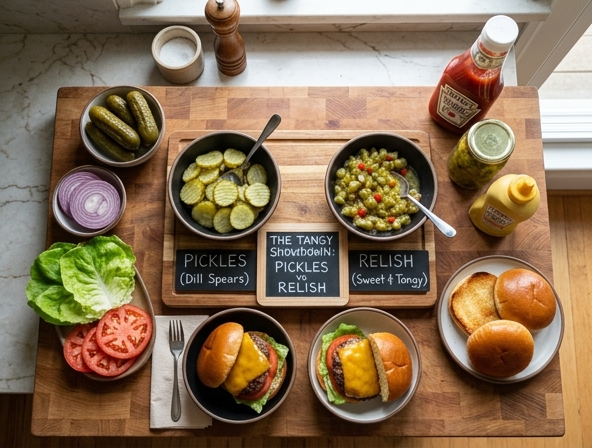
| Topping | Texture | Flavor Profile | Culinary Impact |
|---|---|---|---|
| Dill Pickles | Structural crunch | Sharp, acidic, bright | Enhances bite integrity and provides a crisp contrast. |
| Sweet Relish | Fine, chopped | Caramelized, complex | Adds depth and flavor cohesion to the burger. |
| Note: The choice ultimately depends on personal preference and the desired balance of acidity versus sweetness. | |||
Pickles Vs. Relish: The Tangy Ingredient Showdown for the Ultimate Burger
The burger is arguably the most democratic of all culinary creations. It is a blank canvas, a monument to the marriage of fat, protein, and starch. But while the quality of the beef and the melt of the cheese are paramount, the soul of a burger often lies in its condiments-specifically, those bright, vinegary additions that cut through the richness of the meat. In this corner, we have the stalwart pickle slice, the crunchy, acidic sentinel of the sandwich. In the other, we have relish, the chopped, complex, and integrated flavor-enhancer. The debate over which belongs on your burger is as old as the backyard barbecue itself. Let's break down the tangy showdown.
The Case for the Pickle: The Architecture of Crunch
To understand the pickle, you must first understand the purpose of acid in a high-fat meal. A cheeseburger is a dense, savory experience. The fat from the patty and the salt from the cheese need a counterpoint to prevent "palate fatigue." Enter the dill pickle.
Pickles aren't just an afterthought; they are structural components. A thick-cut, brined cucumber provides a specific, satisfying "snap." When you bite into a burger, you want a contrast of textures. The soft bun and tender patty are elevated by that audible crunch. Furthermore, pickles provide a localized hit of brine. When you encounter that slice, it acts as a palate cleanser, resetting your taste buds so the next bite of beef tastes as fresh as the first.
There is also the visual appeal. The translucent green of a well-placed pickle slice creates a professional, finished look. Whether it's a classic Kosher dill or a spicy bread-and-butter variant, the pickle stands its ground. It is an assertive ingredient-it doesn't hide. You know it's there, and you either lean into it or set it aside.
The Case for Relish: The Master of Integration
If the pickle is a surgical strike of flavor, relish is a blanket application. Relish is, essentially, the "democratization" of the pickle. By chopping the cucumbers and mixing them with vinegar, sugar, and sometimes peppers or mustard seeds, you create a condiment that ensures every single bite is uniform.
Relish excels in the "fast-food style" burger. When you use relish, you aren't just adding acidity; you are creating a cohesive sauce base. Because relish is chopped fine, it marries beautifully with ketchup and mayonnaise to create a "Special Sauce" consistency. It fills the gaps between the meat and the bun, ensuring that even the peripheral bites of the burger carry that tangy, sweet-and-sour profile.
Critics of relish often point to its sweetness, but in the world of burger craft, that sweetness is a secret weapon. A high-quality sweet relish cuts through the heavy char of a flame-grilled patty, providing a balance that mimics the complexity of a barbecue glaze. It provides an immediate, distributed flavor profile that doesn't require the diner to navigate around a large, unwieldy slice.
The Science of the Bite: Acidity vs. Texture
The core of this conflict lies in how we perceive food. If you are a texture-seeker, the pickle is your champion. You want that resistance, that burst of juice, and that specific dill-forward brightness. The pickle is for those who enjoy the *process* of eating-the discovery of the ingredients.
Conversely, if you are a flavor-integration seeker, you are likely a member of Team Relish. You want the burger to be a singular, harmonious experience. You don't want to hunt for the acid; you want it delivered to you in every micro-bite. Relish is the culinary equivalent of an algorithm-it optimizes the consistency of your dining experience from the first bite to the last.
The "Third Way": Why Choose?
Why must this be a zero-sum game? The most sophisticated burger joints have long realized that the best burger experience often utilizes both. Think of the classic "In-N-Out" or "Shake Shack" model: these burgers often feature a sauce (a form of integrated relish) while *also* including whole pickles.
This dual approach provides the best of both worlds. The sauce provides the base-level tangy sweetness that saturates the patty, while the thick pickle slices provide that necessary "reset" and crunch. By using both, you ensure that the burger is never one-dimensional. You get the integration of the relish and the structural integrity of the pickle slice.
Choosing Your Contender: A Guide
- When to go with just Pickles: If you are using high-end, artisan beef that you want to stand alone, or if you are using a brioche bun that might get soggy with too much relish, stick to the whole pickle. It's cleaner, sharper, and more refined.
- When to go with just Relish: If you are hosting a large backyard cookout with standard ground beef, relish is your best friend. It masks the inconsistencies of mass-produced patties and provides that nostalgic, classic burger taste that everyone expects.
- The "Pro" Move: Make your own "Quick-Relish." Take high-quality, whole dill pickles, chop them finely, and toss them with a splash of apple cider vinegar, a pinch of sugar, and some fresh dill. You get the crunch of the pickle with the distribution of the relish.
The Verdict
So, which wins the showdown? If forced to choose, the pickle is the more versatile ingredient. It can be chopped into relish, used as a garnish, or eaten on the side. However, the relish is the king of consistency. In the end, the choice depends on your objective. Are you building a burger for the palate, or for the belly? If you seek a gourmet, textured experience, reach for the jar of pickles. If you seek the comfort of a perfectly seasoned, uniform, nostalgic bite, pick up the relish.
But the real answer? Don't let the culinary gatekeepers dictate your plate. The beauty of the burger is that it is a playground. Experiment with spicy pickles, sweet relishes, and everything in between. Whether you are Team Crunch or Team Integration, as long as you have that punch of acidity, your burger is destined for greatness.
Disclaimer:
The information provided on Eateryn is for general educational and informational purposes only and is not intended as medical, nutritional, or healthcare advice. It should not be used to diagnose, treat, cure, or prevent any disease or medical condition.
Always consult a qualified physician, registered dietitian, or other certified healthcare professional before making changes to your diet, exercise routine, or lifestyle, or regarding any medical questions or concerns you may have. Never disregard or delay seeking professional medical advice because of something you have read on this website.