
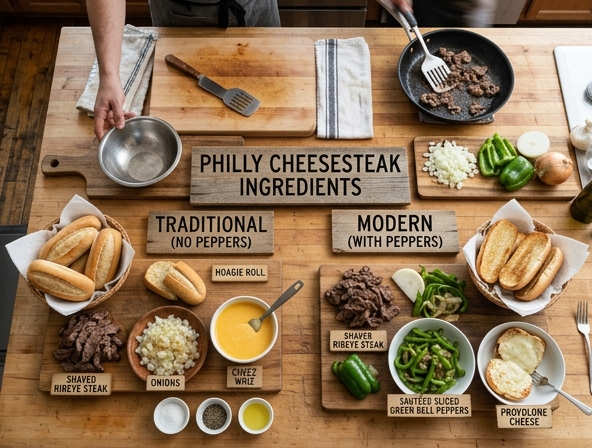
The Great Philadelphia Divide: To Pepper or Not to Pepper?
In the culinary pantheon of American street food, few items are as fiercely protected or as hotly debated as the Philly Cheesesteak. It is a sandwich that transcends mere sustenance; it is a cultural totem, a badge of municipal pride, and a lightning rod for arguments that have raged from the street corners of South Philly to the upscale gastropubs of the West Coast. At the center of this culinary storm lies a simple, vibrant, and surprisingly polarizing ingredient: the green bell pepper.
The Origin Myth and the "Purist" Standard
To understand the pepper debate, one must first understand the sanctity of the original recipe. Legend traces the birth of the cheesesteak to 1930, when Pat Olivieri, a hot dog vendor in South Philadelphia, decided to throw some thinly sliced ribeye onto his grill. Legend has it a cab driver caught the scent and asked for a steak sandwich. The rest is history. In those early days, the formula was simple: beef, bread, and onions. Provolone eventually joined the fray, followed later by the cult-like rise of Cheez Whiz.
For the purist, the "true" cheesesteak is a study in minimalist perfection. It is about the quality of the ribeye, the sear of the griddle, and the structural integrity of the long, Italian-style roll. To these devotees, the addition of peppers-often sautéed into oblivion alongside onions-is not merely an enhancement; it is an intrusion. It introduces moisture that can compromise the bread, and it masks the primal, fatty richness of the beef that is the very soul of the sandwich.
The Argument for "The Garden"
Conversely, there is a vocal contingent that views the cheesesteak as a canvas rather than a static monument. To the "pepper-proponent," the sandwich is a blank slate crying out for color, texture, and a touch of acidity. Green bell peppers, when sliced thinly and griddled until they reach a state of soft, caramelized submission, provide a necessary counterpoint to the salt-heavy profile of the meat and the processed sharp tang of the cheese.
Proponents argue that the sweetness of the pepper cuts through the grease, preventing flavor fatigue as you work your way through a 12-inch roll. In this view, the pepper isn't an intruder; it's a balancer. Furthermore, the inclusion of peppers adds a visual vibrancy that makes the sandwich more than just a monochromatic brown-and-yellow mess. It brings a touch of "vegetable" legitimacy to a meal that is famously devoid of nutritional nuance.
The Culinary Chemistry: Texture vs. Integrity
From a culinary standpoint, the issue boils down to structural integrity. A Philly cheesesteak is, by design, a messy affair. When you add peppers, you introduce a high-water-content vegetable to a hot surface. If the peppers are not cooked down sufficiently, they leak water into the roll, leading to the dreaded "soggy bottom" phenomenon. A well-constructed cheesesteak should be held together by the marriage of molten cheese and rendered beef fat, binding the meat to the bread. If the peppers aren't treated with care-if they are tossed on haphazardly or left too crunchy-they disrupt the mechanical engineering of the sandwich.
There is also the "Mushroom Factor." Once a diner opens the door to peppers, they almost inevitably welcome mushrooms into the fold. For the purist, this is where the sandwich loses its identity entirely, shifting from a "Steak" to a "Steak-Vegetable Medley." The umami-heavy, earthy profile of the mushrooms completely alters the chemistry of the steak, shifting the flavor palette away from the traditional beef-and-dairy focus that defined the dish for decades.
Regional bastardization vs. Evolution
It is worth noting that outside of the Philadelphia city limits, the cheesesteak often becomes a "anything goes" operation. In suburban strip malls or chains across the country, one might find peppers, onions, mushrooms, hot cherry peppers, and sometimes even lettuce and tomato. Philly locals view these variations with a mix of amusement and disdain. To the Philadelphia native, a cheesesteak with lettuce and tomato is essentially a hoagie that has lost its way. By keeping the ingredients limited-perhaps strictly to the onions, which are considered a "foundational" aromatic-the city maintains a sense of control over its greatest export.
The Verdict: A Matter of Preference or Respect?
Ultimately, the debate over peppers is a conflict between nostalgia and utility. If you view the Philly Cheesesteak as a historical artifact, a dish that must be preserved in its 1930s amber, then peppers are a cardinal sin. You eat it "wit" or "witout" onions, and you accept the sandwich as it was intended to be: a protein-heavy, indulgent celebration of the working-class spirit.
However, if you view the cheesesteak as a living, breathing culinary evolution, the pepper becomes a welcome addition. It represents the ability of the sandwich to adapt, to provide a more rounded flavor experience for a modern palate that craves contrast as much as it craves comfort.
So, where do you stand? Do you demand the pure, unadulterated combination of steak and Whiz, or do you crave the sweet, charred complexity of the bell pepper? There is no "right" answer, though if you ask a line cook at a legendary shop on South Street, they will likely tell you to make up your mind quickly-there is a line forming behind you, and the griddle is already hot.
Whether you choose to add them or leave them off, the beauty of the Philly Cheesesteak remains its consistency. Regardless of your vegetable philosophy, a well-made steak, served on a fresh roll and dripping with high-quality cheese, will always be the standard against which all other sandwiches are measured. Just remember: when you are in the heart of Philly, decide before you get to the front of the line-the tradition of the city moves fast, and it doesn't wait for indecision.