
Parmesan vs Pecorino for Macaroni and Cheese - Selecting The Best Salty Finish
Achieving a refined, salty depth in macaroni and cheese is a persistent challenge for home chefs. While standard recipes rely on cheddar or Gruyère for base body, the final salt profile often feels one-dimensional. Selecting the optimal finishing cheese significantly elevates the dish. Please note that both Parmesan and Pecorino require precise ratios to avoid overwhelming the cream. Whether utilizing the sharp sheep-milk edge of Pecorino or the nutty complexity of Parmigiano-Reggiano, this analysis will optimize your selection.
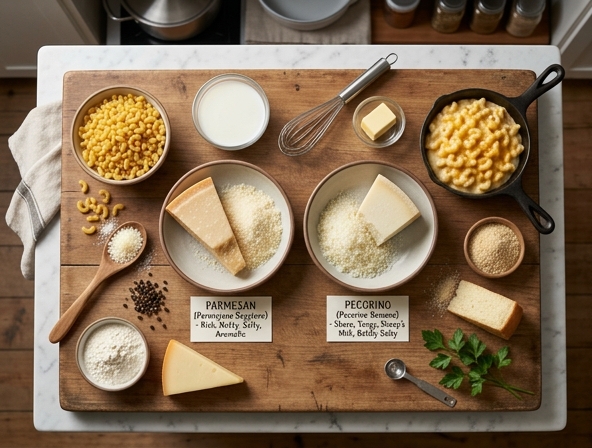
| Attribute | Parmigiano-Reggiano | Pecorino Romano |
|---|---|---|
| Flavor Profile | Nutty, complex, and savory depth. | Sharp, distinct sheep-milk edge. |
| Best Used For | Adding a sophisticated, rounded finish. | Adding a bold, salty, and pungent kick. |
| Application Tip | Use precise ratios to maintain balance. | Use precise ratios to avoid overwhelming the cream. |
Parmesan vs. Pecorino for Macaroni and Cheese: Selecting the Best Salty Finish
In the pantheon of comfort food, few dishes command as much reverence-or spark as much debate-as macaroni and cheese. While the foundation of the dish often lies in the creamy, emulsified glory of a Mornay sauce bolstered by sharp cheddar, Gruyère, or fontina, the true culinary wizardry happens in the final stages. When you are looking for that perfect salty, umami-rich finish to elevate your casserole from "standard" to "sublime," you are inevitably faced with the classic Italian showdown: Parmigiano-Reggiano vs. Pecorino Romano.
While both appear as humble, desiccated blocks of pale gold at the supermarket, their contributions to a mac and cheese are profoundly different. Understanding the chemistry, flavor profile, and historical context of these two titans will allow you to make an informed decision the next time you fire up the oven.
The Case for Parmigiano-Reggiano: The Elegant Backbone
Parmigiano-Reggiano, often referred to as the "King of Cheeses," is a cow's milk cheese hailing from the Emilia-Romagna region. It is a masterpiece of slow aging, often matured for 18 to 36 months, which allows it to develop those signature crunchy tyrosine crystals that melt on the tongue.
Flavor Profile: Parmesan is nuanced. It possesses a deep, savory nuttiness with a subtle sweetness that lingers. It is salty, yes, but that salt is tempered by notes of brown butter, dried fruit, and hay. It provides a structural foundation rather than a sharp punch.
Culinary Application: Because of its sophisticated profile, Parmigiano-Reggiano is the ideal choice if your mac and cheese base already contains assertive ingredients like high-quality sharp cheddar or blue cheese. It acts as an anchor, rounding out the edges of a sauce and bridging the gap between fatty cream and earthy pasta. It doesn't scream; it harmonizes.
The Case for Pecorino Romano: The Aggressive Exclamation Point
Pecorino Romano is a stark departure from its cow's milk counterpart. Crafted from sheep's milk (the word pecora means sheep in Italian), it is historically tied to the Roman countryside and has been a staple of the Italian diet since antiquity. Its production process often results in a drier, firmer texture that is built to stand up to heavy sauces.
Flavor Profile: Pecorino is bold, acidic, and unapologetically salty. The sheep's milk provides a distinctive, slightly tangy "funk" that can cut through even the densest, richest cream sauces. It is aggressive and immediate, leaving a bright, sharp prickle on the palate that is unmistakably bracing.
Culinary Application: Pecorino Romano is the secret weapon for a "Cacio e Pepe" style mac and cheese. If you are using milder melting cheeses like Fontina, Havarti, or mild Gouda as your primary sauce components, Pecorino is the best choice to bring the dish to life. It pierces through the monotony of dairy-heavy flavors, offering a necessary acidity that keeps the palate refreshed with every bite.
The Chemistry of the Melt
When selecting your finish, you must also consider the physics of the melt. Neither of these cheeses are "melters" in the traditional sense; they don't turn into the gooey, stringy stretch of Mozzarella or Monterey Jack. Instead, they are grating cheeses intended to incorporate into the sauce or create a crust.
- Parmesan emulsifies beautifully into a hot béchamel, creating a silky, cohesive sauce. If you want a uniform, velvety consistency throughout your macaroni, incorporate fine-grated Parmesan into your roux-based sauce.
- Pecorino, due to its higher protein and fat composition from the sheep's milk, can sometimes break if heated too rapidly in a thin sauce. It is best used as a finishing element-folded in at the very last moment or used to create a crispy, brown crust on the top of the dish.
Selecting Your Finish: The Decision Matrix
So, which should you choose? The answer lies in the "Salt-to-Fat" ratio of your specific recipe:
1. The "Creamy & Mild" Scenario
If your mac and cheese features a blend of Fontina, Gruyère, and heavy cream, the dish runs the risk of being one-note-rich, but flat. Choose Pecorino Romano. The sharpness will provide the contrast your palate craves, preventing the dish from feeling like a heavy, monolithic block of fat.
2. The "Sharp & Robust" Scenario
If you are utilizing a 2-year-aged English cheddar or a smoked Gouda, your flavor profile is already quite aggressive. Adding Pecorino here may result in a salt overload that becomes unpleasant. Choose Parmigiano-Reggiano. Its nutty, complex profile will complement the sharpness of the cheddar without competing for dominance.
3. The "Textural Crust" Scenario
If your goal is a gorgeous, golden-brown crust on top of your mac and cheese, mix both. A 50/50 blend of Parmesan and Pecorino, combined with a bit of panko breadcrumbs, creates the ideal crust. The Parmesan helps the crust bind and provides the savory base, while the Pecorino creates those delicious, dark-brown, salty bits that are the hallmark of a perfectly baked gratin.
Final Thoughts
There is no "wrong" answer in the quest for the ultimate mac and cheese, but there is a purposeful one. Parmesan is the diplomat of the cheese world-it makes everything it touches taste like a better version of itself. Pecorino is the provocateur-it demands your attention and wakes up the dish with sharp, sheep-milk intensity.
Next time you prepare your mac and cheese, consider the current state of your sauce. Ask yourself: does this need a bridge, or does it need a spark? By thoughtfully selecting your finish, you transform a bowl of pasta into a culinary experience. Whether you favor the regal nuttiness of Parmigiano or the sharp, wild tang of Pecorino, you are participating in a long-standing culinary tradition of balancing the rich with the refined.
Disclaimer:
The information provided on Eateryn is for general educational and informational purposes only and is not intended as medical, nutritional, or healthcare advice. It should not be used to diagnose, treat, cure, or prevent any disease or medical condition.
Always consult a qualified physician, registered dietitian, or other certified healthcare professional before making changes to your diet, exercise routine, or lifestyle, or regarding any medical questions or concerns you may have. Never disregard or delay seeking professional medical advice because of something you have read on this website.