
Panko vs Standard Breadcrumbs for Fried Chicken - Elevating The Crunch Factor
Achieving a professional, shatter-crisp crust on fried chicken is a common culinary challenge. While standard breadcrumbs are the traditional baseline, they often result in a dense, moisture-retaining coating. Panko, however, offers superior aeration through its larger, flaky structure, delivering a significantly lighter texture. Note that Panko demands precise heat control to avoid uneven browning. Whether preparing classic Chicken Katsu or modern air-fried fillets, this guide examines the technical distinctions to elevate your frying results.
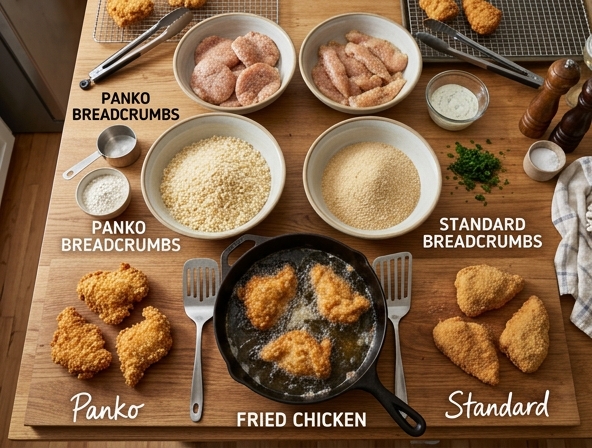
| Feature | Standard Breadcrumbs | Panko Breadcrumbs |
|---|---|---|
| Texture | Dense and compact | Light, airy, and shatter-crisp |
| Structure | Fine, traditional grind | Large, flaky shards |
| Technique | Straightforward application | Requires precise heat control to prevent uneven browning |
| Best For | Traditional fried chicken | Chicken Katsu, air-fried fillets, and elevated crunch |
Panko vs. Standard Breadcrumbs: The Science Behind the Perfect Fried Chicken Crunch
There is perhaps no sensory experience in the culinary world quite as satisfying as the first bite into a perfectly fried piece of chicken. It begins with the golden-brown visual appeal, followed by the audible “crack” of the crust, and finally, the succulent, juicy meat hidden beneath. But for home cooks and chefs alike, the quest for that elusive “ultimate crunch” often boils down to a single, critical decision: the breading.
While the seasoning blend and the frying technique play their roles, the physical composition of your breadcrumb choice acts as the structural foundation of your crust. For years, the debate has centered on two primary contenders: the classic, fine-milled standard breadcrumb and its airy, jagged Japanese counterpart, Panko. Understanding the mechanical differences between these two isn't just about aesthetics; it is about controlling texture, oil absorption, and the structural integrity of your fried chicken.
The Anatomy of Standard Breadcrumbs
Standard breadcrumbs, often referred to as “plain” or “Italian-style” breadcrumbs, are the workhorses of the kitchen. They are typically made from dried, toasted loaves of bread that have been pulverized into a fine, uniform sand-like consistency. Because of their small, dense particle size, they create a cohesive, uniform layer around the chicken.
When you use standard breadcrumbs, the result is a tight, compact crust. This type of breading is excellent for dishes like traditional chicken schnitzel or cutlets where the goal is a smooth, even coating that adheres tightly to the protein. However, because these crumbs are fine and dense, they have a tendency to soak up more oil during the frying process. If the temperature of your oil drops even slightly, or if the chicken is left to sit too long, the standard breadcrumb coating can turn from crisp to heavy and greasy.
The Panko Revolution: Why Texture is King
Panko-the Japanese word for “bread flour”-is a vastly different beast. Unlike standard breadcrumbs, which are made from whole toasted loaves, Panko is created from crustless bread baked using an electrical current. This unique production method creates an exceptionally light, airy bread that is then processed into flakes rather than crumbs. These flakes are long, jagged, and porous.
The "Crunch Factor" in Panko comes down to surface area. When you coat a piece of chicken in Panko, the jagged, irregular flakes stand up away from the surface of the meat. This creates a scaffolding of sorts, trapping air between the crumbs. When this hits hot oil, the moisture within the flakes evaporates rapidly, and the structure becomes rigid and lace-like. Because of this airy structure, Panko absorbs significantly less oil than standard breadcrumbs. The result is a crust that is not just crisp, but shatteringly light-a texture that many fried chicken enthusiasts consider the gold standard.
The Head-to-Head: Performance in the Fryer
1. Oil Absorption and Greasiness
If you have ever encountered a piece of fried chicken that felt "heavy" on the palate, it was likely due to the breading acting like a sponge. Standard breadcrumbs, due to their density, possess a high capacity for oil retention. Panko, however, acts as a barrier. The larger, drier flakes remain crispy while the interior meat cooks through, preventing that dreaded sogginess.
2. Structural Integrity
Standard breadcrumbs provide a reliable, "shell-like" coating that is harder to dislodge. If you are aiming for a classic comfort-food vibe where the breading must stay perfectly intact while being slathered in sauce (like in a Chicken Parmesan), the density of standard breadcrumbs is an advantage. Panko, while vastly superior in crunch, is more delicate. If handled roughly, the flakes can break off, making it less ideal for heavy, wet gravies.
3. Heat Tolerance
Panko's light structure means it browns faster than standard breadcrumbs. Because it lacks the dark, pre-toasted color of many store-bought standard breadcrumbs, you have to watch your fry time closely. While standard breadcrumbs often look “done” because they are already toasted, Panko requires an observant eye to ensure you achieve a beautiful golden-brown color without burning the tips of the flakes.
How to Elevate Your Crunch: The Hybrid Technique
Many professional chefs have realized that you don't necessarily have to choose one or the other. If you find Panko a bit too “spiky” or delicate, you can use a hybrid approach. Start by dredging your chicken in a fine layer of flour, followed by an egg wash, and then a 50/50 mix of standard breadcrumbs and Panko. The standard breadcrumbs fill the gaps between the pieces of meat, while the Panko provides the structural elevation needed for that high-level crunch.
Furthermore, regardless of the crumb you choose, the "dry-dredge" method is non-negotiable. Ensure your chicken is patted completely dry with paper towels before hitting the flour. Moisture is the enemy of the crunch; if there is too much surface water, your breading will steam rather than fry, leading to a detached, soggy coating regardless of whether you used Panko or standard crumbs.
The Verdict
So, which should you choose for your next batch of fried chicken? If your goal is a rustic, hearty, and nostalgic schnitzel that clings to every morsel of meat, stick with standard breadcrumbs. They offer a reliable, consistent, and satisfying bite that pairs perfectly with mashed potatoes and brown gravy.
However, if you are looking to elevate the “Crunch Factor”-if you want that transformative, audible crack that makes fried chicken a delicacy-Panko is the undisputed champion. It transforms the humble breaded chicken from a simple meal into an architectural feat of texture. By understanding how these crumbs interact with heat and oil, you move from merely cooking chicken to engineering the perfect bite.
Whether you choose the reliable standard or the light-as-air Panko, remember: the best fried chicken is a product of technique, heat control, and the bravery to test your breading against the high heat of the fryer. Now, get into the kitchen, heat your oil, and listen for the sound of perfection.
Disclaimer:
The information provided on Eateryn is for general educational and informational purposes only and is not intended as medical, nutritional, or healthcare advice. It should not be used to diagnose, treat, cure, or prevent any disease or medical condition.
Always consult a qualified physician, registered dietitian, or other certified healthcare professional before making changes to your diet, exercise routine, or lifestyle, or regarding any medical questions or concerns you may have. Never disregard or delay seeking professional medical advice because of something you have read on this website.