
Oven vs Air Fryer For Meatloaf - Achieving The Ultimate Crust Texture
Many cooks struggle to achieve a firm, caramelized crust on meatloaf, often settling for a soft, uneven exterior. While the conventional oven provides steady heat, the air fryer offers aggressive convection. Both methods grant superior results if calibrated correctly. Please note that heat distribution varies significantly by appliance capacity. Whether preparing a standard beef blend or a lean turkey loaf, technique is essential. This guide evaluates both thermal approaches to help you master the ultimate meatloaf texture.
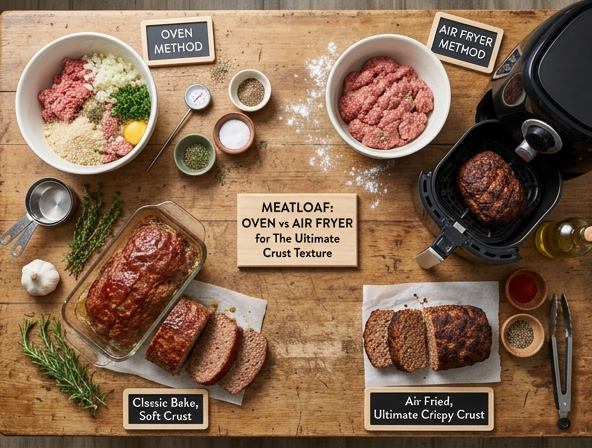
| Feature | Oven | Air Fryer |
|---|---|---|
| Heat Mechanism | Steady, ambient heat | Aggressive convection |
| Crust Potential | Consistent, traditional finish | Enhanced caramelization and firmness |
| Key Considerations | Requires calibration for even cooking | Performance varies by appliance capacity |
| General Tip | Technique is essential regardless of the meat blend or appliance used. | |
The Battle for the Perfect Crust: Oven vs. Air Fryer for Meatloaf
For many, meatloaf is the ultimate comfort food-a savory, nostalgic anchor to family dinners and cozy weeknights. Yet, despite its reputation for being foolproof, there is a distinct divide in the culinary world regarding the "perfect" meatloaf. While the flavor profile of the meat blend-ground beef, pork, veal, or even turkey-is paramount, the textural experience is often defined by one singular, elusive quality: the crust.
A mediocre meatloaf is monolithic, possessing the same soft, uniform density throughout. An exceptional meatloaf, however, offers a complex textural contrast. It starts with a deep, caramelized, slightly chewy crust that gives way to a tender, juicy interior. Achieving this balance is the holy grail for home cooks, leading many to wonder: Is the traditional oven still the king, or has the air fryer finally usurped the throne when it comes to crust development?
The Science of the Crust: Understanding Maillard
To understand why we struggle to achieve the perfect crust, we must first look at the science. The crust on any meat product is primarily the result of the Maillard reaction-a chemical interaction between amino acids and reducing sugars that occurs at temperatures above 300°F (150°C). This reaction creates hundreds of different flavor compounds and that coveted golden-brown hue.
When baking a meatloaf, the challenge is twofold: achieving high enough temperatures on the surface to trigger the Maillard reaction without drying out the interior of the meat, which requires a much lower, gentler temperature to stay succulent. This is where the physics of the oven and the air fryer diverge significantly.
The Oven: The Consistent Workhorse
The conventional oven is the traditional medium for meatloaf for a reason: it provides a stable, consistent environment. When you place a loaf in an oven set to 375°F, the heat surrounds the vessel, cooking the meat slowly and evenly.
The Pros: The primary advantage of the oven is capacity and structural integrity. Because the oven is a large, enclosed space with relatively low airflow, the meatloaf cooks uniformly. This is ideal if you prefer a large, rustic loaf. However, the oven often struggles with crust development because it is prone to trapping moisture. As the loaf cooks, steam is released, and in a traditional loaf pan, that moisture often gets trapped against the sides and top, resulting in a "steamed" exterior rather than a seared one.
The Strategy: To get a better crust in the oven, veteran cooks often move away from loaf pans. Free-forming the meatloaf on a parchment-lined baking sheet allows heat to hit all sides of the loaf, increasing the surface area for browning. Glazing the loaf at the very end of the cooking process-rather than the beginning-also helps prevent the sugars in the glaze (typically ketchup, brown sugar, or balsamic) from burning before the crust can properly set.
The Air Fryer: The Convection Powerhouse
Enter the air fryer-essentially a supercharged convection oven. Its primary mechanism is high-velocity air circulation, which forces hot air to strip away the thin layer of moisture on the surface of the food. In the context of meatloaf, this is a game-changer.
The Pros: The air fryer is essentially a "crust machine." Because of the constant, rapid airflow, moisture evaporates from the surface of the meatloaf almost instantly, significantly accelerating the Maillard reaction. You can achieve a deep, dark, caramelized crust in a fraction of the time it takes in a conventional oven. For those who prioritize texture above all else, the air fryer produces a result that is closer to a sear than a bake.
The Cons: The downside is the risk of overcooking. Because the air fryer is so efficient at heat transfer, if the loaf is too thick or the temperature is set too high, the outside will become hard and leathery before the center reaches a food-safe temperature. Additionally, air fryers have limited real estate, making it impossible to cook the massive, family-sized loaves that a traditional oven handles with ease.
Achieving the Ultimate Crust: Pro-Tips for Both Methods
Whether you choose the traditional path of the oven or the high-speed approach of the air fryer, the secret to a great crust lies in your preparation technique.
- Dry the Surface: Before your loaf goes into any cooking vessel, pat the exterior dry with a paper towel. Moisture is the enemy of browning.
- Use a Rack: If using the oven, elevate your free-formed loaf on a wire rack over a baking sheet. This allows hot air to circulate underneath, preventing the bottom from becoming soggy.
- Master the Glaze Timing: Never apply your glaze at the start. If you do, the sugars will caramelize too quickly and likely turn bitter or burn before the meat is cooked through. Wait until the last 10–15 minutes of cooking.
- Don't Overwork the Meat: A tightly packed meatloaf results in a dense texture that doesn't benefit from the crust-to-meat ratio. Keep the mixture light and airy by adding fresh breadcrumbs soaked in milk (a panade).
- Temperature Control: If using an air fryer, drop the temperature by 25 degrees compared to what you would use in a standard oven. The fan-forced air makes the heat more "aggressive," so a lower temp prevents the exterior from drying out too fast.
The Verdict: Which Method Wins?
The choice between the oven and the air fryer ultimately depends on your priority. If you are feeding a large family and value the traditional, uniform density of a classic loaf, the oven-paired with the "free-form on a rack" technique-is the superior choice. It offers the most control and the least margin for error.
However, if your priority is a bold, intensely flavorful crust that offers a satisfying snap when you cut into it, the air fryer is the clear winner. By using the air fryer, you aren't just baking meat; you are essentially roasting it, creating a concentration of flavor on the exterior that the oven simply cannot replicate without significantly longer cook times.
Perhaps the best approach for the true enthusiast? A hybrid method. Start the meatloaf in the oven to ensure the center reaches the proper temperature gently, then finish it under the broiler or at a high temperature in the air fryer for the final few minutes to lock in that ultimate, caramelized crust. Regardless of your chosen tool, the focus should remain on airflow and moisture management-the two pillars upon which every great crust is built.
Disclaimer:
The information provided on Eateryn is for general educational and informational purposes only and is not intended as medical, nutritional, or healthcare advice. It should not be used to diagnose, treat, cure, or prevent any disease or medical condition.
Always consult a qualified physician, registered dietitian, or other certified healthcare professional before making changes to your diet, exercise routine, or lifestyle, or regarding any medical questions or concerns you may have. Never disregard or delay seeking professional medical advice because of something you have read on this website.