
Oven vs Air Fryer for Apple Pie - Speed Versus Traditional Browning Consistency
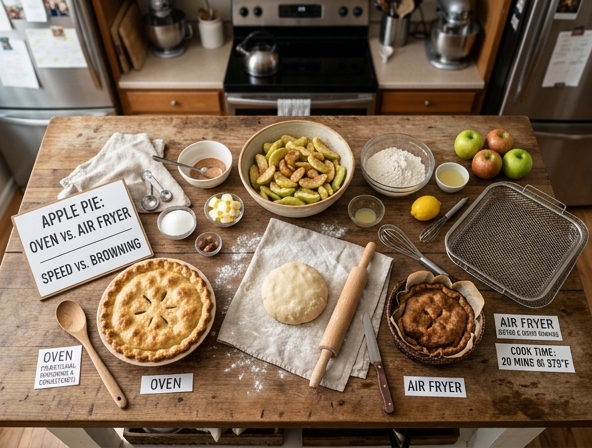
| Comparison Factor | Traditional Convection Oven | Air Fryer |
|---|---|---|
| Heat Distribution | Standard, even, and consistent | Rapid thermal cycling |
| Baking Speed | Traditional pace | Rapid / Fast |
| Temperature Requirements | Standard baking temperatures | Requires lower temperatures to prevent burning |
| Resulting Quality | Professional-grade browning | Efficiency-focused with a risk of premature darkening |
Oven vs. Air Fryer for Apple Pie: Speed Versus Traditional Browning Consistency
The pursuit of the perfect apple pie is a rite of passage for every home baker. We dream of the idyllic intersection of a shatteringly crisp, golden-brown crust and a filling that strikes the delicate balance between tender fruit and perfectly thickened, spiced syrup. Traditionally, this result requires patience-a slow, steady bake in a conventional oven that allows heat to penetrate the layers of butter and pastry without scorching the exterior. However, as the air fryer has secured its place as a kitchen essential, many bakers are posing the question: Can we shave off the time, or are we sacrificing the soul of the pie in the process?
The Physics of the Traditional Oven
To understand the debate, we must first look at the mechanics of a conventional oven. When you place a pie in a standard oven, you are relying primarily on radiant heat and natural convection. The heat source is generally located at the bottom (or through a heating element), and the ambient temperature of the oven cavity rises steadily. This "slow and low" approach is intentional. It allows the fat in the pastry-usually butter-to reach a point of flakiness by gradually releasing steam as it melts, creating distinct, airy layers. The thick glass or ceramic pie dish acts as a heat sink, ensuring the bottom crust is adequately cooked before the top becomes over-browned.
The Air Fryer: Efficiency vs. Intensity
An air fryer is, in essence, a high-velocity convection oven. By utilizing a powerful fan to circulate hot air at high speeds, it significantly reduces the distance the heat must travel to interact with the food. While this is miraculous for frozen fries or chicken wings, baking a complex pastry is a different beast. In an air fryer, the intense, directed airflow creates an incredibly rapid "set" on the crust. While this results in a very crunchy top layer, it often creates a "browning imbalance." The top of the pie may look like it's ready to serve after twenty minutes, while the center of the filling remains cold and the bottom crust remains pale and doughy.
The Battle of Browning Consistency
The Maillard reaction, the chemical process responsible for that deep, nutty brown color and complex flavor in our crusts, requires consistent temperature control. In a traditional oven, the browning occurs gradually, allowing the flavors of the pastry and the butter to meld.
In the air fryer, the air moves so aggressively that the top of the pie often browns prematurely. If you aren't careful, you end up with a "burnt roof" syndrome. To mitigate this, bakers must frequently use a foil shield-a constant intervention that negates some of the "set it and forget it" convenience air fryers are famous for. Conversely, the sides and bottom of the pie in an air fryer often lack the radiant heat required to achieve a deep, uniform golden hue, resulting in a pie that looks uneven and lacks aesthetic professionality.
Filling Gelatinization: The Hidden Struggle
Perhaps the most significant challenge when using an air fryer for apple pie is the filling. An apple pie filling needs time. The starches (flour, cornstarch, or tapioca) need to reach a specific temperature to gelatinize and thicken the juices. Because the air fryer heats the exterior so much faster than the interior, you risk pulling the pie out of the machine when the crust looks perfect, only to find a pool of runny, thin apple sauce waiting beneath the surface. To achieve the same consistency in an air fryer, one would have to lower the temperature significantly-essentially turning the air fryer into a smaller, noisier, and less efficient version of a standard oven.
When Does the Air Fryer Actually Win?
Despite the drawbacks for full-sized pies, the air fryer is a formidable tool for smaller portions. If you are making "hand pies" or individual turnovers, the air fryer is a game-changer. The smaller mass of the pastry allows the heat to penetrate the center quickly enough to cook the fruit without burning the exterior. For single-serving apple crisps or ramekin-based desserts, the air fryer's speed is an absolute asset, allowing for a post-dinner dessert to be prepared in a fraction of the time of a traditional bake.
Verdict: The Expert's Recommendation
- Choose the Oven for: Classic 9-inch double-crust pies, lattice tops, and any occasion where presentation and a fully set filling are paramount. The oven provides the radiant heat necessary to ensure the bottom crust is just as crisp and golden as the top.
- Choose the Air Fryer for: Individual hand pies, single-serving ramekin desserts, or when you are pressed for time and willing to trade a bit of texture for speed.
Ultimately, while the air fryer is a feat of modern engineering, it cannot replace the gentle, steady heat of a traditional oven when it comes to the chemistry of a pastry crust. Baking is fundamentally an exercise in patience. By honoring the slower, more deliberate process of the oven, you allow the moisture to evaporate correctly, the butter to laminate, and the sugars to caramelize in a way that creates the quintessential apple pie experience. Keep the air fryer for your savory snacks and quick bites; for the apple pie, let the oven do what it has done best for centuries.
Disclaimer:
The information provided on Eateryn is for general educational and informational purposes only and is not intended as medical, nutritional, or healthcare advice. It should not be used to diagnose, treat, cure, or prevent any disease or medical condition.
Always consult a qualified physician, registered dietitian, or other certified healthcare professional before making changes to your diet, exercise routine, or lifestyle, or regarding any medical questions or concerns you may have. Never disregard or delay seeking professional medical advice because of something you have read on this website.