
Nonstick Pan vs Stainless Steel for Pancakes - Preventing The Stick
Struggling with torn pancakes that cling to your pan is a common frustration for home cooks. While many debate the merits of nonstick versus stainless steel, the secret lies in thermal management rather than surface material alone. Note that stainless steel demands precise heat control compared to the forgiving nature of nonstick coatings. Professional kitchens, such as those at Le Bernardin, prioritize technique over hardware. This article examines material properties, heat regulation, and preparation to ensure flawless flips.
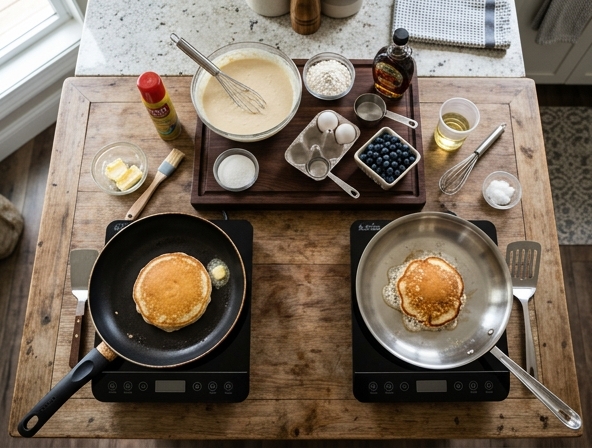
| Feature | Nonstick Pan | Stainless Steel Pan |
|---|---|---|
| Heat Control | Standard; very forgiving | Requires precise thermal management |
| Difficulty | Beginner-friendly | Advanced; technique-dependent |
| Success Factor | Surface coating | Proper temperature regulation |
| Core Takeaway: Regardless of material, professional success is achieved through refined technique rather than hardware choice. | ||
Nonstick Pan vs. Stainless Steel for Pancakes: Mastering the Art of the Flip
The pursuit of the perfect pancake is a weekend ritual that often hinges on one make-or-break moment: the flip. Nothing is more disheartening than a golden, fluffy batter sticking firmly to the pan, forcing you to scrape away half your breakfast in a mess of broken dreams and charred bits. When it comes to the great debate between the nonstick pan and the stainless steel skillet, the kitchen community is sharply divided. Do you choose the effortless release of modern polymers, or the professional-grade crust achievable only with a classic stainless steel surface?
The Science of the Stick
To understand why pancakes stick, we must look at the chemistry of the pan's surface. When you pour batter into a pan, the heat causes the proteins in the eggs and flour to bond with the metal at a microscopic level. In a stainless steel pan, the surface is porous, even if it looks smooth to the naked eye. As the pancake heats, it settles into these tiny microscopic "valleys," creating a physical and chemical lock. A nonstick pan, by contrast, uses a coating-usually polytetrafluoroethylene (PTFE)-that is hydrophobic and oleophobic, repelling both water and oil to prevent these bonds from forming.
The Nonstick Advantage: The "Cheat Code" for Beginners
For most home cooks, the nonstick pan is the undisputed champion of pancakes. The benefits are clear: you can use very little fat, the cleanup is nearly instantaneous, and the risk of catastrophic sticking is significantly reduced. It is the forgiving choice for those still perfecting their batter consistency or heat management.
However, the nonstick option comes with limitations. PTFE coatings are sensitive to high heat, which can cause the coating to degrade over time. Furthermore, nonstick surfaces rarely provide the deep, mahogany-colored crust that defines a truly professional-style pancake. If you are aiming for that specific, crispy-edged perfection, the nonstick pan can sometimes feel a bit "soft" in its results.
Stainless Steel: The Chef's Tool
If you have ever watched a professional breakfast cook on a line, you have likely noticed they aren't using a $20 ceramic pan from a big-box store. They are using heavy-duty stainless steel or carbon steel. The secret to using stainless steel for pancakes isn't the pan itself-it's the technique of heat management and the "Leidenfrost effect."
When you use stainless steel, you are seeking the Maillard reaction-a chemical reaction between amino acids and reducing sugars that gives browned food its distinctive, complex flavor. Because stainless steel doesn't have a nonstick barrier, it conducts heat differently and allows for a more intense caramelization of the pancake's surface.
Mastering the Stainless Steel Flip
If you want to transition to stainless steel, you must master the "Hot Pan, Cold Oil" rule. Here is how to achieve the perfect pancake without the stick:
- Preheat the Pan: Heat your stainless steel pan over medium heat for several minutes before adding any fat. You should be able to drop a tiny bead of water into the pan; if it dances across the surface like a ball of mercury (the Leidenfrost effect), your pan is ready.
- Add the Fat: Once the pan is hot, add your fat (butter or high-smoke-point oil). Let it coat the surface completely.
- The Waiting Game: This is where most cooks fail. Do not try to move the pancake immediately. Let the pancake develop its structure. When the edges look dry and bubbles have formed and popped, the proteins have effectively "seared" themselves into a golden crust that naturally releases from the metal. If you try to flip too early, you are fighting the physics of the pan.
- Temperature Control: Stainless steel retains heat efficiently. You may find that you need to turn the burner down slightly after the first pancake to prevent the pan from getting too hot and burning the butter.
Comparison Overview
| Feature | Nonstick Pan | Stainless Steel |
|---|---|---|
| Ease of Use | Excellent | Requires Skill |
| Crust Quality | Uniform, pale | Crispy, caramelized |
| Durability | Limited (3-5 years) | Lifetime |
| Cleanup | Effortless | Requires scrubbing |
Which Should You Choose?
The choice ultimately comes down to your priorities. If your morning routine is a frantic rush and you value consistency and ease above all else, stick with a high-quality nonstick pan. Invest in one with a thick base to ensure even heat distribution, and always use silicone utensils to preserve the coating.
However, if you view cooking as a craft and want to elevate your pancakes to restaurant quality, commit to the stainless steel method. It takes a few tries to learn the rhythm of the pan, but once you master the temperature and the timing, you will never go back. The flavor profile of a pancake cooked on stainless steel, with its complex, nutty crust, is simply superior.
Regardless of your pan choice, the final tip for success remains constant: never rush the flip. Whether it is Teflon or high-grade steel, the pancake will tell you when it's ready. When it slides across the surface with a gentle nudge, you have achieved success.
Disclaimer:
The information provided on Eateryn is for general educational and informational purposes only and is not intended as medical, nutritional, or healthcare advice. It should not be used to diagnose, treat, cure, or prevent any disease or medical condition.
Always consult a qualified physician, registered dietitian, or other certified healthcare professional before making changes to your diet, exercise routine, or lifestyle, or regarding any medical questions or concerns you may have. Never disregard or delay seeking professional medical advice because of something you have read on this website.