
Neapolitan vs New York Style for Pizza - The Ultimate Dough Comparison
Neapolitan vs. New York Style: Dough Mastery
Many home bakers struggle to replicate the precise crumb and chew of professional-grade pizzas. While standard recipes often generalize dough preparation, mastering high-heat Neapolitan versus classic NYC style requires distinct mechanical approaches. Understanding these nuances-such as utilizing 00 flour versus high-gluten alternatives-unlocks superior crust development. Note that hydration ratios must scale based on your specific oven temperature. We will now compare these iconic methods, providing the technical foundation to elevate your next bake.
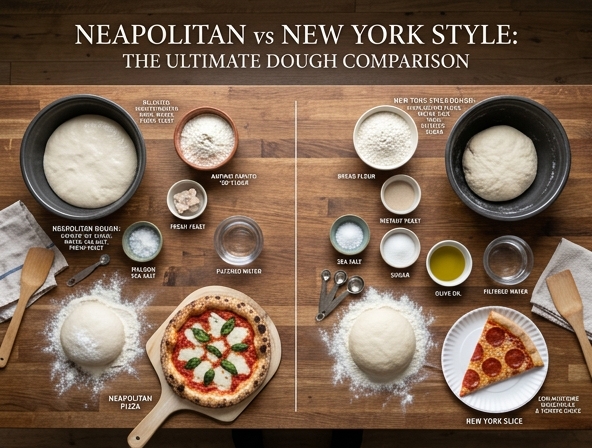
| Feature | Neapolitan Style | New York Style |
|---|---|---|
| Primary Flour | Type 00 Flour | High-Gluten Flour |
| Heat Requirement | Very High Heat | Standard Oven Heat |
| Crust Characteristic | Delicate, airy crumb | Chewy, sturdy texture |
| Hydration Focus | Scaled for high-heat rapid bake | Scaled for specific oven capacity |
| Core Goal | Mastering high-heat development | Achieving signature chew |
The Great Pizza Divide: A Deep Dive into Neapolitan vs. New York Style Dough
In the culinary world, few topics incite as much passion-or as much fierce debate-as the style of one's pizza. While toppings are a matter of personal preference, the true soul of the pie lies in the dough. To understand the difference between Neapolitan and New York style, one must look beyond the crust and delve into the science of hydration, the chemistry of fermentation, and the history of migration that brought these two titans to the global stage.
The Neapolitan Legacy: A Study in Simplicity
Neapolitan pizza is the grandfather of the modern pizza movement. Hailing from Naples, Italy, it is governed by strict, centuries-old traditions codified by the Associazione Verace Pizza Napoletana (AVPN). The dough is a minimalist's masterpiece: high-grade "Tipo 00" flour, water, sea salt, and fresh yeast. There are no fats, no sugars, and no additives.
The magic of Neapolitan dough lies in its specific protein content and its delicate structure. Because Tipo 00 flour is incredibly finely milled, it creates a crust that is soft, pillowy, and tender. When properly fermented, the dough develops a complex, slightly acidic profile. Because there is no sugar or oil to aid in browning, the dough relies entirely on the intense, blistering heat of a wood-fired oven-typically hovering around 900°F (480°C)-to achieve its signature "leopard spotting" on the crust in a scant 60 to 90 seconds.
The New York Evolution: The Industrial Adaption
When Italian immigrants brought their pizza craft to New York City in the early 20th century, the landscape shifted. The ingredients available in the United States differed from those in Southern Italy, and the ovens-largely coal-fired or gas-powered deck ovens-didn't hit the extreme temperatures of a Neapolitan wood-burner. The result? A new, uniquely American creation.
New York style dough is an exercise in structural integrity. Unlike the delicate, spoon-and-fork nature of Neapolitan pizza, New York style is built for the sidewalk. It is designed to be folded in half and eaten on the go. To achieve this, bakers typically use high-gluten flour, which provides the necessary elasticity and chew. Furthermore, New York dough recipes frequently incorporate a small amount of sugar (to promote browning at lower temperatures) and oil (to provide a crispier, crunchier finish that retains its structural integrity as it cools).
The Science of the Bite: Hydration and Fermentation
If you were to analyze these doughs under a microscope, the differences in hydration would be one of your first discoveries. Neapolitan dough generally sits in the 60% to 65% hydration range. The goal is a dough that is soft and extensible but not overly sticky, allowing for that classic "cornicione" (the rim) to puff up dramatically during the rapid bake.
New York style, conversely, is often slightly drier but significantly more "workable." Because the dough must be stretched to a large 16-to-18-inch diameter without tearing, the inclusion of oil helps manage the extensibility. Fermentation in New York style is often a slower, cold-fermentation process-sometimes spanning 48 to 72 hours. This long rest in the refrigerator breaks down starches into sugars, resulting in a deeper, more nuanced crust flavor that balances the heavy toppings often found on a Big Apple slice.
The Bake: Fire vs. Surface
The bake is the final frontier in this comparison. Neapolitan pizza is a "flash-bake." The high temperature of the oven creates a rapid steam release inside the dough, resulting in a crust that is airy and almost hollow on the inside while maintaining a charred exterior. The center of a true Neapolitan pizza remains wet and "soupy," requiring the diner to use a knife and fork.
New York style pizza is a "slow-and-steady" bake. In a deck oven running between 500°F and 600°F, the dough has time to dry out slightly, creating that iconic crisp-yet-pliant base. It doesn't puff up into massive bubbles like its Italian cousin; instead, it develops a uniform, golden-brown structure that holds the weight of cheese and pepperoni without sagging.
Texture and Flavor Profiles
- Neapolitan: The sensory experience is defined by softness. It is light, airy, and easily digestible. The crust is the star, tasting of clean, fermented grain, accented by the char of the wood fire.
- New York: The sensory experience is defined by contrast. You get the crunch of the outer crust, the chew of the dough, and the savory richness of the crust-which acts as a sturdy vehicle for the melty, low-moisture mozzarella.
Which Style Should You Choose?
Choosing between Neapolitan and New York style is not about which is "better"; it is about the occasion. Neapolitan pizza is an artisanal experience. It demands your full attention, a sit-down environment, and an appreciation for the subtle interplay between the char of the crust and the sweetness of raw San Marzano tomato sauce.
New York style is the ultimate comfort food. It is egalitarian, reliable, and perfectly suited to the rhythm of modern life. It satisfies a craving for salt, fat, and texture in a way that is profoundly satisfying, whether you are grabbing a slice at 2:00 AM or feeding a crowd during a game.
Conclusion: A Shared Heritage
Though they are separated by oceans, temperature, and technique, both styles share a common DNA. They are both testaments to the power of flour, water, salt, and yeast. Whether you prefer the blistered, airy elegance of a Napoletana or the foldable, sturdy crunch of a New York slice, you are participating in a global tradition that celebrates the simple alchemy of baking. In the end, the best pizza is the one in front of you-provided it was made with patience, respect for the dough, and a passion for the craft.
Disclaimer:
The information provided on Eateryn is for general educational and informational purposes only and is not intended as medical, nutritional, or healthcare advice. It should not be used to diagnose, treat, cure, or prevent any disease or medical condition.
Always consult a qualified physician, registered dietitian, or other certified healthcare professional before making changes to your diet, exercise routine, or lifestyle, or regarding any medical questions or concerns you may have. Never disregard or delay seeking professional medical advice because of something you have read on this website.