
Mornay Sauce vs Simple Cheese Blend for Macaroni and Cheese - Defining Authentic Texture
Mornay vs. Simple Blend: Achieving Texture
Home cooks often struggle with grainy, separated cheese sauces. While a simple blend of cheddar and cream is common, it lacks structural cohesion. A Mornay sauce provides superior emulsification, ensuring the luxurious mouthfeel favored by professional kitchens. Note that achieving this result requires precision in heat and starch management. By transitioning to a structured Béchamel base, you guarantee consistency. This guide explores these techniques to define the standard for achieving a truly authentic, velvety macaroni and cheese.
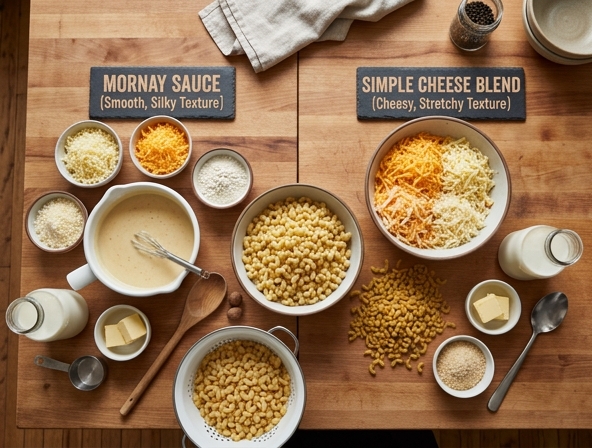
| Feature | Simple Cheese Blend | Mornay Sauce |
|---|---|---|
| Composition | Cheddar cheese and cream | Béchamel sauce base with added cheese |
| Texture | Prone to graininess and separation | Luxurious, velvety, and emulsified |
| Complexity | Low; simple to prepare | High; requires precision in heat and starch control |
| Consistency | Lacks structural cohesion | Professional-grade stability and reliability |
The Great Emulsion Debate: Mornay Sauce vs. Simple Cheese Blend
For many, macaroni and cheese is the ultimate culinary comfort-a dish that exists in the liminal space between childhood nostalgia and refined gastronomy. Yet, beneath its seemingly simple veneer lies a complex architectural challenge: how to suspend molten cheese in a medium that remains silky, stable, and clinging to every contour of the pasta, even as it cools. At the heart of this challenge is the rivalry between two primary methodologies: the classic French-inspired Mornay sauce and the modern, minimalist approach of the simple cheese blend.
The Mornay Method: The Architectural Classic
To understand the Mornay sauce, one must look back to the foundational work of Auguste Escoffier. A Mornay is, at its essence, a Béchamel sauce enriched with cheese-typically Gruyère and Parmesan. It begins with the holy trinity of technique: fat (butter), starch (flour), and dairy (milk). This roux-based structure provides a robust skeletal system for the cheese.
The beauty of the Mornay lies in its reliability. The flour particles swell and thicken the milk, creating a stable matrix that suspends the proteins and fats of the cheese. When you add shredded cheese to a hot Béchamel, you aren't just melting fat; you are incorporating it into an emulsion stabilized by starch. This results in a sauce with structural integrity. It is thick, opulent, and clings to the pasta with a velvety tenacity that feels "proper" and traditional.
However, the Mornay is not without its pitfalls. The inclusion of flour can occasionally lead to a "pasty" mouthfeel if not cooked out sufficiently, or a heavy, chalky sensation if the roux-to-liquid ratio is skewed. Furthermore, it is a multi-step process-requiring careful temperature control to avoid scorching the milk or breaking the emulsion once the cheese is introduced.
The Simple Blend: The Modernist Shortcut
In contrast, the "Simple Cheese Blend" approach-often championed by food scientists like J. Kenji López-Alt-eschews the flour entirely. This method relies on the power of emulsifying salts, specifically sodium citrate or the protein-rich base of evaporated milk. By creating an environment where the proteins in the cheese are prevented from clumping, you are essentially melting pure cheese into a liquid state without the need for a floury carrier.
The texture of a simple cheese blend is entirely different from a Mornay. Where the Mornay is "thick" and "substantial," the simple blend is "glassy" and "fluid." It creates a glossy, translucent coat of cheese that feels thinner but tastes significantly more intense. Because there is no flour to dilute the flavor, the palate is hit directly with the sharpness and salinity of the cheese itself. It is a texture that mimics the liquid gold of processed cheese slices, elevated by the quality of the cheddar or fontina used.
Defining Authentic Texture: The Science of Mouthfeel
When we discuss "authentic" texture, we are really discussing the rheology of the sauce-its flow and its resistance. The Mornay offers a "fat-based mouthfeel" that feels coating and dense. It is the texture of a luxury velvet. It stays warm longer and holds up to the oven's heat, forming that coveted bubbly, browned crust without losing its internal integrity.
The simple blend, conversely, offers a "protein-based mouthfeel." It is slicker. It coats the tongue faster and disappears more cleanly. It feels lighter, which paradoxically allows the diner to consume more of it without feeling the heavy, starch-laden fatigue often associated with traditional mac and cheese.
However, there is a practical danger to the simple blend: thermal stability. Because there is no starch to provide a physical scaffold, a simple emulsion is much more prone to "breaking" if left to cool or reheated incorrectly. If the water content is even slightly off, or if the heat spikes too high, the cheese fats will leach out, leaving you with a puddle of oil atop a pile of sad, rubbery pasta.
The Choice: Context is King
So, which is superior? The answer depends entirely on the desired experience. If you are preparing a Thanksgiving side dish that needs to sit in a warming tray, hold its shape, and survive a trip through the oven, the Mornay is the undisputed king. Its starch base acts as a protective barrier, preventing the fat from separating and ensuring the dish remains a cohesive, scoopable entity rather than a broken mess.
If, however, you are crafting a quick-service dish meant to be eaten immediately upon the stove-where the goal is the highest concentration of flavor and a silky, gravity-defying pull-the simple blend is a marvel of modern efficiency. It captures the essence of cheese in its most primal state.
Final Thoughts on Preparation
Ultimately, both methods require one non-negotiable rule to avoid failure: the "hand-grated" mandate. Regardless of your choice between Mornay or simple blend, using pre-shredded bagged cheese is the death of texture. These products are coated in cellulose and potato starch to prevent clumping. This anti-caking agent is an enemy of the emulsion; it creates a grainy, gritty texture that no amount of whisking can repair.
Whether you choose the structured, time-honored reliability of a Béchamel-based Mornay or the sleek, modernist intensity of a citrate-stabilized blend, you are making a choice about how you want the cheese to interact with the pasta. One is an architect's design; the other is a chemist's triumph. Both, when executed with patience and high-quality ingredients, define the peak of macaroni and cheese perfection.
Disclaimer:
The information provided on Eateryn is for general educational and informational purposes only and is not intended as medical, nutritional, or healthcare advice. It should not be used to diagnose, treat, cure, or prevent any disease or medical condition.
Always consult a qualified physician, registered dietitian, or other certified healthcare professional before making changes to your diet, exercise routine, or lifestyle, or regarding any medical questions or concerns you may have. Never disregard or delay seeking professional medical advice because of something you have read on this website.