
Local vs Chain for Philly Cheesesteak - Identifying The True Philly Experience
The Quest for Authenticity
Navigating the saturated market of cheesesteak vendors often leaves visitors questioning if their meal is truly authentic. While national chains offer predictable convenience, they frequently dilute regional culinary heritage. A superior experience depends on specific ribeye preparation and local roll sourcing. Note that culinary quality requires balancing time-honored techniques with consistency. Comparing iconic local institutions like Pat's or Geno's against commercial outlets illustrates this disparity. This guide evaluates why local craftsmanship remains the definitive Philadelphia standard.
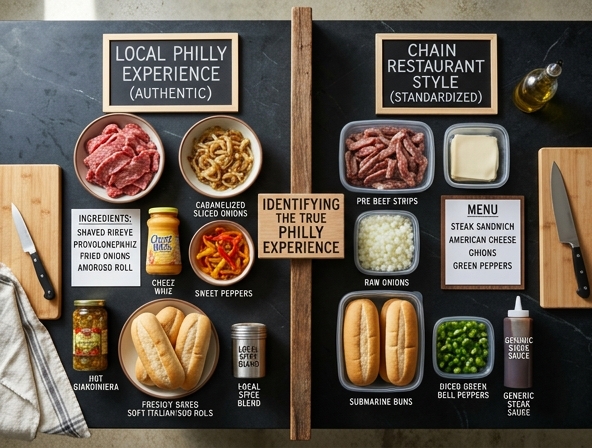
| Feature | Local Institutions | National Chains |
|---|---|---|
| Core Philosophy | Heritage and craftsmanship | Convenience and speed |
| Ingredients | Premium ribeye and local rolls | Standardized, mass-produced |
| Culinary Value | High (Time-honored techniques) | Low (Diluted regional heritage) |
| Overall Experience | Definitive Philadelphia standard | Predictable, but lacks authenticity |
Local vs. Chain: Identifying the True Philly Cheesesteak Experience
There are few foods in the American culinary canon as fiercely guarded, debated, and mythologized as the Philadelphia Cheesesteak. To the uninitiated, it is simply a sandwich: chopped steak, melted cheese, and a roll. But to those who live and breathe the culture of the City of Brotherly Love, the cheesesteak is a litmus test for authenticity, a cultural rite of passage, and a source of intense municipal pride. As the sandwich has exploded in popularity, migrating from the street corners of South Philly to the brightly lit, standardized menus of national chains, a fundamental tension has emerged: Does the "true" experience exist in the consistency of a franchise, or does it live solely within the grit and grease of the local, neighborhood institution?
The Appeal of the Chain: Efficiency and Standardization
In the modern dining landscape, convenience is king. National and regional chains have done a masterful job of packaging the "Philly experience" for mass consumption. When you walk into a chain restaurant-be it a dedicated sandwich shop or a sports bar franchise-you know exactly what you are going to get. The process is streamlined: the meat is pre-portioned, the grill is set to a precise temperature, and the serving time is optimized. For someone living in rural Idaho or downtown Los Angeles, these chains provide a gateway to a flavor profile they might otherwise never encounter.
However, the trade-off for this consistency is the erosion of character. Chains often prioritize shelf-life and supply-chain logistics over the immediate, ephemeral magic of the "griddle-top" cook. The meat is frequently thinner, the onions lack that caramelized, slightly scorched sweetness that comes from sitting on a seasoned steel plate for hours, and the bread-the absolute cornerstone of the sandwich-is often sourced from mass-produced bakeries that cannot mimic the unique, soft-yet-chewy crust of a true Philadelphia roll.
The Soul of the Local Legend
To understand the "True Philly Experience," one must look at the local landmarks-places like Pat's, Geno's, Jim's, or the countless neighborhood "pizza-steaks" joints scattered throughout South Philly and the surrounding boroughs. These establishments are not merely restaurants; they are social hubs. The aesthetic of a classic Philly shop is unmistakable: the stainless steel counters, the decades-old signage, the haze of savory smoke that clings to the air, and the staff who operate with a brisk, no-nonsense efficiency that boarders on performance art.
What makes these local shops superior is not just the recipe, but the *alchemy*. It is the way the grill master manipulates the temperature, the way the ribeye is chopped with surgical precision to ensure the cheese-be it Cheez Whiz, mild provolone, or American-melts into the crevices of the meat rather than sitting on top of it. At a local spot, you aren't just buying lunch; you are participating in a tradition that dates back to the 1930s. The walls are adorned with photos of local heroes, politicians, and ghosts of neighborhoods past, grounding the meal in a specific time and place.
The Anatomy of Authenticity: Breaking Down the Components
If you are trying to determine if your cheesesteak is the "real deal," you must inspect the anatomy of the sandwich based on three pillars:
- The Roll: This is non-negotiable. It must be an Italian-style long roll, usually from a local bakery like Liscio's or Amoroso's. It should be soft enough to compress when you bite down, but sturdy enough to hold the weight of the meat without disintegrating into a soggy mess of grease.
- The Meat: Authentic Philly cheesesteaks are made from thinly sliced ribeye. It should be sliced in-house, not purchased as a pre-frozen, wafer-thin patty. The fat content is essential; it's what keeps the steak juicy on the hot griddle.
- The Cheese: While the "Cheez Whiz vs. Provolone" debate will never end, the application is what matters. It must be melted *into* the meat. If the cheese is served cold or as a separate slab, you are eating a steak sandwich, not a Philadelphia Cheesesteak.
The Ritual of the Ordering
A major part of the "Local" experience is the ritualized ordering process. In a chain, you are asked how you want your sandwich customized from a digital kiosk or a polite server. In a local Philly shop, the interaction is stripped to its bare essentials: "One wit, Whiz."
This shorthand-asking for "wit" (with fried onions) and specifying your cheese preference-is part of the cultural fabric. The pressure of a line out the door, the urgency of the cook, and the specific cadence of the interaction create an environment that a chain simply cannot replicate. To order a "Philly Cheesesteak with lettuce, tomato, and mayo" at an authentic local spot is to immediately signal your outsider status. While the staff will likely still make it for you, you will miss out on the shared understanding that defines the Philadelphia culinary identity.
The Verdict: Why Local Wins
Is there a place for the chain? Certainly. When you are in an airport or a suburban strip mall three thousand miles from Pennsylvania, a chain cheesesteak can provide a decent, nostalgic snack. But to argue that it is the "true" experience is to misunderstand what the cheesesteak actually represents.
The true Philly experience is inextricably tied to the environment. It is the result of thousands of repetitions by a cook who has mastered their specific flat-top grill. It is about the smell of onions mingling with the high-heat sear of ribeye. It is about the slight grease that stains the butcher paper wrapper. These are variables that cannot be standardized by a franchise manual. When you strip away the local atmosphere and the decades of history, you are left with calories, but you are not left with culture.
If you find yourself in Philadelphia, do yourself a favor: avoid the tourist-trap lines if you must, but seek out the small, independent shops where the grill master remembers the names of the regulars. That is where you will find the heart of the city-wrapped in foil, dripping with flavor, and entirely, authentically, Philadelphia.
Disclaimer:
The information provided on Eateryn is for general educational and informational purposes only and is not intended as medical, nutritional, or healthcare advice. It should not be used to diagnose, treat, cure, or prevent any disease or medical condition.
Always consult a qualified physician, registered dietitian, or other certified healthcare professional before making changes to your diet, exercise routine, or lifestyle, or regarding any medical questions or concerns you may have. Never disregard or delay seeking professional medical advice because of something you have read on this website.