
Ketchup vs No Ketchup for Philly Cheesesteak - Navigating The Condiment Controversy
Ketchup vs. No Ketchup: Navigating the Controversy
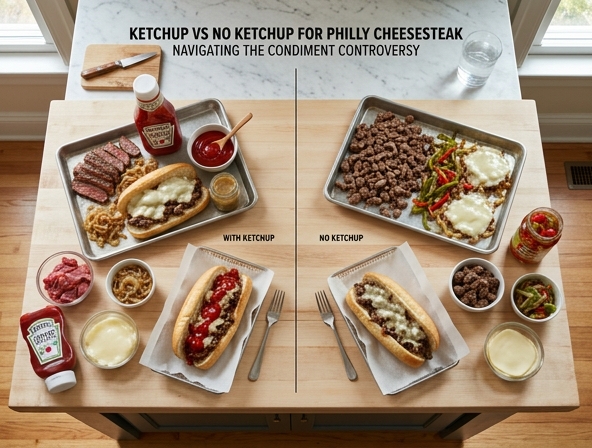
Deciding how to dress a Philly cheesesteak often sparks intense debate, leaving enthusiasts uncertain. While culinary tradition prioritizes Cheez Whiz or provolone and sautéed onions, the introduction of ketchup remains a polarizing variable. Mastering this balance guarantees a more authentic experience. It is important to note that personal preference persists; however, local institutions like Pat's and Geno's provide distinct precedents. This guide evaluates whether ketchup serves to enhance the profile or compromise the classic integrity.
| Aspect | Summary Details |
|---|---|
| Core Topic | The debate regarding the inclusion of ketchup on an authentic Philly cheesesteak. |
| Traditional Ingredients | Classic preparations typically feature Cheez Whiz or provolone cheese served with sautéed onions. |
| The Controversy | Ketchup remains a highly polarizing condiment, with disagreement over whether it enhances the flavor profile or detracts from the sandwich's integrity. |
| Cultural Benchmarks | Renowned Philadelphia institutions, such as Pat's and Geno's, provide the foundational standards for what is considered an "authentic" cheesesteak. |
| Conclusion | While understanding culinary tradition is important, the final decision remains a matter of personal preference. |
Ketchup vs. No Ketchup: Navigating the Philly Cheesesteak Condiment Controversy
In the culinary landscape of the United States, few items command as much reverence, tribal loyalty, and heated debate as the Philly cheesesteak. It is more than just a sandwich; it is a cultural icon, a blue-collar miracle born of shaved ribeye, melted cheese, and long, soft Italian rolls. But within the sacred ritual of ordering this Philadelphia staple, there exists a line in the sand-a red, vinegary divide that has sparked countless arguments across takeout counters for decades: Does ketchup belong on a cheesesteak?
The Purist Perspective: Tradition as Religion
To the Philadelphia purist, the cheesesteak is a finely tuned instrument of flavor. The architecture is specific: high-quality ribeye, thinly sliced and griddled to succulent perfection, combined with the creamy, salt-forward bite of Cheez Whiz or the sharp tang of aged provolone. When you add sautéed onions-"wit" or "wit-out"-you have reached a zenith of balanced fat, salt, and chew. In this view, the sandwich is a finished product the moment it leaves the grill.
The anti-ketchup camp argues that adding a dollop of Heinz-or any tomato-based condiment-is an act of culinary vandalism. Why, they ask, would you take a complex interplay of savory, umami-rich flavors and drown them in the cloying, sugary sweetness of high-fructose corn syrup and vinegar? To a purist, the ketchup masks the quality of the beef. It is seen as a "tourist move," a sign that the diner doesn't understand the intended flavor profile of the sandwich and is instead falling back on a familiar, safe condiment to mask the nuances of the grease and the cheese.
The Case for Ketchup: The Science of Acid and Fat
On the other side of the counter, the pro-ketchup crowd brings a different, arguably more scientific perspective to the table. Cooking, at its core, is about balance. A cheesesteak is, by its very nature, an incredibly rich, heavy, and fatty meal. Ribeye is marbled, the cheese is emulsified fat, and the bread is a dense vessel for all that savory juice. Your palate, after two or three bites, begins to experience "fatigue," where the richness starts to dull your taste buds.
This is where ketchup shines. Its acidity cuts through the heavy lipids of the steak and cheese, acting as a palate cleanser that resets the tongue. For those who grew up eating ketchup on burgers, hot dogs, and meatloaf, the flavor profile is comfort incarnate. The slight sweetness of the tomato provides a counterpoint to the saltiness of the Cheez Whiz. To the casual eater, it isn't about disrespecting tradition; it's about elevating the eating experience to be more dynamic and less monochromatic.
The Socio-Cultural Stigma
It is impossible to discuss this controversy without addressing the social component. In Philadelphia, the cheesesteak is a litmus test for "belonging." Iconic shops like Pat's King of Steaks and Geno's Steaks have essentially turned the ordering process into a high-stakes performance art. Asking for ketchup at one of these institutions isn't just a flavor preference; it's a social signal.
There is a prevailing stigma that those who ask for ketchup are outsiders. It's the equivalent of asking for a well-done steak at a high-end French bistro or requesting hot sauce on sushi. It challenges the authority of the establishment. The local culture dictates that the sandwich is perfect as-is, and to demand a modification is to imply that the sandwich-and by extension, the city's culinary history-is somehow lacking.
The "Middle Ground" Reality
As the cheesesteak has moved beyond the city limits of Philadelphia to permeate diners, food trucks, and sports stadiums across the globe, the rigidity of the rules has begun to soften. Modern fusion cuisine and the rise of the "gourmet" cheesesteak have introduced ingredients that would make a South Philly resident faint: jalapeños, mushrooms, garlic aioli, and, yes, spicy ketchup.
This evolution suggests that the "no-ketchup" rule is perhaps more about the *classic* experience than a universal law of physics. If you are eating a world-class cheesesteak at a historic shop, it makes sense to follow the rules of the house. You are paying for the chef's expertise. But if you are grabbing a quick, greasy cheesesteak at 2:00 AM after a night out, the rules of the kitchen should yield to the preferences of the customer.
A Final Verdict?
So, does ketchup belong on a cheesesteak? If we define the cheesesteak as a historical artifact, the answer is a resounding "no." Ketchup is a distraction that shifts the focus away from the quality of the meat and the craftsmanship of the cook. It belongs to a different culinary world, one of fast food and home-cooked simplicity rather than regional craftsmanship.
However, if we define the cheesesteak as a living, breathing food item-a flexible canvas for personal satisfaction-then ketchup is a perfectly valid tool for the eater. Food is meant to be enjoyed, not policed. If a squirt of ketchup makes your lunch more satisfying, then who is to say you are wrong?
Ultimately, the controversy isn't really about tomatoes or vinegar. It's about identity. It's about the desire to protect a piece of cultural heritage in an era where everything is being modified, optimized, and reinvented. By refusing to add ketchup, the traditionalist is holding onto a memory. By adding it, the casual eater is claiming ownership of the experience. Perhaps the best approach is to try it once without, and if your heart yearns for that tangy red kick, proceed with confidence. Just be prepared to catch a few judgmental glances from the locals behind you in line.
Disclaimer:
The information provided on Eateryn is for general educational and informational purposes only and is not intended as medical, nutritional, or healthcare advice. It should not be used to diagnose, treat, cure, or prevent any disease or medical condition.
Always consult a qualified physician, registered dietitian, or other certified healthcare professional before making changes to your diet, exercise routine, or lifestyle, or regarding any medical questions or concerns you may have. Never disregard or delay seeking professional medical advice because of something you have read on this website.