
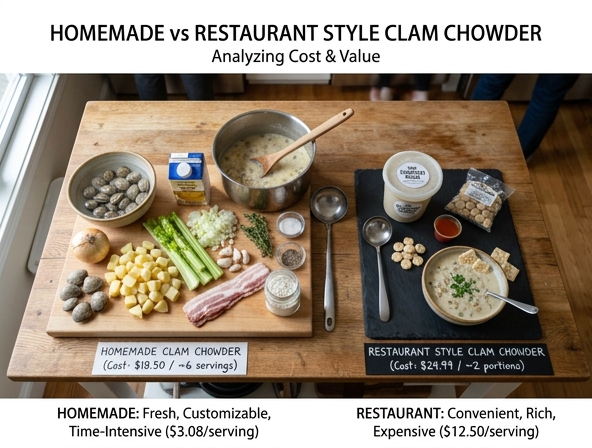
Homemade vs Restaurant Style for Clam Chowder - Analyzing Cost And Value
Many home cooks struggle to replicate the velvety texture of restaurant-grade clam chowder while managing rising grocery expenses. While standard culinary sourcing involves high-end Atlantic clams and premium heavy cream, budget constraints often force compromise. This analysis grants you a clear framework to optimize flavor and fiscal efficiency. Stipulation: this evaluation assumes consistent ingredient quality. By comparing unit costs of fresh shucked clams versus canned alternatives, we define value. The following sections evaluate procurement and labor metrics.
| Feature | Homemade Approach | Restaurant Standard |
|---|---|---|
| Core Goal | Balancing flavor with fiscal efficiency | Maintaining high-end, consistent quality |
| Ingredient Sourcing | Often compromises (e.g., canned vs. fresh) | Premium Atlantic clams and heavy cream |
| Cost Drivers | Fluctuating grocery expenses | High-end procurement and professional labor |
| Technical Focus | Managing budget vs. texture quality | Achieving signature velvety consistency |
| Value Strategy | Optimizing through unit cost analysis | Delivering value through culinary expertise |
The Great Chowder Debate: Homemade vs. Restaurant Style
There are few dishes as emblematic of coastal comfort as clam chowder. Whether it is the milky, potato-rich New England style or the tomato-based Manhattan variety, a bowl of thick, steaming chowder represents a culinary hug. However, for the home cook and the hungry diner alike, a persistent question remains: Is it better to spend hours laboring over a stockpot in your own kitchen, or should you leave the work to the professionals?
To determine whether homemade or restaurant-style clam chowder offers better value, we must look beyond the price tag. We have to examine the hidden costs of labor, ingredient quality, and the intangible "experience tax" that comes with dining out.
The Anatomy of Cost: The Homemade Investment
When you decide to make clam chowder at home, the cost breakdown begins with high-quality ingredients. To replicate a top-tier restaurant experience, you cannot simply reach for the cheapest canned clams in the aisle. High-quality chowder requires fresh or premium frozen clams, high-fat heavy cream, rendered thick-cut bacon, and organic mirepoix (onions, celery, and carrots).
- Raw Ingredients: A batch of chowder that yields six hearty servings will typically run between $25 and $40 in grocery costs, depending on the availability of fresh shellfish in your region.
- Labor: The time cost is significant. From cleaning the clams to dicing the potatoes and simmering the base until the flavors marry, you are looking at two to three hours of active and passive effort.
- The "Waste" Factor: A common hidden cost of home cooking is the leftover problem. Unless you are feeding a crowd, you often end up buying an entire bunch of celery or a full bag of potatoes for a recipe that only requires a fraction.
The Restaurant Perspective: What Are You Actually Paying For?
When you order a $12 bowl of chowder at a seaside bistro, you aren't just paying for the bowl of soup. You are paying for a complex economic model that includes overhead, consistency, and convenience.
Restaurants operate on a standard food cost percentage, usually aiming to keep ingredients at 25% to 35% of the menu price. This means that if the restaurant charges $12 for a bowl, the actual food cost to them is likely around $3 to $4. This discrepancy covers:
- Labor and Skill: You are paying for a chef who knows how to properly bloom the flour (the roux) so the chowder is velvety rather than grainy.
- Overhead: Rent, insurance, electricity, and the specialized equipment needed to maintain the proper temperature during service.
- Consistency: The biggest advantage of a restaurant is the "standardized batch." You are guaranteed that the soup will taste exactly like it did on your last visit, a feat that is often difficult to replicate in a home kitchen.
The Value Matrix: Why Homemade Wins on Quality
While restaurants offer convenience, they often struggle with the "freshness gap." To maintain profit margins, some mid-range restaurants rely on industrial-sized cans of clam base or pre-cooked frozen clams that lose their briny sweetness during the canning process. When you make it at home, you have total control.
Homemade chowder allows for a level of indulgence that restaurants often trim back to cut costs. You can increase the ratio of clams to potatoes, use premium applewood-smoked bacon, and adjust the seasoning to your exact palate. From a purely objective value perspective, $40 spent at a grocery store can yield a volume of food that would cost $120+ in a restaurant setting. The "value" of homemade is found in the sheer quantity of high-quality ingredients you can pack into the pot for the same price as two restaurant bowls.
The Hidden "Experience Tax"
There is, however, an undeniable value to the restaurant experience that cannot be quantified in spreadsheets. The "experience tax" refers to the psychological value of not having to clean up. The process of making chowder is messy: there are clam shells to dispose of, heavy cream spills, and the lingering scent of sautéed onions that hangs in your curtains for 24 hours.
Dining out is an act of outsourcing the chores of daily life. When you pay for that restaurant bowl, you are effectively buying back your time. For a busy professional, $15 for a bowl of soup is an incredible value if it means two hours of free time spent relaxing rather than standing over a stove.
The Verdict: Where Should You Spend?
The choice between homemade and restaurant-style clam chowder depends entirely on your current resource constraints:
Choose Homemade if: You prioritize ingredient quality and want to control the nutritional content (such as reducing sodium or choosing grass-fed dairy). It is also the superior choice if you enjoy the meditative nature of cooking and want to create a "leftover" meal that tastes even better the next day-chowder famously improves after 24 hours in the fridge.
Choose Restaurant-Style if: You are looking for a specific culinary experience or are in a time crunch. If you live in an area with access to fresh, local seafood, a restaurant can provide a level of expertise-such as properly cleaned, sandy-free clams-that is difficult to achieve without practice.
Ultimately, the "value" of clam chowder isn't just in the cost per ounce. It's in the satisfaction of the meal. Whether it's the personal triumph of a perfectly thickened pot at home or the simple joy of a hot bowl served to you by a coastal window, both paths offer a unique kind of nourishment. The next time you find yourself craving that creamy, briny goodness, weigh your resources-time or money-and choose the path that makes the bowl taste just a little bit better.
Disclaimer:
The information provided on Eateryn is for general educational and informational purposes only and is not intended as medical, nutritional, or healthcare advice. It should not be used to diagnose, treat, cure, or prevent any disease or medical condition.
Always consult a qualified physician, registered dietitian, or other certified healthcare professional before making changes to your diet, exercise routine, or lifestyle, or regarding any medical questions or concerns you may have. Never disregard or delay seeking professional medical advice because of something you have read on this website.