
Homemade vs Boxed for Macaroni and Cheese - Is The Effort Worth The Taste
Homemade vs. Boxed Macaroni and Cheese
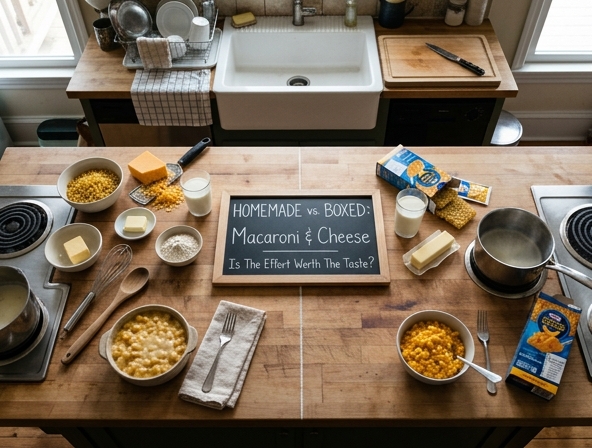
Navigating the dinner rush often pits the convenience of boxed mixes against the satisfaction of scratch cooking. While standard pantry staples offer speed, homemade recipes prioritize complex flavor profiles. This trade-off between culinary integrity and time requires careful consideration; note that gourmet results depend heavily on ingredient quality, such as aged sharp cheddar versus processed powders. This analysis evaluates whether the artisanal effort truly justifies the preparation time when compared to modern boxed convenience.
| Comparison Aspect | Boxed Macaroni & Cheese | Homemade Macaroni & Cheese |
|---|---|---|
| Primary Benefit | Convenience and speed during a dinner rush. | Culinary integrity and complex flavor profiles. |
| Ingredients | Uses processed cheese powders. | Utilizes high-quality components like aged sharp cheddar. |
| Effort Level | Minimal preparation time. | Significant preparation time required. |
| Culinary Outcome | Standard, consistent result. | Artisanal, superior taste experience. |
Homemade vs. Boxed: Is the Effort Behind Macaroni and Cheese Worth the Taste?
There are few dishes in the culinary lexicon that carry as much emotional weight as macaroni and cheese. It is the ultimate comfort food, a dish that bridges the gap between childhood nostalgia and adult culinary experimentation. Yet, the debate between the quick, neon-orange convenience of the boxed variety and the artisanal, bubbly-brown perfection of homemade mac and cheese remains one of the most divisive topics in the home kitchen. Does the hour of labor and the pile of dishes justify the outcome, or is the blue box holding its own against the stove-top masters?
The Case for the Blue Box: Nostalgia and Efficiency
To dismiss the boxed macaroni and cheese-be it the iconic Kraft blue box or more modern, "organic" alternatives-is to ignore the role of speed in modern nourishment. There is an undeniable chemistry to the powdered cheese packet. It relies on sodium citrate and emulsifiers to create a texture that is remarkably consistent. For many, this specific flavor profile is a "flavor memory"-a taste that defines safety, ease, and simplicity.
The primary argument for the box is, and always will be, efficiency. After a ten-hour workday, when the mental load of decision-making is depleted, the box provides a guaranteed result in ten minutes. It requires one pot, a splash of milk, and a knob of butter. It is a "low-stakes" meal; there is very little risk of burning the sauce or ending up with a clumpy mess. The boxed version provides a specific type of satisfaction: a salty, creamy, unapologetically artificial joy that scratch-made recipes often struggle to replicate without significant technical effort.
The Art of the Homemade: Culinary Integrity
On the other side of the spectrum lies the homemade route. This is not merely a meal; it is a process. It begins with the *béchamel*-the fundamental French mother sauce-transformed into a *mornay* by the addition of high-quality, freshly grated cheese. The difference here is visceral. While boxed cheese sauce is a uniform liquid, homemade mac and cheese offers complexity.
When you make it from scratch, you have total control over the flavor profile. You can choose a nutty Gruyère to provide depth, a sharp white cheddar for a sophisticated tang, or a Monterey Jack for supreme meltability. You can incorporate aromatics like garlic, onion powder, or a hint of nutmeg. You can control the texture of the pasta, ensuring it remains *al dente* even after being baked in a casserole dish. When you pull a cast-iron skillet of homemade mac and cheese from the oven, with its golden-brown, crispy breadcrumb crust contrasting against the molten, stretchy interior, you are eating something that bears little resemblance to the boxed variety.
The Effort-Reward Matrix
So, is the effort worth it? The answer depends entirely on the "Effort-Reward Matrix."
- The Time Investment: Boxed mac and cheese takes roughly 10 minutes. Homemade, if done properly-including grating cheese, making a roux, and baking-can take upwards of 45 to 60 minutes.
- The Cleanup: Boxed requires a single pot and a strainer. Homemade often involves a saucepan for the sauce, a pot for the pasta, a baking dish, and multiple measuring utensils.
- The Nutritional Value: While neither is a health food, homemade allows for control over sodium, the quality of dairy used, and the ability to add fiber-rich vegetables or higher-quality protein, which the boxed version lacks.
- The Sensory Experience: Boxed provides a singular, consistent experience. Homemade provides a nuanced, layered, and texturally varied experience.
Finding the Middle Ground: Elevating the Box
Perhaps the reason this debate persists is that we often view it as a binary choice. Many cooks have found that the middle ground is actually the "hacked" box. By using the boxed pasta but discarding the packet in favor of a quick homemade cheese sauce, or by taking the boxed kit and elevating it with fresh chives, sautéed mushrooms, or a handful of real shredded cheese, you can bridge the gap. This "hybrid" approach offers 80% of the flavor of homemade with 50% of the effort.
The Final Verdict
If you are looking for a meal that serves as a warm blanket for the soul after a grueling day, the box is not just "acceptable"-it is a legitimate culinary choice. It fulfills a specific function in the ecosystem of home cooking: reliability.
However, if your goal is to experience food as a craft, to explore how high-quality fats and proteins interact, and to create something that feels like an event, then the effort of homemade is undeniably worth it. The homemade version is a gift you give to yourself (or your guests). It turns a pedestrian starch into a main course that commands attention.
Ultimately, the "worth" of the effort isn't measured in calories or minutes saved. It is measured in the pleasure of the process. If you enjoy the rhythm of grating cheese and the satisfaction of whisking a smooth roux, the effort is the point. If you just want to get dinner on the table and return to your life, the box is your best friend. There is room in every pantry for both.
Disclaimer:
The information provided on Eateryn is for general educational and informational purposes only and is not intended as medical, nutritional, or healthcare advice. It should not be used to diagnose, treat, cure, or prevent any disease or medical condition.
Always consult a qualified physician, registered dietitian, or other certified healthcare professional before making changes to your diet, exercise routine, or lifestyle, or regarding any medical questions or concerns you may have. Never disregard or delay seeking professional medical advice because of something you have read on this website.