
Homemade Sauce vs Store Bought for Barbecue Ribs - Evaluating Quality And Convenience
Balancing culinary effort with time constraints is a constant struggle for barbecue enthusiasts. While standard retail options like mass-produced hickory blends offer immediate convenience, crafting a scratch-made molasses glaze remains the gold standard for flavor depth. Mastering this choice guarantees elite results regardless of your schedule. Note that success hinges on ingredient quality rather than preparation speed alone. We will analyze these pathways, comparing bottled convenience against complex homemade infusions to help you achieve the perfect rib profile.
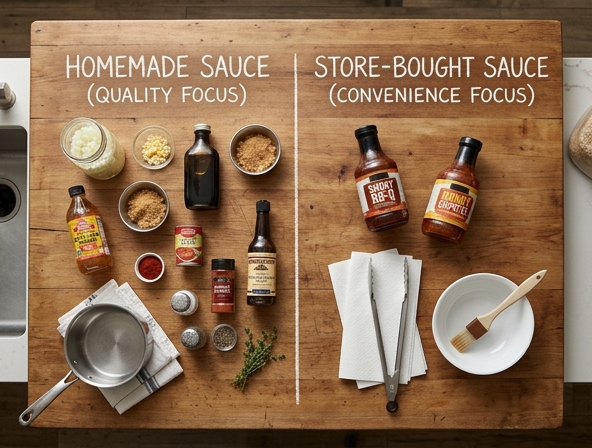
| Comparison Factor | Store-Bought Sauce | Homemade Sauce |
|---|---|---|
| Convenience | High; immediate readiness. | Lower; requires prep time and effort. |
| Flavor Profile | Standard, mass-produced (e.g., hickory blends). | Complex, superior depth (e.g., molasses glaze). |
| Culinary Status | Practical retail option. | The gold standard for flavor. |
| Success Metric | Consistency and speed. | Ingredient quality and infusion complexity. |
The Barbecue Dilemma: Homemade Sauce vs. Store-Bought for Your Next Rack of Ribs
There is perhaps no culinary ritual more revered in American culture than the weekend barbecue. The smoke, the slow rendering of fat, and the anticipation of a perfectly cooked rack of ribs represent the pinnacle of outdoor cooking. However, once the meat is tender and the smoke has done its work, you face a critical crossroad: the final glazing. Do you reach for the bottle of sauce you picked up on sale at the supermarket, or do you take the time to craft a signature sauce from scratch?
This debate-homemade versus store-bought-is as old as the backyard grill itself. While one side champions the virtues of personalization and ingredient purity, the other stands firmly on the pillars of convenience and scientific consistency. To determine which is right for your next cookout, we must peel back the label and look at the chemistry, the art, and the practicality of the barbecue sauce experience.
The Case for the Homemade Signature
Making your own barbecue sauce is an act of culinary intimacy. When you stand over the stove whisking together your base-be it tomato, vinegar, mustard, or even fruit-based-you are taking control of the flavor profile in a way no manufacturer can match. Homemade sauce offers several distinct advantages:
- Tailored Flavor Profiles: Do you want a sauce that leans heavy into smoky chipotle and maple syrup? Perhaps you prefer a Carolina-style mustard tang with a sharp vinegar bite. Homemade sauce allows you to adjust the sweetness, heat, and acidity to match your specific palate and the rub used on the meat.
- Ingredient Transparency: Store-bought sauces are often packed with high-fructose corn syrup, thickeners, artificial smoke flavors, and preservatives. When you make it yourself, you control the quality of the molasses, the freshness of the spices, and the caliber of the vinegar.
- The "Secret Ingredient" Factor: There is a unique psychological satisfaction in serving food that is entirely your own. Whether it's a splash of bourbon, a touch of local honey, or a unique blend of toasted spices, homemade sauce invites conversation and elevates the dish from a "meal" to an "experience."
However, the homemade route is not without its challenges. It requires time, inventory management of spices, and a trial-and-error process. A poorly balanced homemade sauce can be too thin, overly acidic, or lack the "stickiness" required to cling to a rack of ribs through the final stages of a glaze.
The Store-Bought Reality: Convenience and Consistency
It is easy to turn up one's nose at store-bought barbecue sauce, but to dismiss it entirely is to ignore the massive advancements in modern food science. Manufacturers spend millions of dollars perfecting the "cling factor"-the viscosity and texture that ensures a sauce stays on the meat rather than dripping off into the coals.
The benefits of the store-bought approach are undeniable:
- Consistency: When you find a brand you love, you know exactly what the result will be. There is no risk of a "bad batch." For a large party where the stakes are high, predictability is a massive asset.
- Time Efficiency: Hosting a barbecue is labor-intensive enough without simmering a sauce for forty-five minutes. Reaching for a bottle allows you to focus your energy on managing the fire, temperature control, and side dishes.
- Culinary Engineering: Large brands have access to ingredients-such as specific types of natural gums or specialized smoke extracts-that are difficult to source at a home-kitchen level. These ingredients are designed to survive the intense heat of a grill without breaking down or turning bitter.
Finding the Middle Ground: "Doctoring" Your Sauce
Many professional pitmasters have discovered a secret: you don't have to choose between binary options. The "doctoring" method is perhaps the most practical approach for the modern home cook. By starting with a quality store-bought base and adding your own flair, you get the best of both worlds.
If you choose to doctor a sauce, try these modifications:
- Add Complexity: Whisk in a tablespoon of high-quality espresso powder or a splash of dark stout beer.
- Adjust the Heat: Freshly minced habaneros or a generous dash of premium hot sauce can wake up a flat, overly sweet commercial product.
- Balance the Acidity: If a sauce is too sweet, a squeeze of fresh lime juice or a splash of apple cider vinegar can brighten the entire flavor profile, making it taste "fresher" and more homemade.
The Verdict: Which Should You Choose?
The choice ultimately depends on the occasion. If you are experimenting, practicing, or hosting a small gathering of friends who appreciate craft, go homemade. The pride of creation and the ability to customize the sauce to the specific rub you used on the ribs will yield a superior, more cohesive final product.
If you are catering for a large crowd, managing a difficult fire, or simply want to ensure a stress-free afternoon, rely on a high-quality store-bought sauce-but don't be afraid to add your own secret touch. The goal of barbecue, after all, is not to prove you can make every component from scratch; it is to serve delicious, smoky, tender ribs that bring people together.
Ultimately, the sauce is just a supporting character. Whether it comes from a glass bottle or a copper saucepan, if the meat is cooked with patience and care, the sauce will simply be the final flourish on a masterpiece.
Disclaimer:
The information provided on Eateryn is for general educational and informational purposes only and is not intended as medical, nutritional, or healthcare advice. It should not be used to diagnose, treat, cure, or prevent any disease or medical condition.
Always consult a qualified physician, registered dietitian, or other certified healthcare professional before making changes to your diet, exercise routine, or lifestyle, or regarding any medical questions or concerns you may have. Never disregard or delay seeking professional medical advice because of something you have read on this website.