
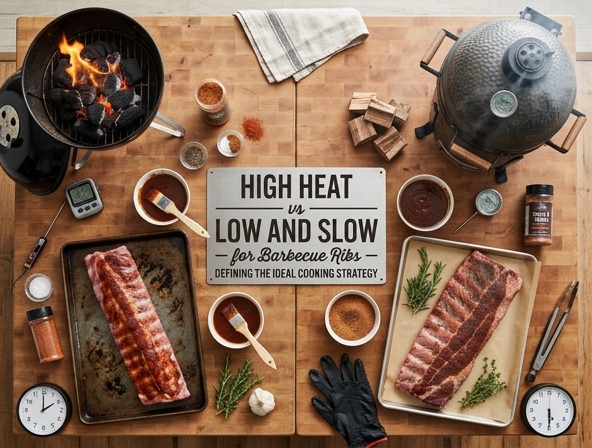
High Heat vs Low And Slow for Barbecue Ribs - Defining The Ideal Cooking Strategy
Achieving the perfect rib texture-balancing tenderness with a clean bite-is a persistent challenge. While traditionalists prioritize the 225°F "low and slow" method, high-heat techniques are gaining traction. Mastering these differences grants you precise control over bark development and moisture retention. Note that outcomes depend heavily on equipment and meat quality. From award-winning pitmasters to backyard enthusiasts, both strategies offer distinct merits. This guide compares these approaches to help you determine the optimal cooking strategy.
| Strategy | Methodology | Key Benefits | Considerations |
|---|---|---|---|
| Low and Slow | Typically 225°F over a long duration. | Consistency, traditional tenderness, and even rendering of fats. | Requires patience; long cook time; standard for traditionalists. |
| High Heat | Higher temperature cooking techniques. | Faster cooking, improved bark development, and distinct texture control. | Requires monitoring to prevent drying; outcome relies on equipment/meat quality. |
| Note: Choosing between these methods depends on your specific equipment and desired balance of tenderness versus texture. | |||
High Heat vs. Low and Slow: Decoding the Ideal Strategy for Perfect Barbecue Ribs
In the world of barbecue, few debates are as spirited-or as enduring-as the conflict between the traditional "Low and Slow" method and the more modern, aggressive "High Heat" approach. For generations, the pitmaster's creed was etched in stone: 225°F (107°C) for six to eight hours, patience being the most essential spice. However, as culinary science has evolved and the competitive BBQ circuit has pushed for more precise textures, the "Hot and Fast" school of thought has emerged as a formidable contender.
Understanding which path to take requires more than just picking a temperature setting; it requires an understanding of how heat, smoke, and connective tissue interact. Whether you are a weekend warrior or an aspiring competition cook, knowing the science behind these strategies is the key to mastering the rib.
The Philosophy of Low and Slow: The Path of Patience
Low and Slow is the hallmark of traditional American barbecue. Operating at temperatures between 225°F and 250°F, this method is designed to allow the smoker to do the heavy lifting over a prolonged period. The primary scientific goal here is the slow, deliberate breakdown of collagen.
Ribs, specifically pork spare ribs, are rich in connective tissue. Collagen, a tough protein, begins to melt into gelatin when held at internal temperatures between 160°F and 180°F for an extended duration. By keeping the ambient temperature low, you create a large window for this transformation to occur without the risk of overcooking the actual muscle fibers. Furthermore, the longer the meat stays in the smoker, the more time the surface has to interact with smoke particles and form a deep, mahogany-colored bark through the Maillard reaction.
Pros:
- Forgiveness: A lower temperature leaves a wider margin of error. If you get distracted by a beer or a conversation, your ribs aren't likely to dry out in a ten-minute window.
- Smoke Integration: Longer exposure to wood smoke results in a more profound, deep-seated smokiness that penetrates the meat.
- Rendered Fat: The extended time allows for a more thorough rendering of the fat cap, resulting in an exceptionally buttery mouthfeel.
The Case for High Heat: Precision and Modern Texture
High Heat-often referred to as "Hot and Fast"-typically involves cooking ribs at temperatures between 300°F and 350°F. While this may seem sacrilegious to purists, it is rooted in practical physics. Proponents argue that since ribs are a relatively thin cut of meat, they do not need eight hours to reach the desired state of tenderness.
When cooking at 325°F, the heat penetrates the meat more efficiently. Because the cook time is reduced-often to three or four hours-there is significantly less time for moisture to evaporate from the surface of the meat. Surprisingly, many cooks find that High Heat ribs are actually juicier than their Low and Slow counterparts because the muscle fibers have had less time to tighten and squeeze out their internal juices.
Pros:
- Texture Control: High heat often produces a "bite-through" texture rather than the "fall-off-the-bone" mushiness that over-boiled ribs suffer from. This is widely considered the gold standard in competition BBQ.
- Efficiency: In a world of busy schedules, trimming four hours off your cook time is a massive logistical advantage.
- Bark Quality: High heat encourages faster, more pronounced browning and bark formation, often resulting in a superior "crust" that pairs beautifully with a sweet or tangy glaze.
Comparative Analysis: The Great Rib Divide
When choosing between these two, you must define your goal. If you are looking for that classic, falling-off-the-bone tender experience that makes for a messy, satisfying backyard meal, Low and Slow is your best bet. It mimics the style of the great smokehouses of the Carolinas and Texas.
Conversely, if you prefer a rib with "tug"-a clean bite that separates from the bone but holds its shape-High Heat is the superior methodology. Judges in the Kansas City Barbeque Society (KCBS) circuit almost universally look for a clean bite. A rib that falls off the bone is actually considered a "fault" in competition, as it implies the meat was overcooked to the point of structural failure.
The Hybrid Approach: The "Best of Both" Strategy
Many modern pitmasters have found success by bridging the gap. This often takes the form of an initial high-heat phase, followed by a wrapping stage, and a final low-heat finish. By starting the ribs at 300°F, you jumpstart the crust formation and render the surface fat quickly. Once the desired color is achieved, you can wrap the ribs in foil or butcher paper with a splash of liquid (apple juice, cider vinegar, or honey) to steam and tenderize the meat, finishing them at a lower heat.
This hybrid method allows you to manipulate the smoke profile early on, control the texture in the middle, and perfect the bark glaze at the end. It takes the guesswork out of the process and ensures that your ribs have both the deep smoke flavor of a traditional cook and the refined texture of a competition-style rib.
Final Verdict: How to Choose
The "Ideal" strategy depends entirely on your specific pit and your personal preference. If you are using a charcoal smoker or an offset stick-burner, Low and Slow is often easier to manage because the fire is more stable at lower temperatures. If you are using a pellet grill, a gas smoker, or an electric unit, you might find that the higher efficiency and cleaner burn of High Heat work better with your hardware.
Ultimately, don't let the dogma of "low and slow" prevent you from experimenting. Barbecue is a science of trial and error. Try a rack at 225°F for six hours, and the following weekend, try a rack at 325°F. You may find that your palate prefers the punchy bark of the high-heat method or the deep, lingering smoke of the traditional approach. The beauty of BBQ is that no matter which side of the fence you land on, the result is still a delicious rack of ribs.
Disclaimer:
The information provided on Eateryn is for general educational and informational purposes only and is not intended as medical, nutritional, or healthcare advice. It should not be used to diagnose, treat, cure, or prevent any disease or medical condition.
Always consult a qualified physician, registered dietitian, or other certified healthcare professional before making changes to your diet, exercise routine, or lifestyle, or regarding any medical questions or concerns you may have. Never disregard or delay seeking professional medical advice because of something you have read on this website.