
Hand-Tossed vs Machine-Pressed for Pizza - The Importance of Air Pockets
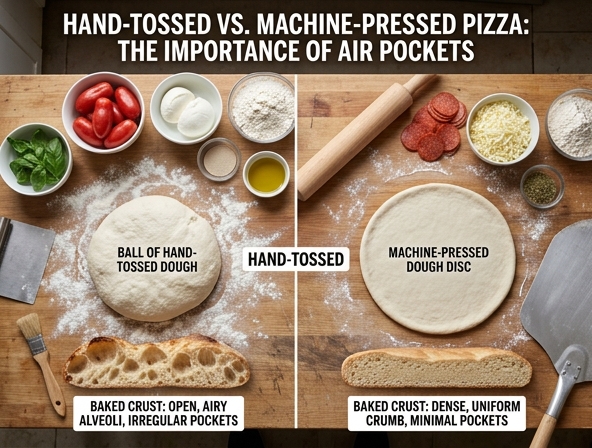
Many chefs struggle with heavy, dense crusts that lack the artisanal texture customers crave. While machine-pressing offers unmatched speed and uniformity, it often collapses the delicate structure required for an exceptional bake. Conversely, hand-tossing preserves essential air pockets, granting the crust a light, airy crumb. Note that this traditional approach requires higher skill and longer proofing times. This technique is fundamental to the iconic Neapolitan crust. Below, we analyze how specific aeration strategies significantly elevate your pizza program.
| Feature | Hand-Tossed | Machine-Pressed |
|---|---|---|
| Texture/Crumb | Light, airy with preserved air pockets | Dense and heavy |
| Operational Pros | Artisanal quality and structure | Unmatched speed and uniformity |
| Operational Cons | Requires high skill and long proofing times | Collapses the dough's delicate structure |
| Ideal Use Case | Neapolitan-style pizza | High-volume, efficiency-focused production |
The Soul of the Crust: Why Hand-Tossed Pizza Reigns Supreme over Machine-Pressed
For the uninitiated, pizza is merely a vehicle for cheese, tomato sauce, and toppings. But for the true pizzaiolo and the discerning aficionado, the crust is the canvas-and arguably the most important element of the entire experience. It is here, in the structure of the dough, that the battle between convenience and craftsmanship is fought. The debate between hand-tossed and machine-pressed dough is not just about tradition; it is a fundamental discussion about the science of fermentation and the sanctity of the air pocket.
The Anatomy of an Air Pocket
To understand why the method of stretching matters, we must first understand what occurs inside a ball of pizza dough. During the fermentation process, yeast consumes the sugars present in the flour, releasing carbon dioxide as a byproduct. These gas bubbles are trapped within a complex, elastic network of gluten proteins. This network acts like a series of tiny balloons, holding the structure together while allowing the dough to rise.
When we talk about an "open crumb" or a "light crust," we are talking about these trapped pockets of air. When the pizza hits the scorching heat of a 700°F (370°C) oven, the air inside these pockets expands rapidly-a process known as "oven spring." This expansion is what creates the airy, puffy, slightly charred rim known as the cornicione. Without these air pockets, a pizza crust becomes a dense, chewy, or cracker-like disc that lacks the sensory complexity that makes artisanal pizza so sought after.
The Machine-Pressed Dilemma: Speed vs. Structure
The machine-pressed method-often used by high-volume chains and mass-market pizzerias-is driven by the need for consistency and speed. A hydraulic press or a set of rollers flattens a ball of dough into a perfect, uniform circle in seconds. While this is a marvel of industrial efficiency, it is an absolute catastrophe for the dough's internal architecture.
The intense, uniform pressure of a machine crushes the delicate gluten network. It forces the trapped carbon dioxide out of the dough, effectively "degassing" it before it ever reaches the oven. Furthermore, the heat generated by the friction of some machines can prematurely weaken the proteins, resulting in a crust that lacks structural integrity. The end result is a flat, dense disc that offers little resistance to the teeth and lacks the complex textural contrast between a crisp exterior and a light, cloud-like interior.
The Art of the Hand-Toss
In contrast, hand-tossing is a gentle, rhythmic dance. It utilizes centrifugal force and gravity to expand the dough, rather than mechanical force. By working from the center outward and keeping the rim intact, a skilled pizzaiolo pushes the gases from the center toward the edge, encouraging the creation of larger, more vibrant air pockets in the cornicione.
This artisanal technique is not merely for show. By treating the dough with respect, the maker preserves the integrity of the gluten strands. The resulting crust is uneven, possessing a character that is impossible to replicate in a factory. You get thin, delicate sections that crisp up instantly, contrasted by thick, airy pockets that are soft, chewy, and deeply flavorful. This contrast is the hallmark of a great pizza.
The Sensory Impact: Why Texture Dictates Flavor
Texture is the primary driver of our perception of flavor. When we bite into a hand-tossed crust with a well-developed, airy rim, the experience is multi-dimensional. The crisp surface provides an initial snap, followed by the soft, aerated crumb that absorbs just enough steam to stay moist without becoming gummy. This aeration also increases the surface area exposed to heat, allowing for better Maillard reaction-the browning process that imparts deep, nutty, and savory notes to the bread.
Machine-pressed crusts, by contrast, offer a one-dimensional texture. Because they lack those pockets of air, they have a higher thermal mass. They heat more slowly and often end up tasting like a dense, heavy cracker or a piece of dry flatbread. When a crust is too dense, it masks the nuanced flavor of a long-fermented dough, leaving the diner with a bland, floury finish.
The Future of Craft: The Middle Ground
While the industry continues to push for faster, cheaper production, there has been a significant "pizza renaissance" globally. Consumers are becoming more educated about the chemistry of their food. We are seeing a return to high-hydration doughs, long cold-fermentation processes (often 48 to 72 hours), and a renewed commitment to hand-shaping.
Even among some semi-automated shops, technology is being adapted to mimic the human touch. Some modern dough-sheeters are designed to be extremely gentle, attempting to preserve the gas structure, though they still rarely match the "live" feeling of dough that has been opened by hand.
Conclusion: The Verdict
If you are looking for a pizza that is truly memorable, the method of production is non-negotiable. The air pocket is not just a bubble; it is the physical manifestation of time, temperature, and technique. It is the difference between a mass-produced commodity and a piece of culinary art. When you order your next pizza, look at the rim. If you see those characteristic irregular bubbles and a crust that looks like it was shaped by a human hand, you can be certain that you are about to experience the true soul of pizza-a symphony of texture and flavor that only hand-tossing can provide.
In the world of dough, the machine may offer efficiency, but it will never replace the magic of a set of human hands working in harmony with biology. The air pocket is the true test of quality; let us always choose to preserve it.
Disclaimer:
The information provided on Eateryn is for general educational and informational purposes only and is not intended as medical, nutritional, or healthcare advice. It should not be used to diagnose, treat, cure, or prevent any disease or medical condition.
Always consult a qualified physician, registered dietitian, or other certified healthcare professional before making changes to your diet, exercise routine, or lifestyle, or regarding any medical questions or concerns you may have. Never disregard or delay seeking professional medical advice because of something you have read on this website.