
Hand-Rolled vs Machine for Bagel - Evaluating artisan production quality
Hand-Rolled vs. Machine for Bagels: Evaluating Artisan Quality
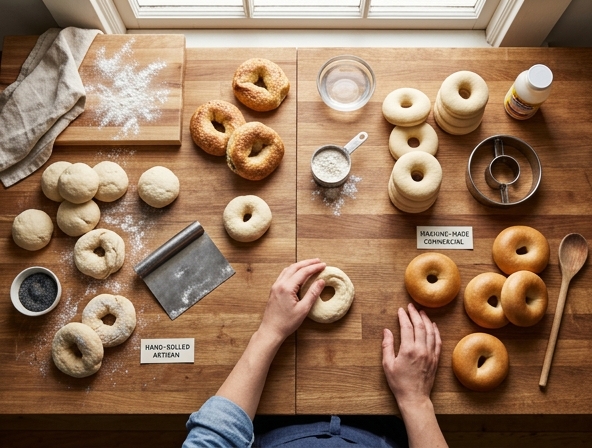
Scaling bagel production often compromises the characteristic chew and crust defining true artisan quality. While many bakeries rely on high-volume automated formers to manage overhead, these methods frequently sacrifice texture for output. However, intentional production design grants a superior, market-leading profile without abandoning craft. Please note: operational success requires matching equipment to your specific dough hydration. Examples like Ess-a-Bagel illustrate how hybrid techniques preserve integrity. This guide evaluates how manual versus industrial methods influence your growth.
| Aspect | Summary Details |
|---|---|
| Core Subject | The trade-off between artisan quality and production scaling in bagel manufacturing. |
| The Challenge | High-volume automated equipment often compromises the signature chew and crust that define premium bagels. |
| The Solution | Implementing intentional production design and hybrid techniques to scale while maintaining craft integrity. |
| Critical Success Factor | Operational success depends on matching specific machinery to the dough's hydration levels. |
| Industry Benchmark | Ess-a-Bagel is cited as a prime example of successfully using hybrid methods to preserve artisan quality. |
The Bagel Dichotomy: Hand-Rolled Craftsmanship vs. Industrial Efficiency
In the world of professional baking, few subjects incite as much debate as the humble bagel. It is a product defined by its paradoxes: it must be simultaneously tough and tender, dense yet airy, and characterized by a glossy, blistered crust that gives way to a chewy, almost resilient crumb. While the ingredients-high-gluten flour, water, malt syrup, salt, and yeast-are humble and constant, the methodology of production remains the primary variable in determining the quality of the final product. At the heart of this divide lies the choice between the labor-intensive art of hand-rolling and the high-output efficiency of industrial machinery.
The Anatomy of the Hand-Rolled Bagel
To the artisan baker, a bagel is not merely a ring of dough; it is a structural exercise in gluten management. The hand-rolling process, specifically the "rope-and-loop" method, is a rhythmic, almost meditative practice that serves a critical scientific purpose. When a baker takes a portion of fermented dough and rolls it out into a rope, they are manually aligning the gluten strands. By wrapping the rope around their palm and sealing it with a deft overlap on the counter, the baker creates a seamless, circular structure.
This process is far more than traditional theater. Hand-rolling allows the baker to feel the dough, adjusting the pressure based on the hydration level and the stage of fermentation. Because the human hand is inconsistent, each bagel ends up with subtle variations in thickness and tension. These irregularities are not defects; they are the hallmarks of artisan production. During the boil and subsequent bake, these variations create uneven pockets of air and diverse textures. A hand-rolled bagel often features a "shaggy" or slightly uneven underside where the ends were joined, providing a delightful textural contrast that industrial machines simply cannot replicate.
The Machine-Made Reality
On the other side of the production spectrum, we find the bagel divider-former. These machines, designed for high-volume wholesale operations, utilize augers and extruders to push dough through specialized dies. The machine then cuts the dough into uniform pieces, punches a hole through the center, or uses a folding mechanism to join the ends.
The efficiency of the machine is undeniable. A commercial bagel line can produce thousands of units per hour, ensuring that every bagel looks exactly like its neighbor. For a supermarket shelf or a chain restaurant, this uniformity is a necessity-consistency is the primary metric of brand reliability. However, this uniformity comes at a cost. The high-speed extrusion process often stresses the gluten matrix in ways that can result in a tighter, more uniform crumb structure that lacks the complex, varied chew of a hand-formed bagel. Furthermore, because machines lack the "feel" of a baker, they often require the dough to be formulated with additives, dough conditioners, and preservatives to ensure it handles well through the mechanical hardware, effectively distancing the product from its traditional, clean-label roots.
Evaluating the Sensory Experience
When comparing the two, the primary differentiator is the "bite." A high-quality hand-rolled bagel should have a distinct structural integrity. When you pull it apart, the crumb should be slightly elongated, reflecting the hand-stretched gluten strands. The crust, having been boiled and baked in a deck oven, should be thick and blistered, providing a satisfying "snap" before the jaw engages with the chewy interior.
Machine-made bagels, conversely, often suffer from what bakers call "doughiness." Because the machinery tends to compress the dough during the forming process, the interior crumb can become too compact, leading to a texture that feels more like a standard bread roll shaped into a ring. Additionally, industrial bagels are frequently baked on conveyor belts in tunnel ovens. While these ovens are marvels of engineering, they struggle to replicate the intense, radiant heat of a stone hearth, often resulting in a thinner, less distinctive crust that softens prematurely.
The Economic and Cultural Conflict
The artisan shop faces a brutal reality: hand-rolling is an incredibly expensive form of labor. It requires skilled staff who can work quickly and consistently, often in the pre-dawn hours. In an era where food costs are rising and competition from mass-market suppliers is fierce, the artisan bagel shop is fighting a battle against time. To charge a price that reflects the labor cost of hand-rolling, the baker must ensure that the quality gap between their product and the local supermarket bagel is immediately apparent to the consumer.
Yet, there is a cultural preservation component to this fight. The bagel, born from Eastern European tradition, is a testament to the idea that simple ingredients, when treated with patience and physical manipulation, become something greater than the sum of their parts. When we abandon the hand-roll, we abandon the history of the product. We shift the bagel from a culinary staple to a mere commodity.
Conclusion: Is the Machine Always the Enemy?
It would be reductive to say that all machine-made bagels are failures. Advances in technology have allowed some high-end bakeries to use hybrid systems-dividing dough mechanically but shaping it by hand-to strike a balance between output and quality. Ultimately, the evaluation of artisan quality in bagel production comes down to the baker's philosophy.
If the goal is to feed as many people as possible at the lowest price, the machine is an essential tool. However, if the goal is to honor the craft and provide an experience that is memorable and distinct, the hand-roll is non-negotiable. The artisan bagel is a conversation between the baker's hands and the dough; a machine, no matter how sophisticated, can never hold that conversation. As consumers, our support for the hand-rolled bagel is more than a preference for a better breakfast-it is a vote for the persistence of craftsmanship in an increasingly automated world.
Disclaimer:
The information provided on Eateryn is for general educational and informational purposes only and is not intended as medical, nutritional, or healthcare advice. It should not be used to diagnose, treat, cure, or prevent any disease or medical condition.
Always consult a qualified physician, registered dietitian, or other certified healthcare professional before making changes to your diet, exercise routine, or lifestyle, or regarding any medical questions or concerns you may have. Never disregard or delay seeking professional medical advice because of something you have read on this website.