
Hand Mix vs Blender for Pancakes - Controlling Your Batter Texture
Hand Mix vs. Blender: Controlling Batter Texture
Achieving the perfect pancake texture is often frustrating, leading to either unappetizing lumps or rubbery, over-developed gluten. While traditional whisking or basic blending are standard methods, neither guarantees uniform results.
Mastering these tools provides greater control over aeration and elasticity. Note that technique remains paramount; over-processing ruins batter regardless of the implement. For fluffy buttermilk pancakes, whisking is superior, whereas high-speed blenders are essential for smooth crepes. We will now examine how each tool shapes your final plate.
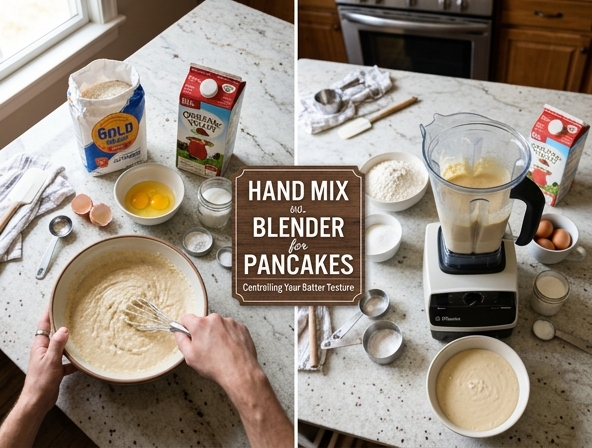
| Mixing Method | Best Used For | Key Advantage |
|---|---|---|
| Hand Whisking | Fluffy buttermilk pancakes | Provides superior control over aeration and minimizes the risk of over-developing gluten. |
| High-Speed Blender | Smooth, thin crepes | Essential for achieving a perfectly uniform, lump-free consistency. |
| General Advice | All batter types | Avoid over-processing: Regardless of the tool, excessive mixing leads to rubbery, tough pancakes. |
Hand Mix vs. Blender for Pancakes: Mastering the Art of Batter Texture
The humble pancake is a staple of breakfast comfort, a dish so deceptively simple that it often masks the complex culinary science occurring within the mixing bowl. Every home cook has faced the internal debate: do I reach for the trusty balloon whisk and a sturdy bowl, or do I drop everything into the blender for a quick, automated emulsification? While both methods yield a cooked pancake, the texture, lift, and structural integrity of the final product differ significantly.
The Chemistry of the Batter: Gluten and Leavening
To understand why your choice of tool matters, we must first look at the chemistry. Pancakes rely on two primary mechanisms: gluten formation and leavening. Flour contains proteins that, when hydrated and agitated, form gluten strands. In bread, we want this; in pancakes, we fear it. Excessive gluten development turns a fluffy pancake into a dense, rubbery disc. Simultaneously, leavening agents like baking powder react with moisture and heat to create carbon dioxide bubbles, which provide that sought-after "fluff" factor.
The Case for the Hand Whisk: The Artisan's Approach
The traditional hand-whisk method is favored by pastry chefs and breakfast purists for one primary reason: control. When you mix by hand, you are manually monitoring the resistance of the batter. You can feel the moment the flour is fully incorporated, and more importantly, you can stop precisely when the streaks of dry flour disappear.
Pros of Hand Mixing:
- Lump Tolerance: Contrary to popular belief, small lumps in pancake batter are not a failure; they are a feature. These pockets of dry flour do not develop gluten, and when they hit the hot griddle, they create soft, pillowy pockets of tenderness.
- Gentle Folding: Using a whisk allows you to use a folding motion rather than a high-speed shearing motion, which preserves the air pockets created by your leavening agents.
- Precision: You have immediate tactile feedback, preventing the "over-mixing" trap that often occurs when an appliance takes over.
The Case for the Blender: Efficiency and Uniformity
The blender is the modern kitchen's answer to the "time-poor" cook. It excels in speed and produces a remarkably uniform batter. If you are preparing a recipe that calls for blending oats, fruits, or even cottage cheese into the batter, the blender is an essential tool. However, the convenience comes with a high risk of "over-processing."
Pros of Blending:
- Speed: A perfect, homogeneous batter in under 30 seconds.
- Integration: Excellent for recipes incorporating blended fruit (like bananas or blueberries) or fibrous ingredients.
- Consistency: Perfect for those who prefer a thinner, crepe-style pancake that requires a perfectly smooth, silky batter to spread evenly across the pan.
The Danger Zone: When you run a high-powered blender, the blades act like a gluten-producing engine. The intense shear force quickly stretches the proteins in the flour, resulting in a batter that is elastic and tough. If you choose the blender, the golden rule is "Pulse, Don't Process." Keep the speed low, and stop the moment the liquid becomes opaque.
Determining Your Goal: What Texture Do You Want?
Your choice of mixing tool should ultimately be dictated by the type of pancake you are aiming for:
1. The "Fluffy Diner" Pancake
If you want tall, thick, cloud-like pancakes, the hand-whisk method is non-negotiable. Combine your dry and wet ingredients separately, then combine them using a folding motion until just barely moistened. The batter should look messy and somewhat lumpy. If you blend this, the lack of lumps will result in a flatter, more refined, but less "tall" pancake.
2. The "Swedish Crepe" or "Dutch Baby"
If your goal is a thin, delicate, golden-brown pancake, the blender is your best friend. A thin batter requires the high-speed emulsification that only a blade can provide, ensuring no dry pockets exist to ruin the thin texture of a crepe.
Pro Tips for Perfect Batter Every Time
Regardless of whether you use a whisk or a blender, there is one secret step that transcends tool preference: The Resting Phase.
After you have mixed your batter, let it sit on the counter for at least 10 to 15 minutes. This resting period allows the starch molecules to swell and absorb the liquid, which stabilizes the batter and ensures that the leavening agents are properly hydrated. It also allows the gluten that was developed during the mixing process to relax. A rested batter will always cook more evenly, rise higher, and have a more tender crumb than a batter used immediately upon mixing.
Conclusion: The Verdict
If you are a casual home cook looking for the classic, fluffy Sunday morning pancake, stow the blender and pick up the whisk. The extra two minutes of manual labor offer a level of texture control that machines simply cannot replicate. Reserve the blender for those times when you are experimenting with complex additives or seeking that perfectly smooth, elegant crepe finish.
Remember, the best pancake isn't necessarily the one mixed with the most advanced technology-it's the one handled with the most restraint. Stop mixing early, let it rest, and enjoy the perfect balance of tender, fluffy, and delicious.
Disclaimer:
The information provided on Eateryn is for general educational and informational purposes only and is not intended as medical, nutritional, or healthcare advice. It should not be used to diagnose, treat, cure, or prevent any disease or medical condition.
Always consult a qualified physician, registered dietitian, or other certified healthcare professional before making changes to your diet, exercise routine, or lifestyle, or regarding any medical questions or concerns you may have. Never disregard or delay seeking professional medical advice because of something you have read on this website.