
Hand-Cut vs Machine-Sliced for Apple Pie - Maintaining Consistent Texture and Cooking Time
Achieving uniform apple pie fillings remains a persistent challenge, as inconsistent slices often lead to uneven cooking and soggy textures.
While traditional hand-cutting is the culinary standard, high-volume kitchens frequently utilize mechanical slicers. Mastering this choice offers precise moisture control and optimized heat penetration. Please note: results depend heavily on your chosen apple variety's pectin content. Renowned bakeries, such as Tart & Crust, effectively leverage mechanical precision for consistent bakes. This analysis examines how these techniques dictate your production outcomes.
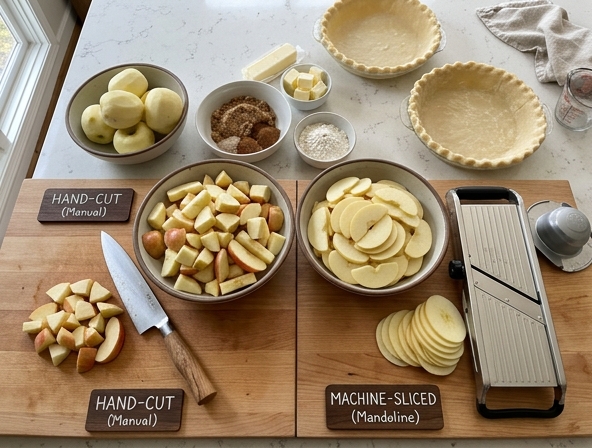
| Comparison Aspect | Hand-Cut Method | Mechanical Slicing |
|---|---|---|
| Ideal Environment | Traditional, small-scale, or artisanal settings. | High-volume, commercial production kitchens. |
| Consistency | Subject to human error; potential for uneven slices. | High precision; ensures uniform thickness. |
| Cooking Impact | Variable cooking times; risk of uneven moisture. | Optimized heat penetration and moisture control. |
| Critical Variable | Apple pectin content (same as machine). | Apple pectin content (same as hand). |
| Industry Example | Culinary standard for boutique baking. | Used by professional bakeries like Tart & Crust. |
The Baker's Dilemma: Hand-Cut vs. Machine-Sliced Apples for the Perfect Pie
The apple pie is, perhaps, the most storied staple in the baking lexicon. It is a dish defined by simplicity-crust, fruit, sugar, and spice-yet it is notoriously difficult to master. While many novice bakers obsess over the hydration of their pastry or the specific blend of apple varieties, there is a quieter, more technical debate that often dictates the final result: the method of preparation for the fruit itself.
Do you reach for your grandmother's paring knife, painstakingly hand-cutting each slice with a rustic, uneven charm? Or do you trust the cold, sterile precision of a mandoline or food processor, ensuring a uniformity that borders on industrial? The choice between hand-cut and machine-sliced apples is more than just a matter of convenience; it is a fundamental decision that affects the structural integrity, texture, and cooking time of the final pie. To achieve the perfect bake, one must understand how the geometry of the slice interacts with the chemistry of the oven.
The Case for the Blade: The Charm and Control of Hand-Cutting
For purists, the act of peeling and slicing apples by hand is a ritual. It connects the baker to the ingredients, allowing for a tactile assessment of the fruit's ripeness and firmness. When you cut apples by hand, you are rarely aiming for perfect symmetry. This variability is not a flaw; it is a culinary strategy.
Hand-cutting allows for "varied thickness pockets." By intentionally creating slices of different dimensions-some slightly thicker, some thinner-you introduce a textural complexity that mass-produced pies often lack. The thinner slices tend to break down and melt into a luxurious, spiced syrup, while the thicker segments maintain a pleasant bite. This creates a layered, "meaty" texture that feels distinctly homemade. Furthermore, hand-cutting allows you to preserve the structural integrity of the apple slices. You can follow the natural curve of the fruit, ensuring that each slice retains enough surface area to stay intact during the long baking process.
However, the risks of hand-cutting are significant. Inconsistency is a double-edged sword. If the variations are too extreme-if you have shards that are paper-thin alongside chunks that are an inch thick-you will inevitably end up with a pie that is unevenly cooked. The thin pieces will turn to mush while the thick ones remain crunchy and under-macerated, resulting in a pie that suffers from a "soupy" interior.
The Precision of the Machine: Consistency as a Science
On the other side of the kitchen counter lies the mandoline. To the professional baker, time is currency, and the mandoline is the ultimate efficiency tool. Beyond the speed of preparation, machine-slicing offers something that the human hand struggles to replicate: absolute, repeatable consistency.
When every slice is exactly 1/8th of an inch thick, the physics of the bake becomes predictable. Consistency in thickness ensures that each piece of fruit releases its moisture and softens at the exact same rate. This is critical for preventing the dreaded "soggy bottom" or the gap between the top crust and the apple filling. If all slices are uniform, the entire filling behaves as a single cohesive unit, thickening evenly when the starch-whether you use cornstarch, flour, or tapioca-is activated by the heat.
There is also the benefit of moisture management. Machine-cut slices have cleaner edges, which can sometimes result in less bruising of the fruit cells compared to the slightly jagged edge of a dull knife. Less cell damage means the fruit is less likely to release all of its juices prematurely, helping to maintain a clearer, more vibrant filling.
The Chemistry of the Bake: Texture and Cooking Time
Why does the cut matter so much to the bake time? It comes down to the pectin-to-sugar ratio and the rate of evaporation. Apple slices act as miniature sponges. As they heat up, they undergo a transition: the cell walls break down, releasing pectin into the surrounding liquid. If the slices are too thin, they lose their structural integrity too quickly, releasing so much moisture that the crust cannot crisp before the filling turns into applesauce. If the slices are too thick, the heat cannot penetrate the center of the slices before the pastry crust-which is prone to burning-reaches its limit.
The "sweet spot" for most apple pie recipes is generally between 1/4 and 3/8 of an inch. At this thickness, a slice is robust enough to survive an hour in a 375°F (190°C) oven without collapsing, yet thin enough to become tender throughout. When you hand-cut, you are constantly battling the risk of going too thin or too thick. When you use a machine, you can calibrate the thickness to the specific variety of apple you are using. For example, a softer apple like a McIntosh requires a thicker cut to survive the bake, whereas a denser, firmer apple like a Granny Smith benefits from a thinner cut to ensure it softens in time with the pastry.
Finding the Golden Mean: The Hybrid Approach
For the serious home baker, the best results often come from a hybrid approach. Many experts suggest using a mandoline to establish a baseline of uniformity, followed by a manual "culling" process to remove any pieces that are too small or irregular. By standardizing the bulk of the filling, you ensure an even cooking time, but you retain the ability to manually adjust for the specific geometry of your fruit.
Additionally, maceration is the great equalizer. Regardless of how you slice your apples, letting them sit with sugar and spices for at least 30 minutes before filling the pie allows the sugar to draw out excess moisture. This process softens the apples slightly *before* they hit the oven, which mitigates the risk of uneven cooking regardless of whether your slices were cut by hand or machine.
Conclusion
The choice between hand-cut and machine-sliced is ultimately a choice about what you value in a pie. If you are chasing a nostalgic, rustic aesthetic where every slice is a surprise, reach for your knife. If you are chasing technical perfection, a professional-grade pie that holds its shape under a clean, sharp slice, the machine is your ally.
However, remember that the oven does not care about your process; it only cares about the thermodynamics of the ingredients inside. Whether you choose the rustic blade or the precise machine, the secret to the perfect apple pie is not just the cut-it is the understanding of how that cut dictates the journey from raw fruit to caramelized perfection. Choose your method, master your thickness, and let the science of the bake handle the rest.
Disclaimer:
The information provided on Eateryn is for general educational and informational purposes only and is not intended as medical, nutritional, or healthcare advice. It should not be used to diagnose, treat, cure, or prevent any disease or medical condition.
Always consult a qualified physician, registered dietitian, or other certified healthcare professional before making changes to your diet, exercise routine, or lifestyle, or regarding any medical questions or concerns you may have. Never disregard or delay seeking professional medical advice because of something you have read on this website.