
Grilled Onions vs Raw Onions for Philly Cheesesteak - Finding The Optimal Flavor Profile
Finding the Optimal Onion Profile
Many home cooks struggle to replicate the nuanced flavor balance of an authentic Philly cheesesteak. While common recipes treat onions as an afterthought, industry standards-seen at landmarks like Pat's or Geno's-reveal that onion preparation is a deliberate culinary choice. Note that texture and heat exposure define your final result: raw onions provide sharp acidity, whereas caramelization delivers essential sweetness. The following analysis explores these distinct methods to help you elevate your sandwich's structural profile.
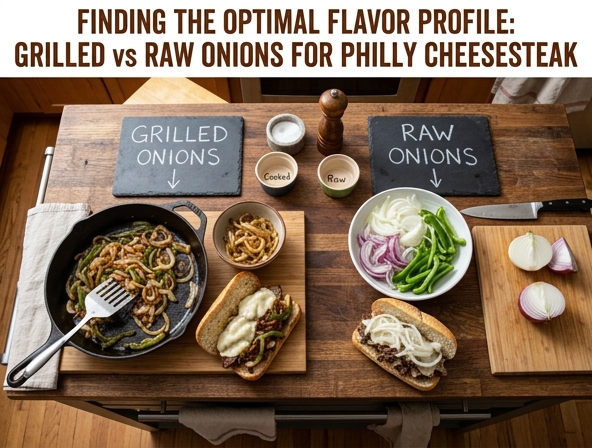
| Onion Preparation | Flavor Characteristics | Impact on Philly Cheesesteak |
|---|---|---|
| Raw Onions | Sharp and acidic | Adds a crisp texture and a pungent "bite" to the sandwich profile. |
| Grilled/Caramelized Onions | Deep and sweet | Provides essential sweetness and a softer texture that balances the meat and cheese. |
The Great Onion Debate: Grilled vs. Raw in the Iconic Philly Cheesesteak
In the hallowed halls of Philadelphia's culinary history, few topics ignite as much passion-or as much debate-as the construction of the perfect cheesesteak. While the choice of cheese (Whiz, provolone, or American) and the quality of the thinly sliced ribeye are paramount, there is a secondary, deeply polarizing element that defines the experience: the onion.
If you have ever stood at the window of a historic cheesesteak shop in Philly, you've likely heard the shorthand: "One wit, one witout." This simple phrase determines the presence of onions. But for the home cook or the aspiring sandwich artisan, the question goes much deeper than "on or off." It becomes a philosophical inquiry: Does the onion belong on the grill, softening into a sweet, caramelized ribbon of umami, or does it demand a place on the sandwich in its crisp, pungent, raw state?
The Case for the Grilled Onion: The Traditionalist's Harmony
For most purists, the grilled onion is the soul of the cheesesteak. When white or yellow onions are tossed onto a flat-top grill alongside the searing beef, they undergo a transformation. As the sugars in the onion break down through the Maillard reaction, they turn translucent and eventually a deep, golden brown. This process isn't just about color; it is about flavor profile.
Grilled onions bring a mellow sweetness that acts as a bridge between the savory, salty fat of the ribeye and the creamy, often tangy notes of the cheese. They lose their sharp, sulfurous bite, replacing it with a luxurious, buttery texture that essentially melts into the meat. When done correctly, the onions become an integrated part of the filling, ensuring that every bite is consistent. For those who prioritize the "melt-in-your-mouth" experience of a cheesesteak, the grilled onion is non-negotiable.
The Case for the Raw Onion: The Textural Counterpoint
While the "wit" crowd dominates the traditional narrative, there is a distinct, defiant faction that prefers their onions raw-or perhaps more accurately, "fresh." There is a specific culinary logic to this: richness requires a counterpoint.
A Philly cheesesteak is an undeniably heavy sandwich. It is a high-fat, high-sodium indulgence. If every element of the sandwich is soft-the steamed roll, the chopped meat, the molten cheese-the palate can quickly become fatigued. This is where the raw onion shines. It provides an aggressive, sharp "snap" and a crisp texture that cuts through the heaviness of the beef and cheese. The inherent pungency of a raw onion cleanses the palate between bites, keeping the sandwich interesting from the first mouthful to the last. It's a bold, unapologetic choice that prizes contrast over homogenization.
The Science of the Onion
To understand the debate, one must understand the chemistry. Onions contain sulfur compounds that give them their signature sting. When you slice an onion, you damage its cell walls, triggering a reaction that releases syn-propanethial-S-oxide-the compound responsible for tearing eyes and a sharp, spicy taste.
Heat effectively destroys these enzymes and drives off the volatile sulfur compounds, leaving behind the natural sugars. If you are sensitive to the "burn" of raw onions, grilling is your natural ally. However, if you crave that botanical sharpness, only a raw application will suffice. Furthermore, the variety of onion matters. A yellow onion offers the best balance of sugar for grilling, while a sweet Vidalia or a sharp red onion changes the entire character of the sandwich should you choose to go the raw route.
Finding Your Optimal Flavor Profile: The Hybrid Approach
Who says you have to choose? Many modern cheesesteak aficionados have begun experimenting with the "hybrid" method. This involves a technique often seen in high-end culinary circles: a "flash-grill" or a layered approach.
Some chefs advocate for a quick sear-giving the onions just enough heat to take the edge off the raw bitterness while maintaining a significant amount of structural crunch. Alternatively, you can use "textural layering": placing a bed of deeply caramelized onions underneath the meat, and topping the meat with a light sprinkle of finely diced, raw white onions just before closing the roll. This provides the best of both worlds: the sweetness to ground the beef, and the sharp finish to lift the profile of the sandwich.
The Verdict: How to Choose
Ultimately, the "optimal" flavor profile depends on what you want from your meal:
- Choose Grilled if: You are seeking a classic, comfort-food experience where every component feels like a singular, unified whole. This is the choice for those who value sweetness, tenderness, and depth of flavor.
- Choose Raw if: You view the cheesesteak as a high-contrast culinary experience. If you find standard cheesesteaks "too heavy" or "mushy," the raw onion will provide the necessary textural and acidic relief to elevate your enjoyment.
- Choose Hybrid if: You are a tinkerer who believes that complexity is the key to a great dish. By managing the ratio of cooked-to-raw, you can tailor your cheesesteak to your specific mood.
At the end of the day, the Philly cheesesteak is a democratic sandwich. It exists to satisfy the eater, not to adhere to a rigid set of academic rules. Whether you lean into the caramelized, savory depths of the grill or the sharp, biting clarity of the raw bulb, the most important rule remains: never skip the onions entirely. A cheesesteak without the onion is merely a steak sandwich, missing the very ingredient that gives it its character, its history, and its soul.
Disclaimer:
The information provided on Eateryn is for general educational and informational purposes only and is not intended as medical, nutritional, or healthcare advice. It should not be used to diagnose, treat, cure, or prevent any disease or medical condition.
Always consult a qualified physician, registered dietitian, or other certified healthcare professional before making changes to your diet, exercise routine, or lifestyle, or regarding any medical questions or concerns you may have. Never disregard or delay seeking professional medical advice because of something you have read on this website.