
Granny Smith vs Honeycrisp for Apple Pie - The Battle of Tartness and Texture
Granny Smith vs. Honeycrisp for Apple Pie
Selecting the ideal apple for baking is a common frustration for bakers balancing flavor and texture. While many rely on generic produce, professional results require understanding cultivar behavior. Choosing the right variety-like the tart, high-pectin Granny Smith versus the sweet, moisture-dense Honeycrisp-is essential for structural integrity. Please note: individual results depend on your specific sugar ratios. This guide examines starch profiles and heat-tolerance, helping you decide which apple best suits your next signature pie.
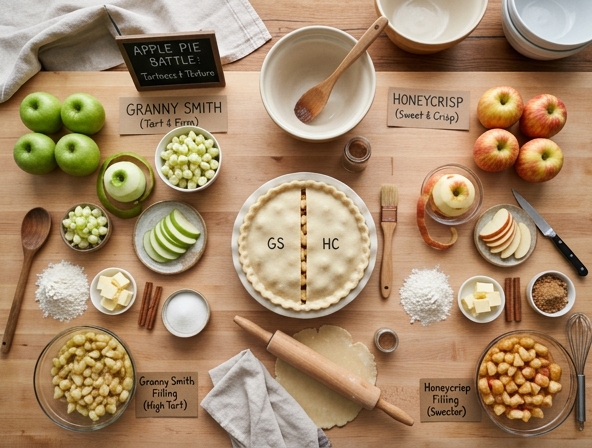
| Feature | Granny Smith | Honeycrisp |
|---|---|---|
| Flavor Profile | Tart | Sweet |
| Composition | High-pectin | Moisture-dense |
| Baking Traits | Excellent for structural integrity | Requires attention to heat-tolerance |
| Pro-Tip | Final results depend heavily on individual sugar ratios and starch profiles. | |
Granny Smith vs. Honeycrisp: The Ultimate Showdown for Apple Pie Supremacy
There are few culinary debates as polarizing among home bakers as the choice of apple for a classic pie. While regional preferences and family traditions often dictate the selection, two titans consistently dominate the produce aisle: the venerable Granny Smith and the crowd-pleasing Honeycrisp. Choosing between them isn't just a matter of availability; it is a fundamental decision regarding the flavor profile, textural integrity, and structural success of your dessert. To bake the perfect pie, one must understand the unique "personality" of these apples and how they behave under the intense heat of an oven.
The Granny Smith: The Reliable Veteran
For generations, the Granny Smith has been the undisputed heavyweight champion of the baking world. Originating in Australia in the 1860s, this apple is prized for its high acidity and firm, dense flesh. When you slice into a raw Granny Smith, the immediate sensation is a sharp, bracing tartness that can make your mouth water. But what happens when that fruit meets heat?
The culinary magic of the Granny Smith lies in its structure. Because it contains a high amount of pectin-a natural fiber that acts as a thickening agent-the apple holds its shape remarkably well during the baking process. Even after forty-five minutes at 375°F, a Granny Smith slice will retain its identity, providing that sought-after "bite" that defines a traditional pie. Its tartness also serves a critical function: it cuts through the richness of the buttery crust and the sweetness of the sugar, creating a balanced, sophisticated flavor profile that prevents the pie from becoming cloyingly sweet.
The Honeycrisp: The Modern Innovator
Enter the Honeycrisp, a marvel of modern pomology developed at the University of Minnesota. Since its introduction, it has skyrocketed in popularity, not because it was designed for the oven, but because it is objectively delicious to eat out of hand. Its defining characteristic is, as the name suggests, a remarkable crispness paired with a honey-like sweetness and an abundance of juice.
However, when the Honeycrisp enters the kitchen, it introduces a unique set of challenges. Because it is bred to be exceptionally juicy and snappy, its cell structure is designed to burst. Under the heat of an oven, that juice is released rapidly. While this results in a deeply flavorful, aromatic filling, it also significantly increases the risk of a "soggy bottom"-a baker's worst nightmare. Furthermore, the Honeycrisp tends to break down more quickly than the Granny Smith. If you are looking for distinct, firm apple slices in your finished pie, the Honeycrisp might leave you disappointed as it leans closer to a soft, saucy consistency.
The Battle of Science: Texture and Chemistry
To truly understand the conflict, we have to look at the chemistry of the bake. A pie is essentially a vessel for controlled caramelization. As the apples heat up, the sugar molecules undergo chemical changes, and the cell walls begin to soften.
- Acidity: Granny Smiths have a low pH, which helps inhibit the enzymes that cause premature softening. This is why they stay firm.
- Moisture Content: Honeycrisps are hyper-hydrated. If your pie crust isn't shielded or blind-baked, that moisture will migrate into the bottom crust, preventing the starch from setting.
- Sugar Balance: The Honeycrisp has a higher sugar-to-acid ratio. This means you generally need to reduce the added sugar in your recipe to avoid a sugary mess, whereas the Granny Smith acts as a blank canvas, inviting you to add spices like cinnamon, nutmeg, and ginger.
The Case for the Hybrid Approach
If the Granny Smith is the sturdy backbone and the Honeycrisp is the juicy soul, why not use both? Many professional pastry chefs argue that the "perfect" apple pie isn't a monoculture of one variety, but a curated blend. By using a 50/50 ratio, you leverage the architectural stability of the Granny Smith to provide the structure, while allowing the Honeycrisp to provide the sweet, juicy nectar that fills the gaps.
When you combine them, you effectively manage the moisture levels. The Granny Smith absorbs some of the excess juice released by the Honeycrisp, and the resulting mixture creates a complex, multi-dimensional flavor that neither apple can achieve alone. It is the culinary equivalent of blending high-end coffee beans or mixing different varieties of flour to achieve the perfect bread crumb.
The Verdict: Which Should You Choose?
Ultimately, your choice depends on the kind of pie you want to serve:
Choose the Granny Smith if: You are a traditionalist who values structure. You want distinct slices, a bright, tart contrast to your crust, and a pie that stays beautiful when sliced on a serving platter. It is the safer, more predictable choice for beginners.
Choose the Honeycrisp if: You prefer a softer, saucier, and sweeter pie. If you are an experienced baker who knows how to mitigate moisture (perhaps by using a deep-dish pan or a longer bake time), the Honeycrisp provides an incredible, aromatic sweetness that feels more "modern" and indulgent.
Choose the Hybrid if: You want to achieve the gold standard of apple pie. Combining the two varieties covers your bases, ensuring that your pie is neither too tart nor too sweet, and neither too firm nor too mushy. It is, in every sense, the best of both worlds.
Regardless of which route you take, remember that the "battle" is really just an invitation to experiment. The beauty of baking lies in the process-the smell of cinnamon and apples wafting through your home, and that first, satisfying slice. Whether you lean toward the tart veteran or the juicy innovator, the true winner is always the person holding the fork.
Disclaimer:
The information provided on Eateryn is for general educational and informational purposes only and is not intended as medical, nutritional, or healthcare advice. It should not be used to diagnose, treat, cure, or prevent any disease or medical condition.
Always consult a qualified physician, registered dietitian, or other certified healthcare professional before making changes to your diet, exercise routine, or lifestyle, or regarding any medical questions or concerns you may have. Never disregard or delay seeking professional medical advice because of something you have read on this website.