
Gala vs Fuji for Apple Pie - Balancing Natural Sweetness and Structural Integrity
Bakers frequently struggle with apple pie filling that either loses structural integrity or lacks depth. While tart varieties remain the standard industry staple, selecting Gala or Fuji apples grants a nuanced natural sweetness that elevates the final bake. Stipulated, their lower acidity necessitates precise heat management to avoid textural failure. Renowned pastry experts like Claire Saffitz exemplify the importance of cultivar selection. This analysis examines the trade-off between glycemic profile and structural firmness to optimize your recipe.
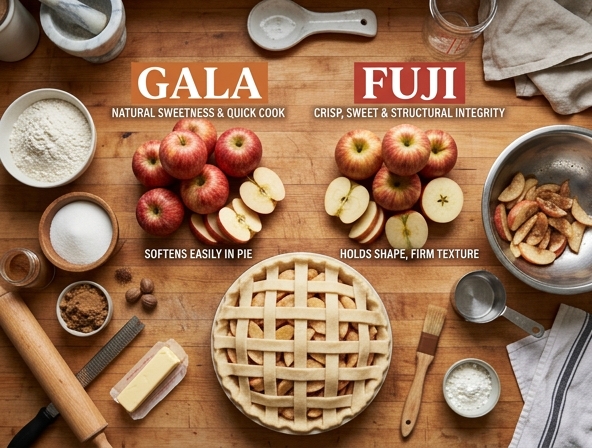
| Feature | Gala vs. Fuji Analysis |
|---|---|
| Flavor Profile | Both varieties provide a natural, nuanced sweetness that improves upon the flavor depth of standard tart baking apples. |
| Structural Integrity | They have lower acidity compared to traditional varieties, which can lead to textural failure (mushiness) if not handled correctly. |
| Baking Technique | Requires precise heat management during the baking process to maintain the apples' structural firmness. |
| Expert Insight | As emphasized by experts like Claire Saffitz, choosing the right cultivar is a critical step in balancing flavor and texture for a successful pie. |
The Great Debate: Gala vs. Fuji for the Perfect Apple Pie
Baking the perfect apple pie is an exercise in both art and science. While the crust provides the architecture, the filling provides the soul. Among the thousands of apple varieties available, two contenders frequently sit in the produce aisle, waiting to be chosen for the centerpiece of your dessert table: the Gala and the Fuji. While both are widely available, affordable, and undeniably delicious, they behave very differently when subjected to the transformative heat of an oven.
The Gala Apple: The Sweet, Jammy Contender
The Gala apple is, in many ways, the crowd-pleaser of the apple world. Developed in New Zealand, it is known for its mild, vanilla-like sweetness and floral aroma. When you bite into a raw Gala, you are greeted with a pleasant snap that quickly yields to a soft, juicy interior.
However, when it comes to pie, the Gala's greatest strength-its tenderness-becomes its potential downfall. Because the Gala has a relatively low cell-wall density, it breaks down quickly under high heat. In a pie, this leads to a "jammy" consistency. If your goal is a pie with a rustic, sauce-like filling where the fruit practically melts into a spiced compote, the Gala is an excellent choice. But if you are aiming for distinct, firm slices that hold their shape against the pressure of a fork, the Gala will often leave you disappointed, potentially resulting in a "soupy" pie if not properly thickened with starch.
The Fuji Apple: The Architect's Choice
In contrast, the Fuji apple-a descendant of the Red Delicious and the Virginia Ralls Genet-was bred for durability and longevity. It is the powerhouse of the structural world. The Fuji is famously dense, with a crisp, crunchy bite that remains remarkably firm even after being sliced and baked for nearly an hour.
For the baker who values texture, the Fuji is a dream. It retains its individual shape, allowing each slice in the pie to provide that classic "toothsome" resistance. Furthermore, the Fuji is exceptionally high in natural sugar, which means you can often dial back the refined white sugar in your recipe, allowing the clean, bright flavor of the fruit to shine through. The primary challenge with Fuji is its lack of inherent acidity; it is so sweet that it can sometimes taste one-dimensional. To unlock the potential of a Fuji-based pie, one must pair it with a generous squeeze of lemon juice or a tart companion apple like a Granny Smith to balance the palate.
The Science of Structural Integrity
Why do these two apples behave so differently? It comes down to the pectin content and cell structure. Pectin is the "glue" that holds plant cell walls together. As apples bake, this glue begins to break down. Gala apples possess a structure that is more susceptible to this thermal degradation, leading to rapid softening. Fuji apples possess a more resilient cellular matrix that resists softening, maintaining a higher level of structural integrity throughout the baking cycle.
When choosing between them, consider the "weep factor." As the cell walls break down, they release moisture. Because the Gala breaks down so quickly, it releases its water content early, which can soften the bottom crust and lead to the dreaded "soggy bottom." The Fuji's slower breakdown allows for a more controlled release of juices, which is far easier to manage with thickeners like cornstarch, tapioca, or flour.
The Baker's Strategy: The Power of the Blend
If you find yourself torn between the jammy sweetness of the Gala and the structural fortitude of the Fuji, the professional secret is not to choose one, but to embrace the synergy of both. By using a 50/50 blend, you achieve the "Golden Ratio" of apple pie filling.
In this scenario, the Gala apples break down to create a luscious, syrupy base that binds the pie together, while the Fuji slices remain intact, providing the necessary texture and "bite" that defines a high-quality dessert. This blend also balances the flavor profile, marrying the floral notes of the Gala with the deep, clean sweetness of the Fuji.
Tips for Execution
- Maceration is Key: Regardless of which apple you choose, toss your sliced apples with sugar and spices and let them sit in a bowl for 30 to 60 minutes before filling the crust. Drain the excess liquid, reduce it on the stove into a syrup, and pour it back over the fruit. This ensures a concentrated flavor and prevents a watery pie.
- Don't Skip the Acid: If you are using Fuji exclusively, add a teaspoon of apple cider vinegar or lemon juice to ensure the pie doesn't taste cloyingly sweet.
- Slice Thickness Matters: If using Gala, slice your apples thicker (about 1/2 inch) to give them more "gas" before they dissolve. If using Fuji, you can slice them thinner (1/4 inch) to ensure they cook through without becoming too hard.
Conclusion
The choice between Gala and Fuji is ultimately a matter of the experience you want to provide. If your vision is a comforting, homestyle pie where the fruit and spice melt together into a unified, jammy delight, the Gala is your ally. If your vision is an elegant, structured pie with distinct, satisfying slices of fruit, the Fuji is the superior choice. But for the true enthusiast, the magic lies in the marriage of the two-a harmonious blend that offers the best of both worlds, ensuring your pie is not just a dessert, but a balanced masterpiece of culinary chemistry.
Disclaimer:
The information provided on Eateryn is for general educational and informational purposes only and is not intended as medical, nutritional, or healthcare advice. It should not be used to diagnose, treat, cure, or prevent any disease or medical condition.
Always consult a qualified physician, registered dietitian, or other certified healthcare professional before making changes to your diet, exercise routine, or lifestyle, or regarding any medical questions or concerns you may have. Never disregard or delay seeking professional medical advice because of something you have read on this website.