
Frozen vs Live Clams for Clam Chowder - Benchmarking Freshness Standards
Frozen vs. Live Clams: Benchmarking Freshness Standards
Sourcing consistent, high-quality clams often challenges culinary operations balancing flavor integrity with supply chain realities. While conventional kitchens rely on frozen bulk stock to mitigate inventory fluctuations, this method frequently compromises essential oceanic salinity. Establishing rigorous freshness benchmarks-comparing frozen Littlenecks to live hard-shells-is vital for flavor precision. Note: While freezing preserves utility, it alters texture profiles significantly. This report analyzes critical procurement variables to elevate your chowder's overall consistency and sensory impact.
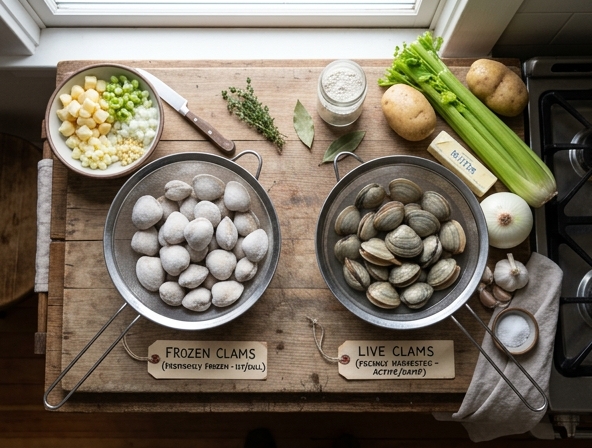
| Feature | Frozen Clams | Live Clams |
|---|---|---|
| Flavor Profile | Compromised salinity | Authentic oceanic salinity |
| Texture | Significantly altered | Superior, firm texture |
| Supply Chain | Consistent/Reliable | Subject to inventory fluctuations |
| Kitchen Utility | High (Convenience-focused) | High (Quality/Precision-focused) |
| Strategic Impact | Mitigates logistical risk | Elevates sensory performance |
Frozen vs. Live Clams for Clam Chowder: Benchmarking Freshness Standards
The debate between using live clams versus frozen alternatives is a perennial argument in the culinary world, particularly when it comes to the revered American staple: clam chowder. For purists, the mere suggestion of frozen shellfish is akin to blasphemy; for high-volume restaurateurs and busy home cooks, it is often a necessary adaptation for consistency and efficiency. But where does the line between convenience and quality truly lie? To understand the benchmarks of freshness, we must deconstruct the biological and culinary properties of the mollusk itself.
The Case for Live Clams: The Gold Standard
In the hierarchy of shellfish, live clams are the undisputed gold standard. When we talk about "freshness" in this context, we aren't just talking about a calendar date; we are talking about cellular integrity and the preservation of the liquor.
1. The Vitality Factor
A live clam is a biological system. When harvested and handled correctly, the adductor muscles remain relaxed until the moment of preparation. This freshness ensures a specific "snap" or bite that is impossible to replicate once the tissue has been subjected to the slow-burn breakdown of freezing and thawing. The texture of a fresh clam is slightly firm, yielding easily to the tooth without turning rubbery.
2. The Liquid Gold
Perhaps the most significant loss when using frozen products is the loss of the "nectar"-the natural clam juice captured within the shell. In a live clam, this liquor is perfectly balanced with ocean minerals and salinity. When you steam a live clam, you release this pristine juice directly into your chowder base, providing an umami profile that is inherently clean and briny. It is the hallmark of a true New England or Manhattan-style chowder.
The Case for Frozen/IQF Clams: Convenience vs. Consistency
Individually Quick Frozen (IQF) clams have evolved significantly over the last decade. In the commercial sector, flash-freezing technology at the point of harvest has narrowed the quality gap significantly.
1. The Reliability of the Process
One of the hidden benefits of frozen clams is the removal of the "dud" factor. Working with live clams requires a rigorous inspection process: checking for shells that fail to close, discarding sand-heavy specimens, and ensuring the harvest date is reliable. IQF products are typically purged and shucked in a controlled environment, reducing the risk of grit-the enemy of a great bowl of chowder-and ensuring every ounce of meat is usable.
2. Seasonal and Regional Accessibility
Freshness is a prisoner of geography. A clam harvested in the Pacific Northwest and shipped to a landlocked state is, by definition, less fresh than a locally caught clam. In such instances, a high-quality IQF clam, frozen at the source, may actually be "fresher" by the time it reaches the pot than a "fresh" clam that has spent 72 hours in transit.
Benchmarking Freshness: The Technical Standards
To scientifically benchmark whether your clam choice is meeting high-end standards, consider these three metrics:
- Turgor and Texture: Upon cooking, the meat should not shrink excessively. Excessive shrinkage is often a sign of "freezer burn" or prolonged storage that has dehydrated the cell structure.
- Aroma Profile: A fresh clam should smell like the ocean-clean, slightly metallic, and iodine-rich. It should never smell "fishy" or sour. If the cooking liquor is cloudy or has a pungent, off-putting odor, the freshness benchmark has failed.
- Mineral Balance: The brine of the clam should be clean. If you are forced to add significant amounts of salt to compensate for a lack of flavor, your shellfish is likely lacking the natural salinity profile of a fresh, properly handled product.
The Culinary Impact: Does the Chowder Mask the Difference?
A critical nuance in this discussion is the nature of the dish. Clam chowder is a complex emulsion involving cream, potatoes, salt pork, and aromatics. Does the heavy cream and starch hide the subtleties of a frozen clam?
The answer depends on the style. In a thin, clear Manhattan chowder, the quality of the clam is center stage-there is nowhere to hide a rubbery, flavorless mollusk. In a thick, flour-thickened New England chowder, the texture of the clam is more important than its nuance. Because chowders often involve long simmer times, the "overcooking" of clams is a common error. Frozen clams are often pre-cooked or partially cooked, which makes them much more resistant to the toughening effects of a long simmer than raw, live clams, which can turn into "clam-flavored pencil erasers" if left in the heat for even a few minutes too long.
Conclusion: A Hybrid Approach
For the home chef looking for the best possible result, the answer is often a hybrid approach. Use fresh, live clams for the base of your broth-steam them, strain the liquor to remove the sand, and use that liquid as the foundation of your soup. If live clams are unavailable or cost-prohibitive, supplement the meat content with high-quality, flash-frozen shucked clams. This ensures you maintain the genuine, briny soul of the dish while benefiting from the convenience of processed meat.
Ultimately, freshness is about integrity. Whether you pull your clams from a net or a freezer bag, the standard remains the same: the final product should taste of the sea, carry a pleasant, firm bite, and provide a clear, mineral-rich nectar that anchors the entire dish. Don't be a slave to the "fresh vs. frozen" label; instead, become a judge of the texture and aroma. If the clam meets those standards, the chowder will succeed.
Disclaimer:
The information provided on Eateryn is for general educational and informational purposes only and is not intended as medical, nutritional, or healthcare advice. It should not be used to diagnose, treat, cure, or prevent any disease or medical condition.
Always consult a qualified physician, registered dietitian, or other certified healthcare professional before making changes to your diet, exercise routine, or lifestyle, or regarding any medical questions or concerns you may have. Never disregard or delay seeking professional medical advice because of something you have read on this website.