
Frozen vs Freshly Made for Macaroni and Cheese - Evaluating Quality After Reheating
Achieving consistent quality in reheated macaroni and cheese remains a common operational challenge, as traditional batch methods often compromise final texture. While industry standards prioritize efficiency, true excellence lies in mastering starch gelatinization. Note that moisture retention acts as a structural necessity rather than a secondary preference. By prioritizing stable béchamel integrity and al dente pasta resilience, you ensure premium results. This assessment evaluates specific thermal outcomes to help you optimize your kitchen's approach to menu delivery.
| Focus Area | Operational Insight |
|---|---|
| Core Challenge | Maintaining consistent texture and quality when reheating macaroni and cheese. |
| Common Pitfall | Traditional batch production methods frequently degrade the dish's final texture. |
| Technical Priorities | Focus on mastering starch gelatinization and ensuring optimal moisture retention. |
| Quality Markers | Success is defined by the stability of the béchamel sauce and the resilience of the al dente pasta. |
| Goal | Optimizing thermal processes to achieve premium, consistent results for menu delivery. |
Frozen vs. Freshly Made: The Science of Reheating Macaroni and Cheese
Macaroni and cheese stands as the ultimate comfort food-a dish defined by the luxurious marriage of tender pasta and a creamy, velvet-like cheese sauce. Yet, the universal appeal of this dish often clashes with the reality of our busy schedules. We find ourselves asking a fundamental culinary question: Can a reheated portion ever truly capture the glory of the original, and does it matter whether the dish was frozen beforehand or freshly prepared?
The Chemistry of the Perfect Sauce
To understand the reheating process, we must first look at what makes macaroni and cheese work in the first place. A high-quality cheese sauce is essentially a stable emulsion of fat, water, and proteins. When you combine milk, butter, flour (for a roux), and cheese, you are creating a complex network. The starches from the pasta and the flour act as stabilizers, preventing the fat in the cheese from separating from the water content of the milk.
When you reheat macaroni and cheese, you are challenging this stability. The goal is to return the dish to its optimal temperature without breaking the emulsion. When an emulsion breaks, the oils leach out, the cheese becomes grainy or "clumpy," and the sauce loses its cohesive, silky texture.
Freshly Made: The Advantage of Control
Preparing a batch of macaroni and cheese from scratch allows for specific adjustments that favor future reheating. If you know you are making a meal intended to be eaten in installments, you can use "reheat-friendly" techniques. One of the most effective strategies is slightly undercooking the pasta-aiming for a firm al dente stage. Because the pasta will continue to absorb moisture from the sauce while sitting in the refrigerator or during the reheating process, an initially firm noodle will reach the perfect texture upon its second cooking.
Furthermore, freshly made sauce typically relies on fresh dairy, which has not undergone the cellular stress of freezing. By incorporating stabilizers like sodium citrate (often found in processed cheeses but easily sourced for home cooks), you can create an emulsion that is far more resilient to the temperature fluctuations of a microwave or oven.
The Frozen Factor: Why Convenience Costs Quality
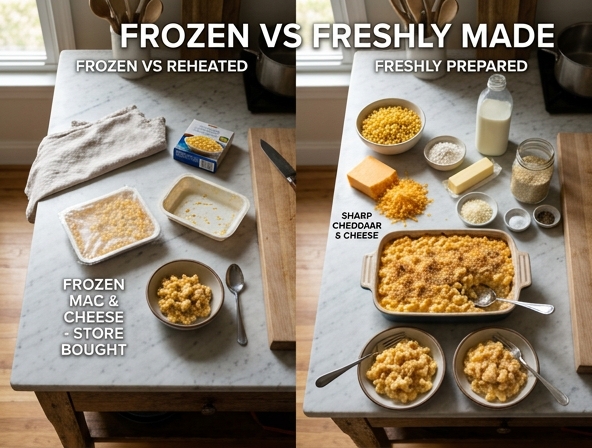
Commercial frozen macaroni and cheese faces a significantly harder battle. The process of freezing is inherently damaging to the structure of dairy-based sauces. As a sauce freezes, the water within the milk and cheese expands into ice crystals. These microscopic crystals can puncture the structure of the proteins, causing the emulsion to collapse upon thawing. This is why frozen mac and cheese often appears "watery" or "separated" immediately after it begins to warm up.
To combat this, industrial manufacturers rely heavily on hydrocolloids and thickeners-such as xanthan gum, guar gum, or modified starches-to keep the sauce together. While these additives effectively prevent separation, they often change the mouthfeel of the dish, giving it a slightly "gummy" or "rubbery" texture that purists often find unappealing. You are essentially trading the natural, creamy richness of real butter and aged cheddar for the structural stability provided by laboratory-developed stabilizers.
Evaluating the Reheating Experience
When it comes time to reheat, the method you choose is just as important as the preparation method. For both fresh and frozen options, the "low and slow" approach is the gold standard.
- The Stovetop Method: This is arguably the best way to revive either style. By adding a small splash of milk or heavy cream and heating over low heat while stirring constantly, you re-introduce moisture and provide the mechanical agitation necessary to re-emulsify the sauce.
- The Oven Method: Ideal for larger portions, but risky. If the dish is uncovered, the moisture evaporates, leading to dry, crunchy edges and a "skinned" top. Covering with foil and adding a tablespoon of water or broth before baking helps maintain the integrity of the sauce.
- The Microwave Method: While convenient, it is the most aggressive. High-energy waves can cause the fat in the cheese to overheat, leading to a greasy "oil slick" on the surface. To mitigate this, reheat in 30-second bursts, stirring in between to ensure even heat distribution.
The Verdict: Flavor vs. Texture
In a head-to-head comparison, the freshly made, refrigerated-then-reheated dish almost always wins on flavor profile. Because fresh ingredients haven't been subjected to long-term freezer storage, the sharpness of the cheese and the nuanced flavor of the aromatics (like mustard powder, nutmeg, or garlic) remain intact. The texture, provided the pasta was prepared correctly, remains tender without becoming mushy.
Frozen macaroni and cheese has improved drastically in recent years, but it remains a compromise. It is engineered for stability, not culinary excellence. You are eating a dish that has been built to survive an environment it wasn't naturally designed for. However, for sheer convenience, it remains an unparalleled option for a quick meal.
Final Recommendations for the Home Cook
If you want the best of both worlds, adopt a "partial-prep" strategy. Make your sauce from scratch, but hold back on the final bake if you intend to store the dish. If you are freezing, use a shallow container to ensure that the cold penetrates the dish quickly, minimizing the size of ice crystals. When reheating, always supplement with a bit of fresh liquid-milk, half-and-half, or even a little pasta water-to revitalize the sauce.
Ultimately, while science explains the degradation of frozen mac and cheese, the difference between "freshly made" and "frozen" comes down to the integrity of the ingredients. By understanding how your sauce reacts to heat and moisture, you can elevate even a reheated meal into something that satisfies the soul as much as it fills the stomach.
Disclaimer:
The information provided on Eateryn is for general educational and informational purposes only and is not intended as medical, nutritional, or healthcare advice. It should not be used to diagnose, treat, cure, or prevent any disease or medical condition.
Always consult a qualified physician, registered dietitian, or other certified healthcare professional before making changes to your diet, exercise routine, or lifestyle, or regarding any medical questions or concerns you may have. Never disregard or delay seeking professional medical advice because of something you have read on this website.