
Frozen Pizza vs Takeout for Pizza - Convenience Against Culinary Quality
Balancing immediate hunger with the demand for culinary excellence often feels like a compromise. Traditionally, consumers choose between convenient frozen staples and artisanal takeout services. Distinguishing these options grants you the ability to optimize your weekly mealtime ROI.
Stipulation: Quality varies by processing methods and ingredient sourcing. For instance, mass-market frozen brands contrast sharply with premium wood-fired delivery. This analysis evaluates cost-efficiency, textural integrity, and nutritional profiles to inform your next dining decision.
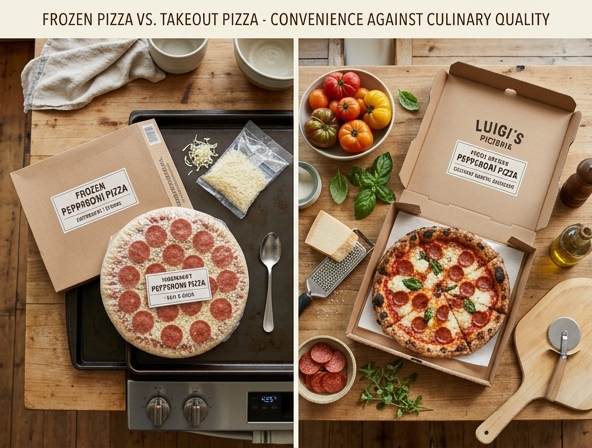
| Comparison Factor | Frozen Pizza | Takeout Pizza |
|---|---|---|
| Cost-Efficiency | High; generally more budget-friendly. | Lower; premium pricing for service and preparation. |
| Textural Integrity | Often compromised by mass-market freezing/processing. | Superior; typically offers artisanal textures. |
| Convenience | High; immediate access from home freezer. | Moderate; requires ordering and delivery wait times. |
| Nutritional Profile | Varies; often subject to industrial processing. | Varies; relies on ingredient sourcing and preparation methods. |
| Quality Expectation | Consistent but baseline quality. | Higher potential for premium, wood-fired excellence. |
Frozen Pizza vs. Takeout: The Friday Night Culinary Clash
The scene is archetypal: it is 7:00 PM on a Friday. You have finished a long week, the refrigerator is looking sparse, and the prospect of cooking a complex meal feels like a Herculean task. Your stomach rumbles, and your mind drifts toward the ultimate comfort food-pizza. But then, the age-old dilemma arises: Do you reach for the box in the freezer, or do you summon the delivery driver?
This is not merely a question of hunger; it is a calculation of convenience, culinary quality, and economic value. In the tug-of-war between the accessible, store-bought frozen pie and the curated, restaurant-style delivery, there is much to consider regarding what we value most when we eat at home.
The Evolution of the Frozen Pie
For decades, frozen pizza was the culinary equivalent of a cardboard cutout-an emergency sustenance measure characterized by rubbery cheese and a crust that tasted suspiciously like a saltine cracker. However, the last decade has seen a revolution in the frozen aisle. Today's market is saturated with "gourmet" options, artisan-style rising crusts, stone-fired bases, and dietary-conscious alternatives like cauliflower or chickpea crusts.
The primary advantage of frozen pizza is, undeniably, convenience. It is the “fire and forget” option. It waits patiently in your freezer for weeks, requiring no tip, no delivery fee, and no awkward social interaction at your front door. From a budget perspective, it is the clear winner; a high-quality frozen pizza can cost a fraction of what you would pay for a large pie from a specialty pizzeria. For families or those managing a tight budget, the frozen pizza represents a reliable, cost-effective staple that guarantees a meal without the volatility of delivery times or fluctuating menu prices.
The Case for the Takeout Experience
While the frozen pizza has improved, it rarely hits the highs of a genuine takeout experience from a local, independent pizzeria. When you order from a restaurant, you are paying for more than just the ingredients; you are paying for the infrastructure. A dedicated pizza oven, whether coal-fired, wood-fired, or a high-heat deck oven, creates a texture that a standard home oven simply cannot replicate.
The hallmark of a great pizza is the "leoparding" on the crust-that charred, blistered exterior that provides a satisfying crunch-coupled with an airy, chewy interior. This chemistry relies on rapid, high-temperature heat that causes the dough to spring instantly. Furthermore, takeout offers fresh, high-quality toppings that haven't spent months in a sub-zero environment. The aromatic pull of a steaming box arriving at your door, the melty, stringy pull of fresh mozzarella, and the specific spice profile of a house-made marinara sauce provide a sensory experience that frozen alternatives strive to mimic but rarely achieve.
The Culinary Divide: Chemistry and Thermodynamics
If we look closely at the culinary differences, the divide is rooted in thermodynamics. Frozen pizza is designed to be resilient. The dough is often treated with conditioners to prevent it from drying out in the freezer, and the toppings are chosen for their ability to withstand the freezing and thawing process. This can lead to a "homogenized" flavor profile-where the cheese and sauce have melded into a singular, uniform taste.
Takeout pizza, conversely, is an exercise in moisture management. The steam trapped inside a cardboard delivery box is the enemy of a crispy crust, which is why the best pizzerias use vented boxes. When you receive a delivery, you are enjoying a product created by a professional within the last twenty minutes. The fats in the cheese are still emulsified properly, the herbs (like fresh basil) are vibrant rather than limp, and the overall integrity of the pie remains distinct. You are tasting the chef's work, not the factory's preservation technology.
The Cost-Benefit Analysis
When choosing between these two paths, one must consider the "Convenience Tax." A takeout pizza usually costs between $15 and $30 after delivery fees and tips. A frozen pizza can range from $5 to $12. Over the course of a year, opting for frozen pizza instead of delivery can save the average household hundreds, if not thousands, of dollars.
However, the value isn't just financial. It is also temporal. If you are exhausted, waiting 45 minutes for a delivery driver to navigate local traffic-and potentially receiving a lukewarm pie-might be more frustrating than the 20 minutes it takes to preheat your oven and bake a frozen one to your exact specifications. Conversely, if you are hosting friends, the "event" of a delivery box arriving carries a social weight that a frozen pizza simply cannot match.
The Verdict: A Matter of Intent
Ultimately, the battle between frozen and takeout is not a zero-sum game; both have a place in the modern kitchen. The frozen pizza is the champion of the "invisible meal"-a low-friction solution for those nights when the primary goal is simply to be fed without hassle. It is the pragmatic choice, providing a consistent, acceptable baseline of quality that acts as an anchor for busy schedules.
Takeout, however, is a treat. It is a vote of support for local businesses and a demand for a superior culinary experience. It is the choice for when you want to experience the craftsmanship of dough fermentation, the heat of a wood fire, and the specific flavor profile of a restaurant-grade product.
The next time you find yourself staring at your pantry or scrolling through a delivery app, ask yourself what you truly need. If you need comfort and speed, look to the freezer. If you need an experience and an elevation of your Friday night routine, place that order. In the end, as long as there is melted cheese and a good crust, you have already won.
Disclaimer:
The information provided on Eateryn is for general educational and informational purposes only and is not intended as medical, nutritional, or healthcare advice. It should not be used to diagnose, treat, cure, or prevent any disease or medical condition.
Always consult a qualified physician, registered dietitian, or other certified healthcare professional before making changes to your diet, exercise routine, or lifestyle, or regarding any medical questions or concerns you may have. Never disregard or delay seeking professional medical advice because of something you have read on this website.