
Fresh vs Day-Old Bread for Grilled Cheese Sandwich - Ensuring Optimal Texture
Optimizing Texture: Fresh vs. Day-Old Bread
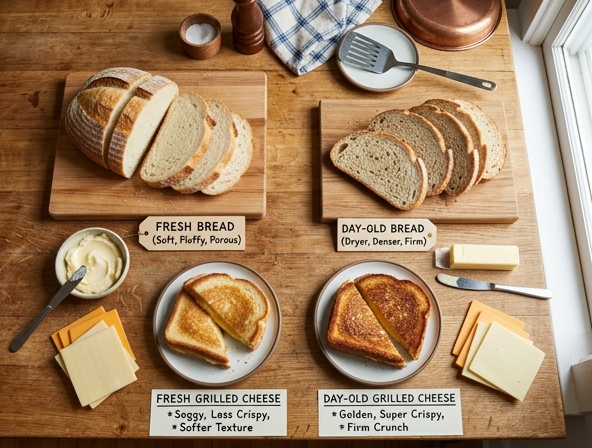
Achieving the perfect grilled cheese often results in a soggy, inconsistent interior when using fresh loaves. While artisan options are standard, their high moisture content undermines crispness. Conversely, day-old bread offers structural integrity, acting as an ideal vessel for a controlled sear. Note: Success requires balanced heat management regardless of age. For instance, day-old sourdough provides superior moisture-wicking properties. The following sections examine essential preparation techniques to ensure your sandwich achieves the perfect structural equilibrium.
| Bread Type | Characteristics | Impact on Grilled Cheese |
|---|---|---|
| Fresh Bread | High moisture content | Often results in a soggy, inconsistent interior; undermines crispness. |
| Day-Old Bread | Higher structural integrity; moisture-wicking properties (e.g., sourdough) | Provides a superior, controlled sear and better structural equilibrium. |
| General Tip | Heat Management | Proper heat control is essential for the perfect sandwich, regardless of bread age. |
The Great Grilled Cheese Debate: Fresh vs. Day-Old Bread for Optimal Texture
The grilled cheese sandwich is a cornerstone of comfort food-a minimalist masterpiece of bread, fat, and cheese. Yet, for all its simplicity, achieving the "perfect" grilled cheese is a pursuit that borders on the scientific. We have all experienced the tragedy of a sandwich that turns into a soggy mess or, conversely, one that is so abrasive it threatens the roof of your mouth. At the heart of this textural dilemma lies a single, crucial variable: the age of the bread.
The Science of Bread Structure
To understand why age matters, we must look at what happens to bread after it leaves the oven. When bread is fresh, it is defined by high moisture content and a delicate crumb structure. As it cools, the starch molecules-specifically amylose and amylopectin-begin a process called retrogradation. In the first 24 to 48 hours, these starch molecules begin to recrystallize, losing their elasticity and firming up. This is commonly referred to as "going stale."
While staling is undesirable for a simple slice of toast eaten with butter, it is a secret weapon for the grilled cheese enthusiast. That structural rigidity changes how the bread reacts to heat, fat, and the melting cheese within.
The Case Against "Too Fresh"
Using bread straight from the bakery-warm and pillowy-is often a tactical error. Fresh bread has a high water content. When you place a slab of fresh, soft bread into a hot pan, that internal moisture is forced outward by the heat. Because the bread is so porous and supple, it lacks the structural integrity to hold its shape under the weight of the melting cheese. Instead of a crisp crust, you often end up with a sandwich that is steamed from the inside out, resulting in a gummy, limp texture that fails to provide the necessary crunch.
Furthermore, fresh bread is highly absorbent. It will soak up your butter or mayonnaise like a sponge, potentially leading to a greasy interior rather than a golden-brown exterior. If you must use fresh bread, you are forced to cook it at a lower heat for a longer duration, which risks over-melting the cheese to the point of separation or burning the butter before the crust is adequately set.
The Day-Old Advantage
Day-old bread, or bread that has been left to breathe for a few hours on the counter, is the undisputed champion of the grilled cheese world. Because some of the surface moisture has evaporated, the bread is more "primed" for the Maillard reaction-the chemical process that creates the delicious browning and complex flavor profile we associate with a perfect crust.
The firmer structure of day-old bread acts as a sturdy scaffold. It can withstand the pressure of a spatula without collapsing. More importantly, because it isn't filled with excess steam-releasing moisture, the fat you use to fry the sandwich creates a clean, uniform sear. The result is a contrast: a crisp, golden-brown exterior that shatters when bitten, giving way to a warm, gooey interior that hasn't been compromised by bread-mush.
Techniques for Both Worlds
Of course, we don't always have the luxury of planning our grilled cheese 24 hours in advance. If you are working with fresh bread, there are ways to simulate the "day-old" effect:
- The Pre-Toast Method: Place your slices in a low-heat oven or toaster for 60 seconds. You aren't trying to turn them into toast; you are simply dehydrating the surface and firming the crumb.
- The Low and Slow Approach: If the bread is very fresh, cook the sandwich on medium-low heat. This allows the heat to penetrate the center slowly without scorching the exterior, giving the bread time to dry out naturally in the pan.
- The "Dry" Pan Sear: Before adding your butter or mayo, place the bread slices in the hot pan for a few seconds per side. This "sets" the interior face of the bread, creating a barrier that prevents the cheese oils from soaking into the crumb.
Selecting the Right Variety
Age isn't the only factor; the type of bread plays a significant role. Sourdough is widely considered the gold standard for grilled cheese. Its natural tang cuts through the richness of the cheese, and its hearty, open crumb is structurally sound, even when fresh. Conversely, brioche-while delicious-is a high-fat, high-sugar bread that browns extremely quickly. If you use fresh brioche, you are almost guaranteed to burn the crust before the center reaches the ideal temperature.
Final Verdict: The Pursuit of the Crunch
If you want the most reliable, professional-grade result, opt for bread that has spent at least one night in a paper bag or on a wire rack. The slight dehydration provides a superior canvas for searing, ensuring that your grilled cheese delivers that satisfying, audible crunch that defines the dish. Whether you are using a classic white Pullman loaf or a rustic country sourdough, remember: moisture is the enemy of crispness. Manage that moisture, respect the structure of the starch, and you will elevate your grilled cheese from a simple lunch to a culinary event.
Ultimately, the perfect grilled cheese is a balance of contrasts. By choosing bread that has matured slightly, you ensure the exterior provides the resistance needed for that perfect first bite, allowing the interior to remain the decadent, molten experience we all crave. Happy grilling.
Disclaimer:
The information provided on Eateryn is for general educational and informational purposes only and is not intended as medical, nutritional, or healthcare advice. It should not be used to diagnose, treat, cure, or prevent any disease or medical condition.
Always consult a qualified physician, registered dietitian, or other certified healthcare professional before making changes to your diet, exercise routine, or lifestyle, or regarding any medical questions or concerns you may have. Never disregard or delay seeking professional medical advice because of something you have read on this website.