
Frank's RedHot Vs Tabasco For Buffalo Wings - Choosing The Authentic Flavor Profile
Selecting the ideal wing sauce often leads to kitchen indecision. While many chefs experiment with complex, artisanal blends, Frank's RedHot and Tabasco remain the primary industry standards. Choosing the correct profile is essential to achieving an authentic Buffalo experience. Note that heat intensity and vinegar acidity vary significantly between these products. Frank's provides the classic, buttery consistency expected of traditional wings, while Tabasco offers a sharper, pepper-forward profile. This guide evaluates these profiles to refine your technique.
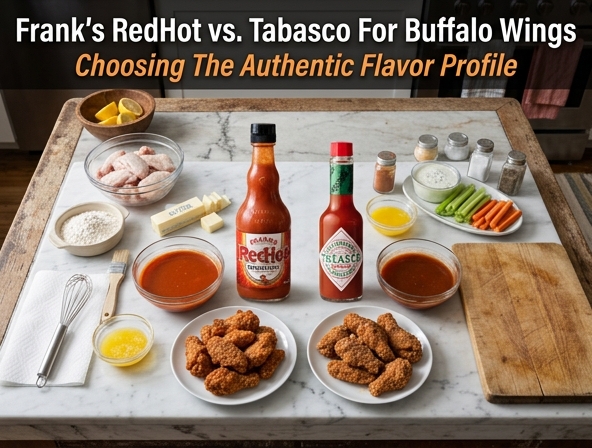
| Feature | Frank's RedHot | Tabasco |
|---|---|---|
| Flavor Profile | Classic, balanced vinegar | Sharp, intense, pepper-forward |
| Consistency | Buttery and smooth | Thin and highly acidic |
| Buffalo Suitability | The industry standard for "authentic" wings | Best for those seeking higher heat and complexity |
| Key Takeaway | Ideal for the traditional Buffalo experience | Best for modifying heat intensity and sharp profiles |
Frank's RedHot Vs. Tabasco For Buffalo Wings: Choosing The Authentic Flavor Profile
When it comes to the pantheon of American bar food, few dishes command as much reverence-or spark as much debate-as the Buffalo wing. Born in 1964 at the Anchor Bar in Buffalo, New York, the recipe was a stroke of mid-century culinary genius: deep-fried chicken wings tossed in a vibrant, orange-red emulsion of hot sauce and butter. While the recipe seems deceptively simple, the soul of the dish lies entirely in the choice of hot sauce. The perennial conflict in kitchens across the country remains: Frank's RedHot or Tabasco?
The Case for the Original: Frank's RedHot
To understand why Frank's RedHot is widely considered the "authentic" choice, one must look back to the inception of the Buffalo wing. Teressa Bellissimo, the proprietor of the Anchor Bar, didn't reach for a complex, artisanal blend; she reached for Frank's. This historical precedent established Frank's as the primary flavor profile for what the world identifies as "Buffalo."
Frank's RedHot is crafted primarily from aged cayenne peppers. Its flavor profile is balanced, leaning heavily into a moderate, consistent heat coupled with a prominent, savory vinegar tang. The key to Frank's dominance in the wing world is its viscosity. Because it contains a specific ratio of cayenne, distilled vinegar, water, and garlic powder, it emulsifies perfectly with melted butter. When you whisk Frank's into butter to create the classic "Buffalo sauce," the result is a glossy, velvety liquid that clings to the crispy skin of a fried wing rather than sliding off it.
The Case for the Connoisseur: Tabasco
If Frank's is the comfort-food standard, Tabasco is the refined, aggressive alternative. Founded in 1868 on Avery Island, Louisiana, the Tabasco brand relies on a different philosophy. Their peppers are mashed with salt and aged in oak barrels for up to three years before being blended with high-grade distilled vinegar.
The resulting flavor is sharper, significantly more acidic, and boasts a distinct "funky" depth derived from the oak-aging process. While Frank's offers a "round" heat that coats the palate, Tabasco provides a "stinging" heat that hits the front of the tongue. For those who prefer a wing that bites back, or for those who find the classic Frank's profile a bit too mild, Tabasco offers a more intense sensory experience. However, because Tabasco is significantly thinner and more vinegar-forward than Frank's, it requires a higher ratio of butter or a thickening agent to achieve the proper texture for a wing sauce.
The Chemistry of the Wing Sauce
A Buffalo wing is defined by the marriage of fat and acid. The butter provides the fat-which carries flavor and tempers the harshness of the peppers-while the hot sauce provides the acid and capsaicin. When comparing the two, consider the interaction between the vinegar content and the butter emulsion:
- Emulsion Stability: Frank's RedHot has a consistency that creates a stable emulsion. The fats in the butter bind to the solids in the sauce, creating a thick coating.
- Acid Profile: Tabasco's higher acidity can sometimes cause a "break" in a butter emulsion if not whisked properly. It can separate, leaving you with a pool of orange oil at the bottom of your serving bowl.
- Heat Distribution: Frank's heat is consistent and approachable. Tabasco's heat is sharp and fleeting, often needing to be balanced with honey or additional garlic to make it palatable as a primary sauce for a dozen wings.
Choosing Your Flavor Profile
Choosing between these two isn't just a matter of availability; it's a matter of the experience you want to provide.
When to choose Frank's RedHot:
Choose Frank's when you want to recreate the nostalgic, quintessential Buffalo experience. If you are serving a crowd, this is the safest and most authentic bet. It is the flavor profile that people anticipate when they order "Buffalo wings." It pairs best with classic blue cheese dressing and celery sticks, as the creamy profile of the cheese cuts through the vinegary, cayenne-forward sauce with perfect synergy.
When to choose Tabasco:
Choose Tabasco when you want to elevate the dish or move toward a Cajun-inspired profile. Tabasco works exceptionally well if you are adding ingredients like Worcestershire sauce, fresh garlic, or even a touch of brown sugar or honey to create a "Signature Wing Sauce." If you are a fan of high acidity and prefer a wing that makes your lips tingle more than it makes your stomach warm, Tabasco is the superior choice.
The Final Verdict: Is There a Clear Winner?
If the goal is "Authenticity," Frank's RedHot wins by default. It is the DNA of the Buffalo wing. However, culinary evolution rarely stops at the original. Many of the world's best wing joints use a "Frank's-plus" approach-using Frank's as the base for its perfect viscosity, then bolstering it with dashes of Tabasco or other specialty peppers to add complexity.
For the home cook, the best approach is to start with the classic: 1 cup of Frank's RedHot to 1/2 cup of high-quality unsalted butter. Whisk them over low heat until they are fully integrated. Once you have mastered this, experiment by replacing two tablespoons of the Frank's with Tabasco. You may find that this subtle adjustment provides the exact punch of heat and acidity you were missing, bridging the gap between the historic Buffalo tradition and your own personal taste.
Ultimately, the "authentic" flavor is the one that makes you reach for the next wing. Whether you value the consistency of Frank's or the sharp complexity of Tabasco, the secret to a great wing will always be the patience in the whisking and the quality of the butter you use to emulsify your sauce.
Disclaimer:
The information provided on Eateryn is for general educational and informational purposes only and is not intended as medical, nutritional, or healthcare advice. It should not be used to diagnose, treat, cure, or prevent any disease or medical condition.
Always consult a qualified physician, registered dietitian, or other certified healthcare professional before making changes to your diet, exercise routine, or lifestyle, or regarding any medical questions or concerns you may have. Never disregard or delay seeking professional medical advice because of something you have read on this website.