
Foil Wrapped vs Naked for Barbecue Ribs - Controlling The Tenderness
Many pitmasters struggle to balance rib tenderness with bark integrity. While standard smoking provides a foundation, your enclosure method often dictates the final texture. Mastering the foil-wrapped versus naked approach grants you precise control over moisture retention. Note that while foil accelerates connective tissue breakdown, it can soften the exterior. From the "Texas Crutch" for tenderness to naked smoking for a robust crust, we evaluate these distinct techniques below to help you refine your barbecue craft.
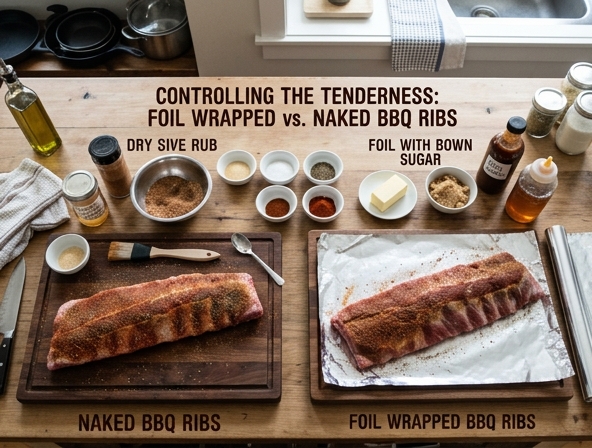
| Technique | Primary Benefit | Trade-off | Best For |
|---|---|---|---|
| Foil-Wrapped (Texas Crutch) | Accelerates connective tissue breakdown; maximizes tenderness and moisture. | Softens the exterior, potentially compromising the bark. | Pitmasters prioritizing a melt-in-the-mouth texture. |
| Naked Smoking | Develops a robust, well-defined crust (bark). | Requires more time; may result in a firmer texture compared to wrapping. | Pitmasters prioritizing texture contrast and a flavorful crust. |
Foil Wrapped vs. Naked for Barbecue Ribs: Controlling The Tenderness
In the world of competitive barbecue and backyard smoking, few debates are as heated as the battle between the “Texas Crutch”-wrapping your ribs in aluminum foil-and the traditional “naked” or low-and-slow approach. Both methods aim for that elusive holy grail of barbecue: the perfect, clean-bite rib. But how you get there significantly alters the final texture, flavor profile, and overall experience of the meat. To truly master your craft, you must understand the science behind these two techniques and how they manipulate the muscle fibers and connective tissues of the rack.
The Science of Tenderness: Understanding the Rib
To control tenderness, one must first understand what makes a rib tough. Pork ribs are packed with collagen, a dense connective tissue that holds muscle fibers together. When cooked quickly, collagen is rubbery and chewy. However, when subjected to low heat over an extended period, collagen undergoes hydrolysis, transforming into gelatin-a silky, moisture-rich substance that provides that “melt-in-your-mouth” sensation.
The challenge for the pitmaster is achieving this gelatinization without drying out the actual muscle fibers. This is where the foil vs. naked debate begins.
The Foil Method: The Texas Crutch
The “Texas Crutch” refers to the practice of wrapping ribs in heavy-duty aluminum foil after the first few hours of smoking. This is typically done once the meat has developed a solid "bark" and has absorbed a sufficient amount of smoke-usually around the 150°F to 160°F internal temperature range.
Pros of Foiling
- Speed: By wrapping the ribs, you create a self-contained steaming environment. This traps heat and moisture, effectively pushing the meat through the “stall”-that frustrating point where evaporation keeps the meat's temperature from rising-significantly faster.
- Tenderness Control: Foil allows for a very consistent, predictable level of tenderness. Because you are essentially braising the ribs in their own juices (and perhaps added liquids like apple juice, butter, or honey), the collagen breakdown is accelerated.
- Moisture Retention: For those who struggle with dry ribs, the foil method provides a safety net, ensuring the meat stays succulent and juicy.
Cons of Foiling
- The "Mush" Factor: The biggest criticism of the foil method is that it can over-tenderize the meat. If left in the foil too long, the rib can become “mushy,” losing all structural integrity and falling off the bone at the slightest touch-which, contrary to popular belief, is often considered a sign of *overcooked* barbecue by competition judges.
- Loss of Bark: The steam inside the foil softens the crust (bark) that you worked so hard to develop. If you don't take the time to unwrap the ribs and finish them back on the smoker, they can end up soggy.
The Naked Method: The Purist's Path
The “naked” method involves smoking the ribs start-to-finish without any wrapping. This is the traditional way to smoke, relying entirely on the gentle flow of smoke and convection heat to do the work.
Pros of Going Naked
- Superior Bark Texture: Without the steam of foil, the exterior bark stays firm, crispy, and deeply flavored. The Maillard reaction-the chemical reaction between amino acids and reducing sugars that gives browned food its distinctive flavor-is allowed to continue uninterrupted.
- Complex Smoke Flavor: Because the ribs are exposed to the smoker's atmosphere for the entire duration, they tend to develop a deeper, more robust smoke profile.
- Better Bite Control: Naked ribs provide a more consistent “tug.” You get a clean bite off the bone without the meat disintegrating into a pile of sauce-laden fibers.
Cons of Going Naked
- Patience is Required: Naked ribs take significantly longer to cook. You have to wait out the stall, which requires a steady hand with temperature management.
- Higher Risk of Dryness: Without the foil's humidity, there is a greater risk that the ribs may dry out if the smoker temperature spikes or if the cook is left unattended for too long.
Finding the Middle Ground: The "Bend Test" and Beyond
Regardless of which method you choose, the key to tenderness isn't just about the wrap; it's about knowing when to pull the meat off the heat. Both schools of thought rely on the “Bend Test.” Pick up the rack of ribs with a pair of tongs from one end; if the rack bends into a U-shape and the bark begins to crack, you are in the sweet spot. If the meat starts to tear away from the bone entirely, you've gone too far.
For those who find themselves caught in the middle, many pitmasters have turned to butcher paper. Butcher paper is breathable compared to foil. It allows a small amount of steam to escape while still protecting the meat from the direct heat of the fire. This is a compromise that offers some of the speed benefits of the Texas Crutch while retaining much of the integrity of the naked method's bark.
Conclusion
Ultimately, the choice between foil-wrapped and naked ribs comes down to your personal goal. If you are feeding a hungry crowd and need a predictable, tender result in a shorter timeframe, the foil method is a reliable tool in your arsenal. If you are chasing that artisan, crispy-barked, deep-smoke profile, the patience required for the naked method will be well rewarded.
Don't be afraid to experiment. Smoke one rack wrapped and one rack naked side-by-side. Your palate is the final judge, and the journey to discovering your preferred level of tenderness is the most delicious part of the barbecue experience.
Disclaimer:
The information provided on Eateryn is for general educational and informational purposes only and is not intended as medical, nutritional, or healthcare advice. It should not be used to diagnose, treat, cure, or prevent any disease or medical condition.
Always consult a qualified physician, registered dietitian, or other certified healthcare professional before making changes to your diet, exercise routine, or lifestyle, or regarding any medical questions or concerns you may have. Never disregard or delay seeking professional medical advice because of something you have read on this website.