
Flour vs Cornstarch for Clam Chowder - Comparing Thickening Agent Efficiency
Achieving the perfect consistency for clam chowder often leads to frustration, whether resulting in flour-based clumps or cornstarch-induced thinning. While many chefs default to a standard flour roux, understanding the technical difference is crucial. Mastering this chemistry grants you precise control over your soup's mouthfeel. Note that stabilizers behave differently: flour creates traditional, opaque depth, while cornstarch delivers a glossy finish. This guide evaluates both thickening agents, analyzing efficiency to ensure your chowder achieves professional results.
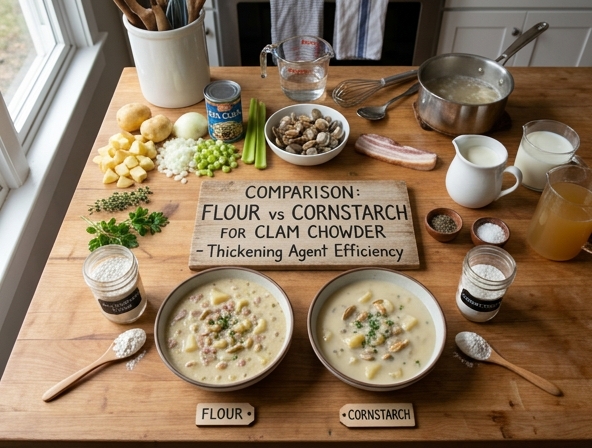
| Thickening Agent | Consistency / Result | Key Characteristic |
|---|---|---|
| Flour | Traditional, opaque depth | Commonly used in a roux-based preparation |
| Cornstarch | Glossy, smooth finish | Requires precise handling to avoid thinning |
Flour vs. Cornstarch for Clam Chowder: Comparing Thickening Agent Efficiency
A bowl of clam chowder is a masterclass in texture. It is a balancing act of briny shellfish, earthy potatoes, aromatics, and a rich, velvety liquid that binds everything together. But the secret to achieving that perfect, soul-warming consistency lies entirely in the thickening agent. While both flour and cornstarch are pantry staples, they react to heat, fats, and liquids in fundamentally different ways. Choosing the right one isn't just about chemistry-it's about the final mouthfeel of your chowder.
The Case for Flour: The Traditionalist's Roux
In the world of New England-style clam chowder, flour is the undisputed king. Traditionally, flour is incorporated through a roux-a mixture of equal parts flour and fat (usually butter or rendered salt pork fat) cooked until the raw flour smell disappears.
Why Flour Excels:
- Structural Integrity: Because flour is cooked into the fat, the starch granules are coated, which prevents them from clumping and creates a more stable, opaque structure. This provides the "body" that New England chowder is famous for.
- Flavor Depth: Cooking a roux develops a nutty, toasted flavor profile that complements the sweetness of the clams and the creaminess of the dairy. It adds a background note of richness that cornstarch simply cannot mimic.
- Texture: Flour produces a matte, opaque, and creamy consistency. It does not pull the chowder toward a translucent finish; rather, it makes the broth look substantial and hearty.
The Drawbacks:
Flour requires patience. If you don't cook the roux long enough, your chowder will have a distinct "pasty" or raw flour aftertaste. Additionally, if the roux isn't whisked correctly, you risk lumps that are difficult to smooth out once the liquids are added.
The Case for Cornstarch: The Modern, Gluten-Free Alternative
Cornstarch is a pure starch derived from the endosperm of corn. Unlike flour, it is not cooked with fat; instead, it is mixed with cold liquid to create a "slurry" and then added to the hot soup near the end of the cooking process.
Why Cornstarch Excels:
- Gluten-Free: For those with sensitivities or dietary restrictions, cornstarch is an excellent way to achieve a thick soup without compromising flavor.
- Clarity and Gloss: Cornstarch creates a translucent, glossy sheen. If you prefer a chowder that looks vibrant and bright rather than heavy and opaque, cornstarch is your best bet.
- Efficiency: It is remarkably powerful-roughly twice as effective as flour gram-for-gram. It also doesn't require a long cooking time to "cook out" the raw taste; once the liquid reaches a simmer, the starch activates almost instantly.
The Drawbacks:
Cornstarch creates a "slipperier" mouthfeel. Because it lacks the protein found in wheat flour, it doesn't provide the same "chew" or heavy-duty viscosity. Furthermore, cornstarch is sensitive to acidic environments and prolonged high-heat boiling, which can cause the thickener to break down, resulting in a thin, watery soup if left to boil too long.
Head-to-Head Comparison: Efficiency and Performance
| Feature | Flour (Roux) | Cornstarch (Slurry) |
|---|---|---|
| Opacity | Opaque and Matte | Glossy and Translucent |
| Mouthfeel | Creamy and Velvety | Slightly Slimy/Slick |
| Preparation | Requires time and constant whisking | Fast and easy (slurry method) |
| Heat Stability | High (stays thick even when reheated) | Moderate (can break down over time) |
| Flavor Impact | Nutty, toasted depth | Neutral |
The Science of Thickening: What Happens in the Pot?
Both thickening agents work through gelatinization. Starch granules are essentially tiny, crystalline structures. When you add these granules to water and apply heat, the granules swell, absorbing liquid and eventually bursting, which traps the liquid within a starch matrix.
Flour contains proteins (gluten) and other components like fats and fibers that act as a buffer. This is why a flour-thickened chowder is more "forgiving"-the protein structure helps maintain the integrity of the sauce even if you reheat the leftovers the next day. Cornstarch is nearly pure amylopectin and amylose. It swells much faster and more dramatically, creating a tighter, more rigid mesh. While this is great for a quick thickening fix, that mesh is brittle. If you stir it too vigorously while it's hot or let it sit on a low flame for too long, the mesh collapses, and the chowder "weeps" or thins out.
Chef's Verdict: Which Should You Use?
If your goal is to recreate a classic, diner-style New England Clam Chowder, flour is the superior choice. The density of the flour creates a satisfying, hearty mouthfeel that stands up to chunks of potato and salty clam meat. It holds the chowder together during long simmering times and ensures that the leftovers taste just as thick and creamy the next day.
However, if you are making a lighter, Mediterranean-inspired seafood stew, or if you are catering to gluten-free guests, cornstarch is the pragmatic winner. It highlights the purity of the ingredients without adding the "heaviness" that a roux provides. Just remember the cardinal rule of cornstarch: never add it directly to a hot pot. Always whisk it into a small amount of cold water or broth first to create a slurry. If you dump dry cornstarch into hot chowder, you will end up with unappetizing clumps of solidified starch that are nearly impossible to incorporate.
Ultimately, the choice comes down to the personality of your chowder. Do you want it to be a heavy, comforting blanket on a cold day, or a bright, clean celebration of the sea? Match your thickener to the experience you want to provide, and you'll find that both agents have a well-deserved place in your kitchen.
Disclaimer:
The information provided on Eateryn is for general educational and informational purposes only and is not intended as medical, nutritional, or healthcare advice. It should not be used to diagnose, treat, cure, or prevent any disease or medical condition.
Always consult a qualified physician, registered dietitian, or other certified healthcare professional before making changes to your diet, exercise routine, or lifestyle, or regarding any medical questions or concerns you may have. Never disregard or delay seeking professional medical advice because of something you have read on this website.